Hotel El Ganzo: A Trip, Not a Destination
When a hotel's real product is its culture program, the website has to merchandise the program with the same seriousness it merchandises the rooms. Hotel El Ganzo is 69 rooms on the marina at La Playita, San José del Cabo: adults only, a recording studio in the basement, artists in residence who paint the rooms they sleep in, and, by the hotel's own account, Mexico's first B Corp certified hotel. Its brand line is "It's a trip, not a destination," and it means it. The site we inherited sold boutique Cabo luxury with an amenity list, and buried all of that. We rebuilt it editorial first: a navigation written in the hotel's voice, a cultural calendar merchandised like room inventory, the El Ganzo Sessions video archive treated as a channel, and a nightly rate printed on every room card. Eight years later the live site is not ours. Below is what shipped, and which of those decisions survived.
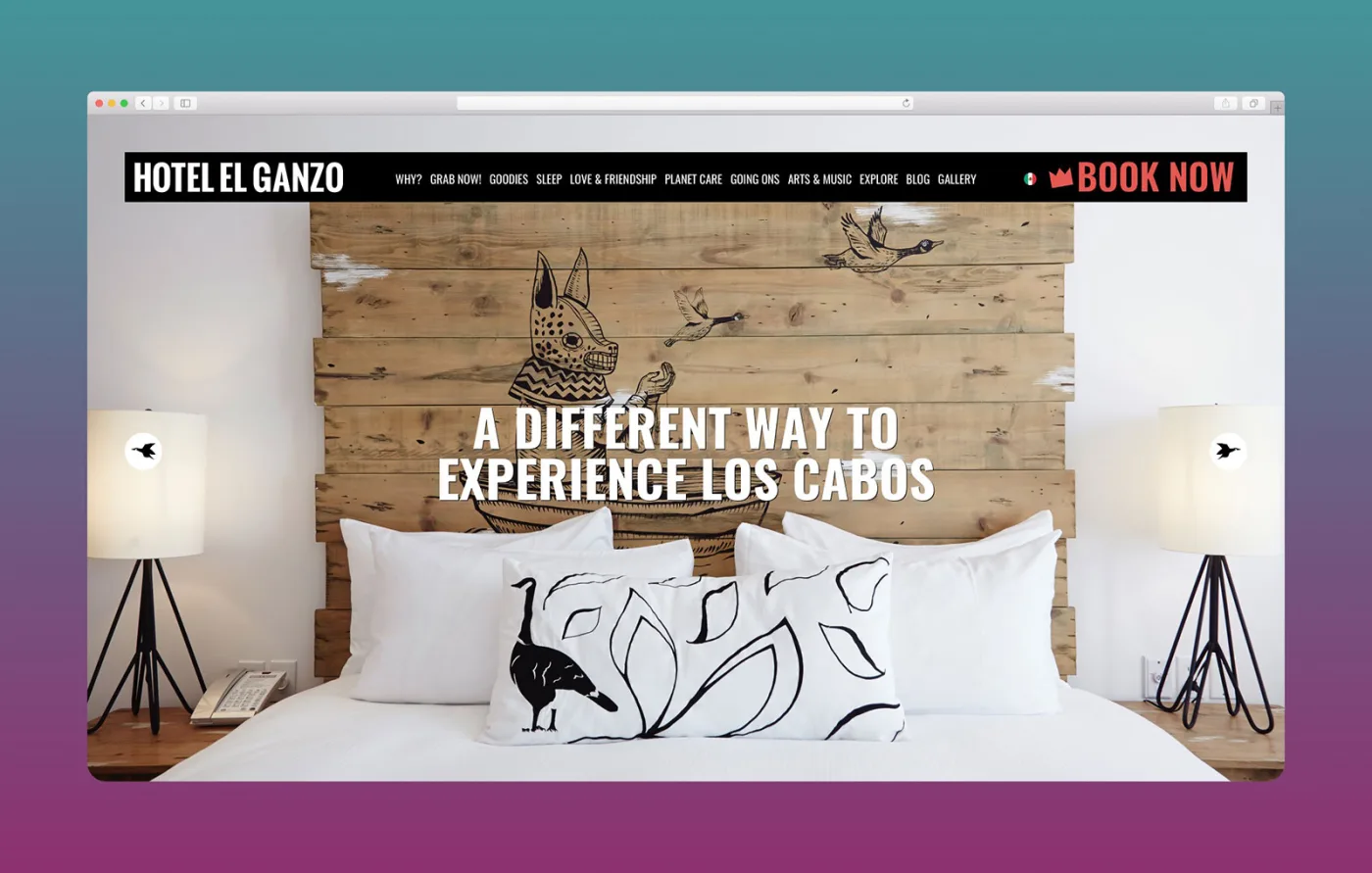
The property, in one sentence
El Ganzo was conceived in 2012 as an artist residency and a recording studio that happened to rent rooms, which is the opposite of how hotels normally acquire a culture program. The studio under the lobby has hosted, by the hotel's own current listing, Khruangbin, Natalia Lafourcade, Julieta Venegas, Kings of Convenience, L'Impératrice, Parcels, Hermanos Gutiérrez, Silvana Estrada and Caloncho, among hundreds of others, and the recordings are published as El Ganzo Sessions. Visiting artists leave murals and room interventions behind. The rooftop looks at the Sea of Cortez over the marina. None of that is an amenity. It is the reason a specific kind of traveler picks this hotel over the forty other places in Los Cabos with a nicer pool.
What the previous site did instead
It described a nice hotel. Bullet-pointed amenities, a calendar widget, photography that could have belonged to any property in Baja. A traveler who arrived from a magazine piece about the studio had no signal within the first screen that they were in the right place, and the guest list, the residencies and the B Corp work were three clicks down, if they were anywhere.
That is the standard failure, and it is not a taste problem. It is a merchandising problem: the property's differentiator was not being sold, so the site competed on pool, location and rate, where it has no advantage.
The decisions
Our role was creative direction, creative strategy, and UX and UI design.
Write the navigation in the hotel's voice. The primary nav reads WHY?, GRAB NOW!, GOODIES, SLEEP, LOVE & FRIENDSHIP, PLANET CARE, GOING ONS, ARTS & MUSIC, EXPLORE. Not Rooms, Dining, Offers, About. The labels do the work the homepage copy usually has to do, which is to tell you within one second what kind of place this is. The trade-off is real and we made it deliberately: playful labels cost a little comprehension, so the one action that must never be clever, BOOK NOW, stays in plain language, in red, in the corner where every hotel puts it.
Merchandise the program like inventory. The homepage runs a CULTURAL CALENDAR directly under accommodations, in three lanes: #ELGANZOMUSIC PRESENTS, #ARTISTINRESIDENCE, and WELLNESS. Each card carries a name, a date, and an action, the same shape as a room card. A residency with a date on it is a reason to pick a week. An amenity is not.
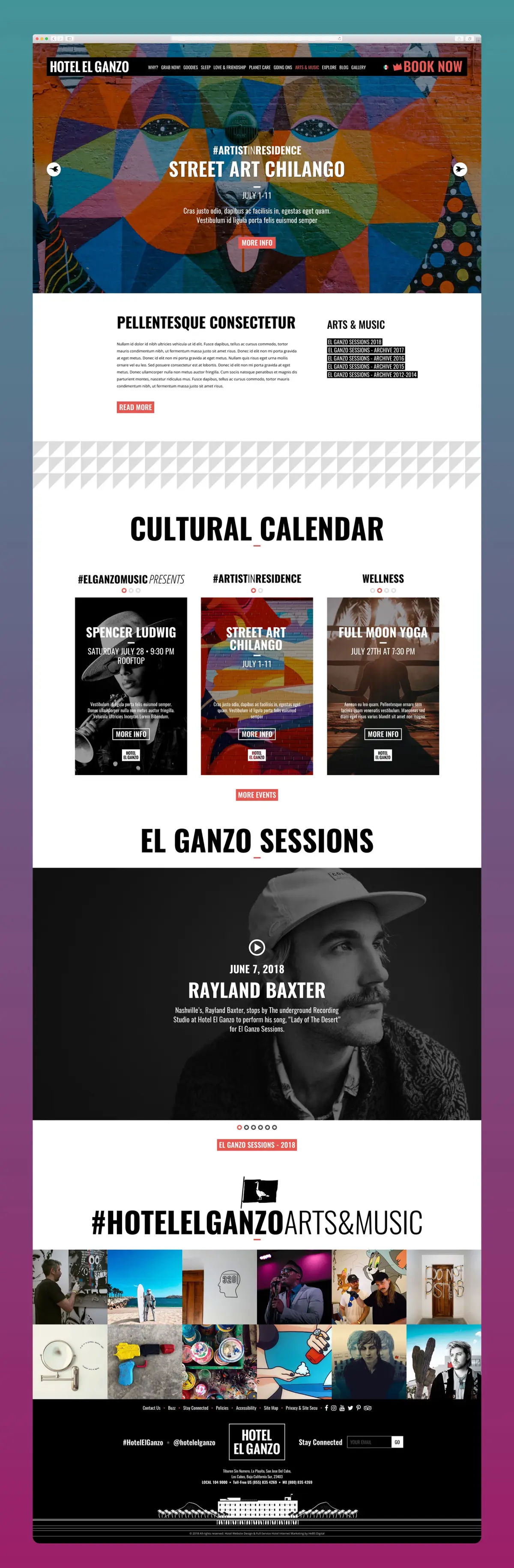
Treat the archive as a channel, not a footnote. Arts and Music got its own page, with the El Ganzo Sessions player at the center and the back catalogue browsable by year, 2012 through 2018. Hotels routinely sit on media assets like this and file them under press. This property produces a music video series; the site was built to publish it.
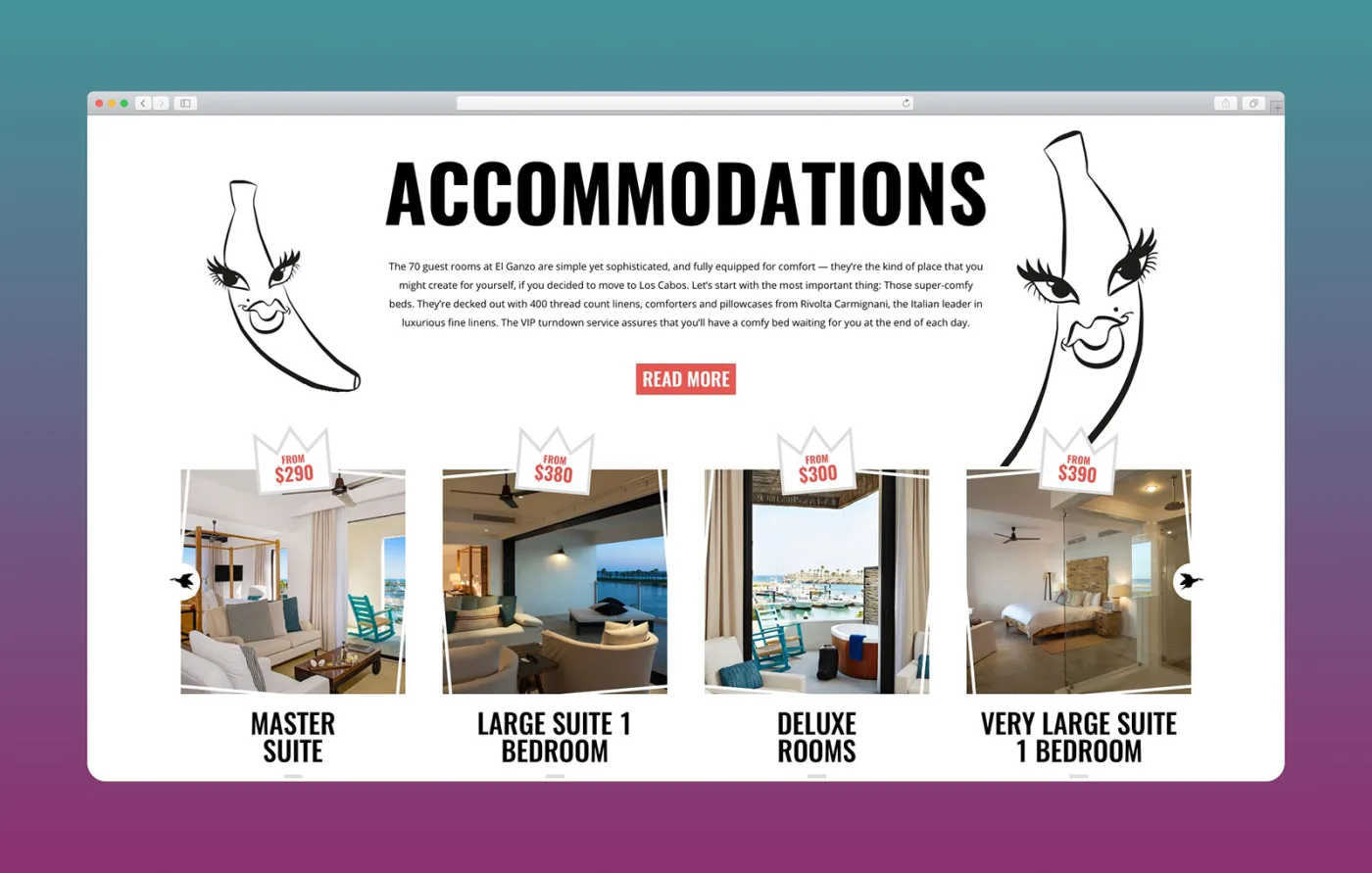
Put the price on the room card. Every room on the accommodations rail carries a crown badge: FROM $290, FROM $300, FROM $380, FROM $390, with its own booking action. A guest comparing five hotels on a phone gets an answer without starting a booking flow. This is the single change I would still make first on almost any hotel site, and I wrote out the full argument this week in why Booking.com looks cheaper than the hotel website: the platform usually is not cheaper, it is just legible.
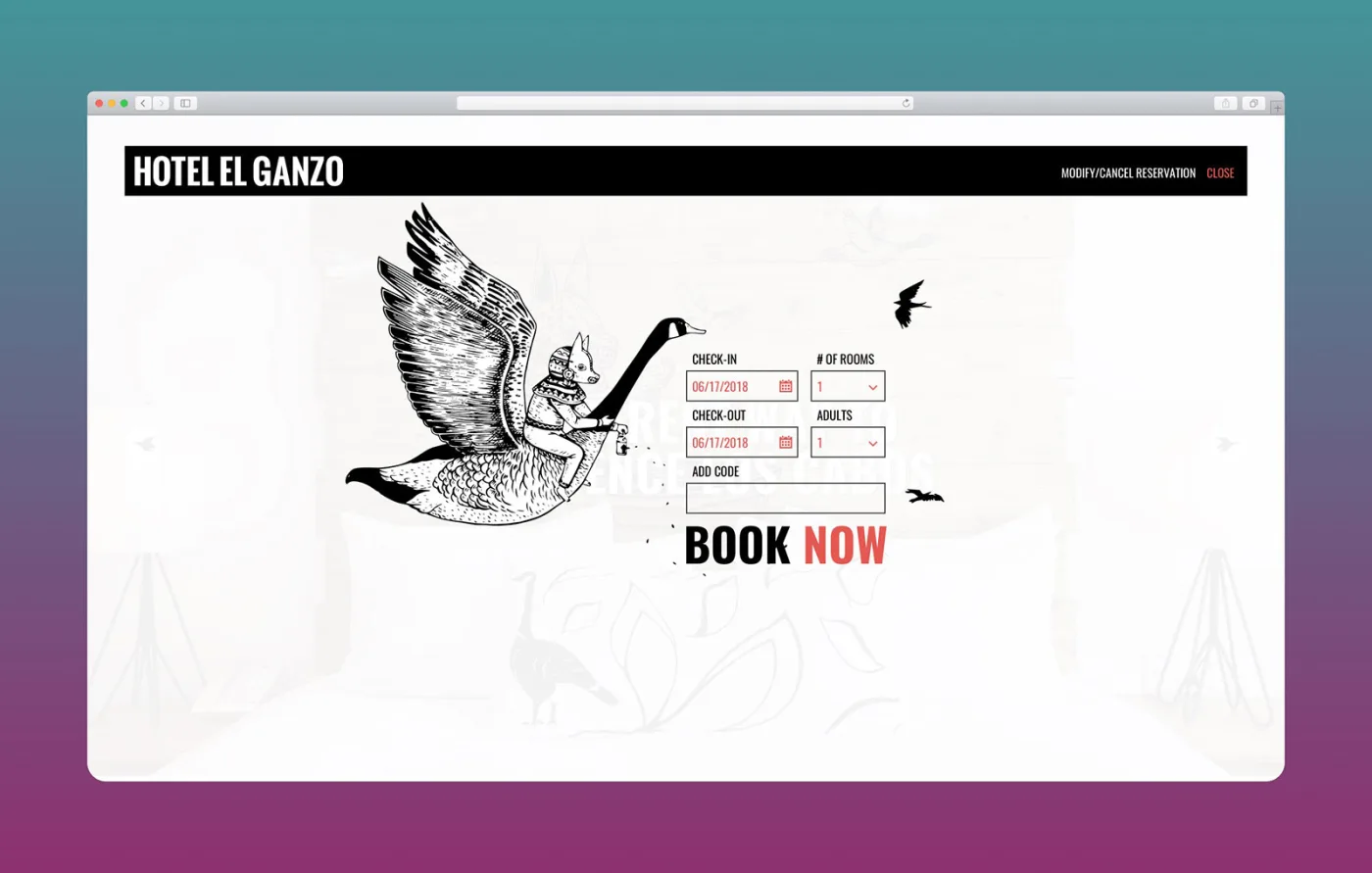
Keep the booking step inside the brand. Book Now opens a full-screen overlay in the hotel's own illustration language, a figure riding a goose, with dates, rooms, guests and a promo code, plus modify and cancel for returning guests. The engine takes over after that, which is normal. What is not normal is handing the guest to a grey third-party form one click after a site that spent the previous screen establishing a personality. Our comparison of hotel booking engines covers the vendors; the handoff is the part no vendor sells.
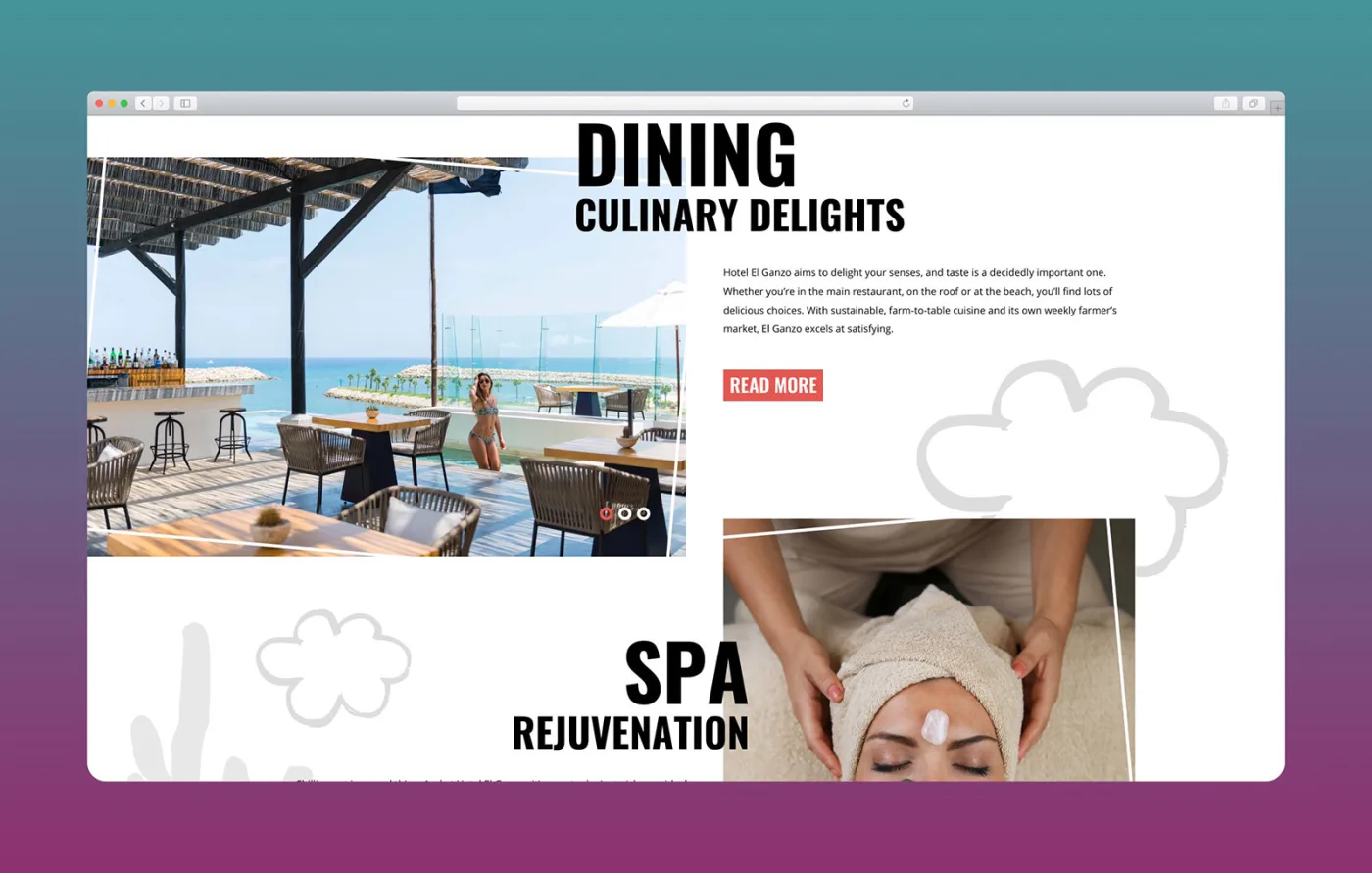
Sell the restaurants as restaurants. The dining page gives each venue its own block, and Ganzo Downstairs carries a date and time picker with RESERVE A TABLE inline. A rooftop sushi bar and a beach club have their own local demand, including from people who are not staying the night, and a hotel site that treats dining as a description with no action leaves that on the table.
What this is, and is not
These are the screens as designed and shipped, from the era when this work was produced with a hospitality agency team. The property's booking numbers were theirs and we never published them, so there is no conversion claim here, and I would not trust one from any agency about a site this old. Some modules in these comps still carry placeholder text where client copy had not landed yet, which is what a real design file looks like rather than a portfolio render.

What the site looks like today
I checked on 20 September 2026. The live site is a later build and not our work, and the comparison is the interesting part.
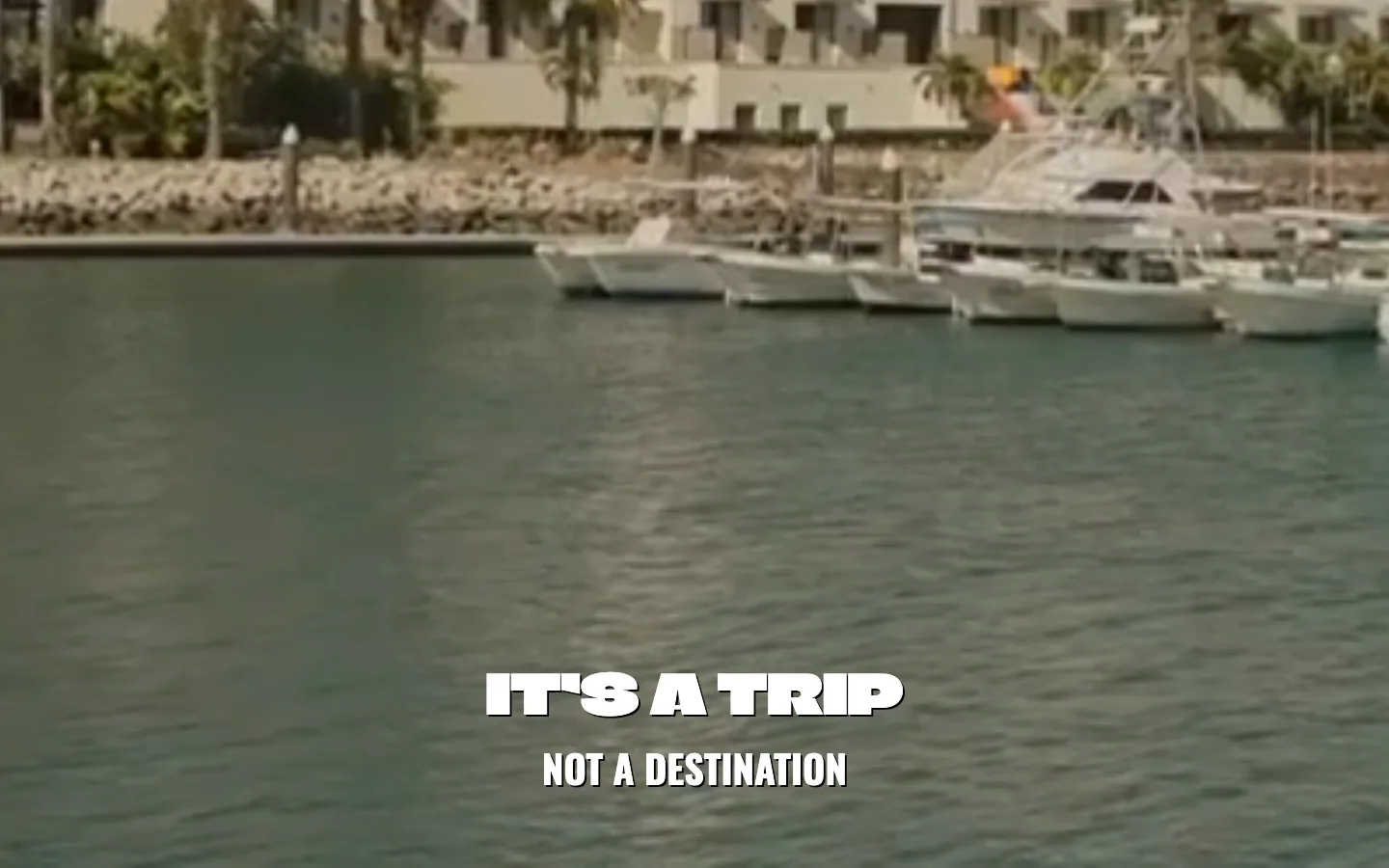
Kept: the tagline, now set full-bleed over video on the first screen. The red BOOK NOW in the same corner. And the structure. Today's navigation reads Music, Art Headspace, Happenings, Sustainability, Eat & Drink, Accommodations, Offers, Retreats, Weddings. That is the same information architecture we set, with the voice sanded off: Planet Care became Sustainability, Going Ons became Happenings, Goodies became Eat & Drink.
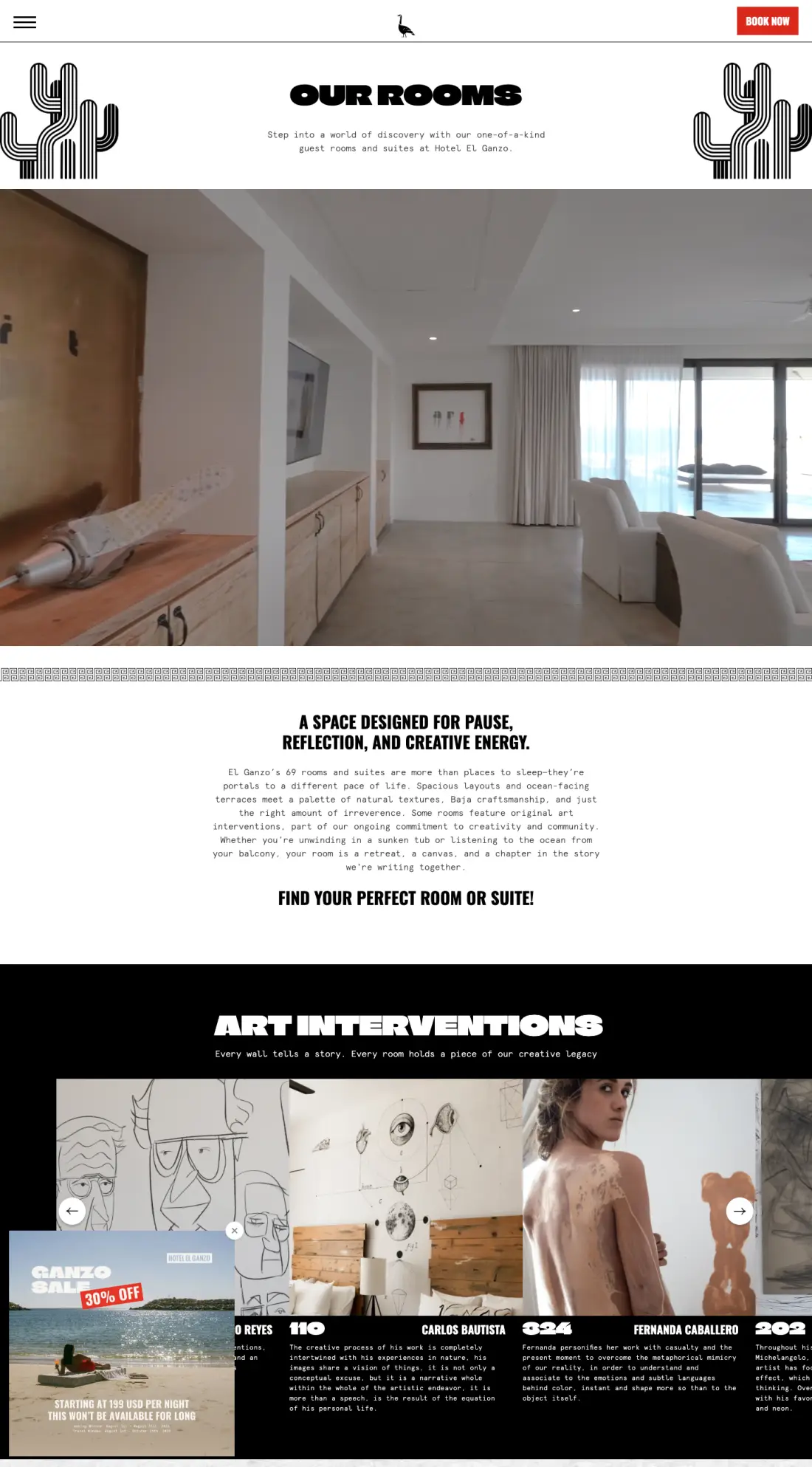
Improved: the rooms page now lists art interventions by room number, crediting the artist on each. That is better than what we shipped, and it is the sort of idea that only a property living with its own program comes up with.
Reversed: the nightly rate is no longer on the room card. The rooms page describes 69 rooms and suites with no number in sight; the price surfaces in a promotional overlay offering up to 30 percent off from $199, and otherwise behind the booking engine. A guest comparing hotels has to open the engine to learn anything, which is exactly the gap an OTA listing fills for free.
What carries to any property with a program
- If the program is the reason people come, give it inventory. Names, dates, and an action per item, in the same visual language as the room cards. A residency calendar sells a specific week in a way that "art and music" in a paragraph never will.
- The archive is an asset, so build a place to publish it. Sessions, murals, residencies, the farmer's market. Most hotels have several years of this filed under press and invisible to search.
- Put a number on the room card. The rest of the site can be as editorial as the brand can carry, and the price still has to be one scroll from the front door. See the four mechanisms behind the OTA price gap for what it costs when it is not.
- Voice is the first thing to get value-engineered away; structure survives. Eight years on, the labels we wrote are gone and the sections they named are all still there. Spend the argument on the structure, and treat the voice as the part you will have to defend again at every rebuild.
The way we sell this work now is on published, fixed prices: the tiers are on the hotel website design page, from $12,000 for a site on our Aurelia template with your brand and your real engine wired in, from $30,000 for a custom design, from $75,000 for a multi-property platform. For a group that wants the direct channel run as a product month to month, that is the Hospitality Digital Experience Lab. The free hotel website grader scores the site you have, booking path included, in about a minute.
Two more properties, two different structural problems: The Resort at Pedregal, where the arrival through a tunnel became the structure of the site, and Brush Creek Ranch, where four separate operations each needed their own front door. The full case study for this one is at Hotel El Ganzo.
Have a product idea?
Designed, built, and shipped in about 5 days.