How Quick Design Saves Costs in Travel UX Projects
Quick design can save money in travel UX when it resolves open decisions and avoids repeated work without reducing care. In our work, the useful levers are reusing settled structure, testing uncertain behavior, time-boxing a risky idea and sharing a system across properties. The price and timeline examples below describe our October 6, 2026 offers and project records. They compare different scopes, not a controlled experiment proving a universal saving.
What actually makes a travel UX project expensive
Key Takeaways
- Reuse settled structure and test uncertain behavior early.
- Small usability sessions find problems; they do not establish conversion rates.
- Price comparisons below describe the dated offers, not identical scopes.
- Do not save time by skipping the booking handoff or accessibility checks.
Beyond the hours needed to produce and review the design, these three factors can expand a travel project's cost:
Open decisions. How many room types get their own page. Whether offers live on one page or on each room. Whether weddings is a section or a separate funnel. Every one of these is a meeting, and every meeting with a property's owner, revenue manager, sales lead and marketing lead is four calendars. A project with thirty open structural questions takes longer than a project with five, whatever the design team's speed.
Late discovery. The booking engine does not support a promo code in the URL. The photography cannot crop to a phone hero. The PMS feeds rates only for some room types. Found in week two, these are a conversation. Found in week nine, they are rework.
Missed timing. Travel demand is seasonal. A summer resort site that launches in August has spent the budget and missed the window it was built for.
Early decisions and integration checks can reduce avoidable rework. They do not guarantee a launch date; content, approvals and implementation still affect the schedule.
Lever 1: Decide the structure once, then reuse it
Reusing an appropriate information architecture can avoid designing the same structure again. Check whether its room, offer and booking paths fit the property before estimating the saving.
We built Aurelia, a fictional boutique hotel, as a working eight-page site: home, rooms, offers, gallery, events, weddings, amenities and contact, with its own booking widget. It is free to download as the Aurelia hotel website template. When a hotel buys the template build from us, the structure is already decided, tested and coded. What remains is the property: its palette, type, photography, copy structure and its real booking engine wired in.
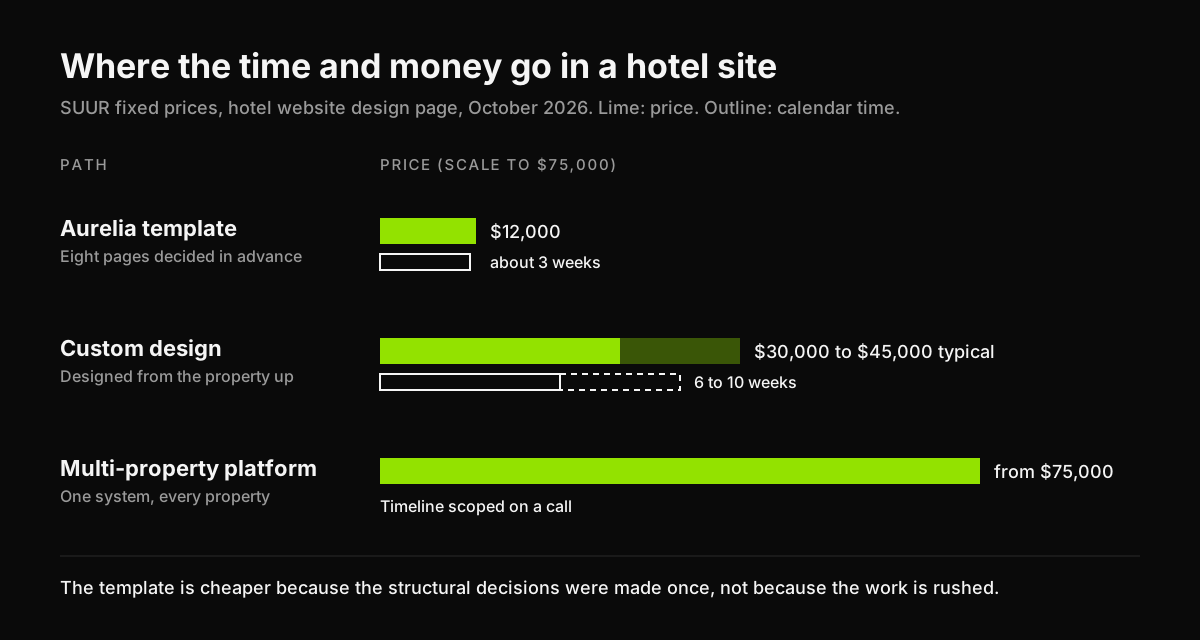
The worked example, using the fixed prices on our hotel website design page as of 6 October 2026:
| Path | Price | Calendar time |
|---|---|---|
| Aurelia template, your brand | $12,000 | About 3 weeks |
| Custom design | From $30,000, typically $30,000 to $45,000 | 6 to 10 weeks |
| Multi-property platform | From $75,000 | Scoped on a call |
The difference between the first two rows is $18,000 to $33,000 and three to seven weeks. That money buys a design built from the property up: brand and photography direction, a booking flow designed rather than connected, every page and state designed around one specific building. For a property whose story is its architecture or its program, that is worth paying for. For a property that needs a fast, honest site with its rates visible and its engine working, it is not. The saving comes from knowing which one you are before the project starts.
Lever 2: Test small and often
The second cost of slow design is one large round of feedback at the end, when everything is built and every change is expensive.
Jakob Nielsen's five-user article argues for iterative qualitative testing: find problems, repair them and test again. Its modeled discovery rate is not a guarantee that five people find a fixed share of every product's problems. Different user groups and tasks may need separate coverage. This method does not establish a population conversion rate or a sufficient sample for a quantitative experiment.
For a hotel site, begin with a small qualitative round covering room selection and the booking handoff on participants' own phones. Look for difficulty finding rates, using the date picker or recognizing the transition to the booking engine. Five participants may reveal useful issues but can miss important problems; recruit for the guest groups, devices and tasks in scope, and test revisions. Allow time for recruitment, accessibility needs, analysis and follow-up rather than promising a fixed duration.
Lever 3: Time-box the risky idea
Some ideas are worth testing before anyone commits a budget to them. The cheap way to test them is a fixed, short window with a clear question.
We ran a four-week concept exploration on a travel portal to examine animated illustration as an alternative to photography on a booking platform. The work produced a visual direction to review. It did not establish that illustration sells more trips: that would require a defined outcome and an appropriate comparison with users or live traffic. A time box limits the cost of exploring a direction; its deliverable must state which questions remain unanswered.
The same logic is behind our Design Sprint: a fixed $6,000, about five days, design only, for a team that has a developer and needs one flow or a set of screens settled. A booking flow, a room page, an offers template. One question, one week, a decision at the end.
Lever 4: One system across many properties
For hotel groups, speed comes from sharing decisions across the portfolio rather than repeating them per property.
The Hard Rock Hotels website redesign was delivered in six weeks, with 25 or more properties on the redesigned global platform. The structure split the site by who was arriving: loyalty members, leisure travelers, event planners and casino guests each got their own path, on one typography and motion system. Once that system existed, a new property page was an assembly job, not a design project. The case study is at Hard Rock Hotels.
Where speed costs more than it saves
Some parts of a travel site get more expensive when you rush them.
- The booking engine handoff. Confirm the actual engine and integration rather than assuming capabilities from the hotel software vendor's name. Check what can be passed in a link, what can be customized and what happens on a phone. These dependencies can cause late rework; test them early.
- Photography. A site designed around images the hotel does not have yet will be rebuilt around the images it does have. Confirm the library, or the shoot, before the hero is designed.
- Accessibility. WCAG's contrast guidance specifies 4.5:1 for normal text and 3:1 for large text, with exceptions including incidental text and logotypes. The WCAG 2.2 target-size criterion uses 24 by 24 CSS pixels or qualifying spacing, with additional exceptions including inline, equivalent, user-agent-controlled and essential targets. These checks cover only part of accessibility. Include keyboard, focus, labels and error behavior in the booking-flow review.
- Rates and content. A site with no rates on room pages, or offers that only an agency can edit, is cheap to launch and expensive every season after.
The short answer
To reduce avoidable work, reuse suitable structure, test specific uncertainties in small rounds and time-box concept exploration. Compare the effort saved with adaptation and maintenance costs. Keep booking, content and accessibility checks in scope. The free hotel website grader checks booking-link and search evidence in source HTML; the real booking journey needs manual testing. The dated prices above are different scope examples to discuss, not a guaranteed saving for a particular hotel.
Have a product idea?
Designed, built, and shipped in about 5 days.