Hotel Branding
Hotel Branding Agencies Compared (2026)
Eleven hotel branding agencies compared on scope, price and fit, every site read on 20 September 2026. Two publish budget bands. None publishes a price.
| Vendor | Pricing | Turnaround | Best for |
|---|---|---|---|
| Landor | None published. No budget field in the enquiry form. The whole English site is 15 pages plus case studies, with no services, process or pricing page | Not published | Multi-market hotel brands that need a master brand architecture, and have a procurement department to match |
| FINE | None published. No budget field; the intake asks only what brings you here | Not published. Says client partnerships often run years | Hotel groups that want brand, website build, and the service standards and playbooks that make the brand survive contact with staff |
| King & Partners | None published. No budget field; the intake asks which services you want | Not published | Luxury properties and branded residences that want the brand and the paid media run by the same agency |
| Helms Workshop | None published, but the contact form's budget bands are $50K to $100K, $100K to $250K, and $250K and up, read on 20 September 2026. The clearest floor in this set | Not published. One case study describes two years on a single brand | Resorts, lodges and F&B-led properties that want brand, signage, merchandise and the site from one Austin studio |
| Longitude° | None published, but intake budget bands read under $20k, $20k+, $50k+, $100k+ on 20 September 2026. The lowest published entry point here | Not published | Independent and boutique properties that want a documented strategy process from a team that also owns and operates hotels |
| Crown Creative | None published. The intake form asks discipline and location, not budget | Not published | Properties that want the brand, the interiors and the website from one firm, including FF&E and OS&E direction |
| Spherical | None published. No budget field. Dollar figures on its About page are job salaries, not project prices | Not published | Hotels that want brand, a built site wired into the PMS and CRS, paid media and in-house photo and video from one agency |
| Anagrama | None published. No budget field anywhere on the site | Not published. States a four-word process: idea, concept, design, solution | Restaurant and F&B-led concepts, and any project where the architecture, the typeface and the booking site should come from one studio |
| Colt | None published. The contact page carries no form at all, only an email address and a phone number | Not published | Hotels, restaurants and bars that want a named, itemised identity scope including brand guidelines, from a London studio that does nothing else |
| & Smith | None published, including for its subscription-shaped 12 month calendar of ideas | Not published | Hospitality brands that want identity plus a running stream of campaign ideas, and groups with restaurants as well as rooms |
| Mucca | None published. No project enquiry form on the site at all | Not published | Landmark and heritage properties that want typographic craft, where the identity has to carry a building with a story |
| SUURThat’s us | Published flat fees: Startup Branding $9,500, Naming and Verbal Identity $5,000, Property Discovery $15,000 plus travel, Hotel Website Design $12,000 on our template, from $30,000 custom, from $75,000 multi-property | Published: branding 7 to 10 days, naming one week, a custom hotel site in about two months | Independent properties and small groups that want the brand and the website at a number agreed before the work starts, and do not need interiors or media buying |
- Pricing
- None published. No budget field in the enquiry form. The whole English site is 15 pages plus case studies, with no services, process or pricing page
- Turnaround
- Not published
- Best for
- Multi-market hotel brands that need a master brand architecture, and have a procurement department to match
- Pricing
- None published. No budget field; the intake asks only what brings you here
- Turnaround
- Not published. Says client partnerships often run years
- Best for
- Hotel groups that want brand, website build, and the service standards and playbooks that make the brand survive contact with staff
- Pricing
- None published. No budget field; the intake asks which services you want
- Turnaround
- Not published
- Best for
- Luxury properties and branded residences that want the brand and the paid media run by the same agency
- Pricing
- None published, but the contact form's budget bands are $50K to $100K, $100K to $250K, and $250K and up, read on 20 September 2026. The clearest floor in this set
- Turnaround
- Not published. One case study describes two years on a single brand
- Best for
- Resorts, lodges and F&B-led properties that want brand, signage, merchandise and the site from one Austin studio
- Pricing
- None published, but intake budget bands read under $20k, $20k+, $50k+, $100k+ on 20 September 2026. The lowest published entry point here
- Turnaround
- Not published
- Best for
- Independent and boutique properties that want a documented strategy process from a team that also owns and operates hotels
- Pricing
- None published. The intake form asks discipline and location, not budget
- Turnaround
- Not published
- Best for
- Properties that want the brand, the interiors and the website from one firm, including FF&E and OS&E direction
- Pricing
- None published. No budget field. Dollar figures on its About page are job salaries, not project prices
- Turnaround
- Not published
- Best for
- Hotels that want brand, a built site wired into the PMS and CRS, paid media and in-house photo and video from one agency
- Pricing
- None published. No budget field anywhere on the site
- Turnaround
- Not published. States a four-word process: idea, concept, design, solution
- Best for
- Restaurant and F&B-led concepts, and any project where the architecture, the typeface and the booking site should come from one studio
- Pricing
- None published. The contact page carries no form at all, only an email address and a phone number
- Turnaround
- Not published
- Best for
- Hotels, restaurants and bars that want a named, itemised identity scope including brand guidelines, from a London studio that does nothing else
- Pricing
- None published, including for its subscription-shaped 12 month calendar of ideas
- Turnaround
- Not published
- Best for
- Hospitality brands that want identity plus a running stream of campaign ideas, and groups with restaurants as well as rooms
- Pricing
- None published. No project enquiry form on the site at all
- Turnaround
- Not published
- Best for
- Landmark and heritage properties that want typographic craft, where the identity has to carry a building with a story
- Pricing
- Published flat fees: Startup Branding $9,500, Naming and Verbal Identity $5,000, Property Discovery $15,000 plus travel, Hotel Website Design $12,000 on our template, from $30,000 custom, from $75,000 multi-property
- Turnaround
- Published: branding 7 to 10 days, naming one week, a custom hotel site in about two months
- Best for
- Independent properties and small groups that want the brand and the website at a number agreed before the work starts, and do not need interiors or media buying
Search "hotel branding agency" and you get two kinds of result: agencies, and listicles of agencies. What you do not get, from any of them, is a price. The category guide that ranks highest for this on Hotel Tech Report lists five agencies and, as of 20 September 2026, states no cost figure anywhere in it.
So this page does the thing the category will not. Eleven agencies that brand hotels, read on their own websites on 20 September 2026: what each one actually sells, who each one is for, and every price signal any of them publishes. We are one of the eleven, and our row is marked; our own prices are published in full, which is the whole argument we are making.
The finding: two of eleven publish anything about money
None of the eleven publishes a price, a package or a retainer. That much is normal for agencies. The more useful measurement is what happens one step earlier, at the intake form, because a budget dropdown tells you where a firm starts before you spend a call finding out.
Two publish one. Helms Workshop offers three bands, $50K to $100K, $100K to $250K, and $250K and up. That is a fifty thousand dollar practical floor, stated before contact. Longitude° offers four, from under $20k up to $100k+, the lowest published entry point in this set.
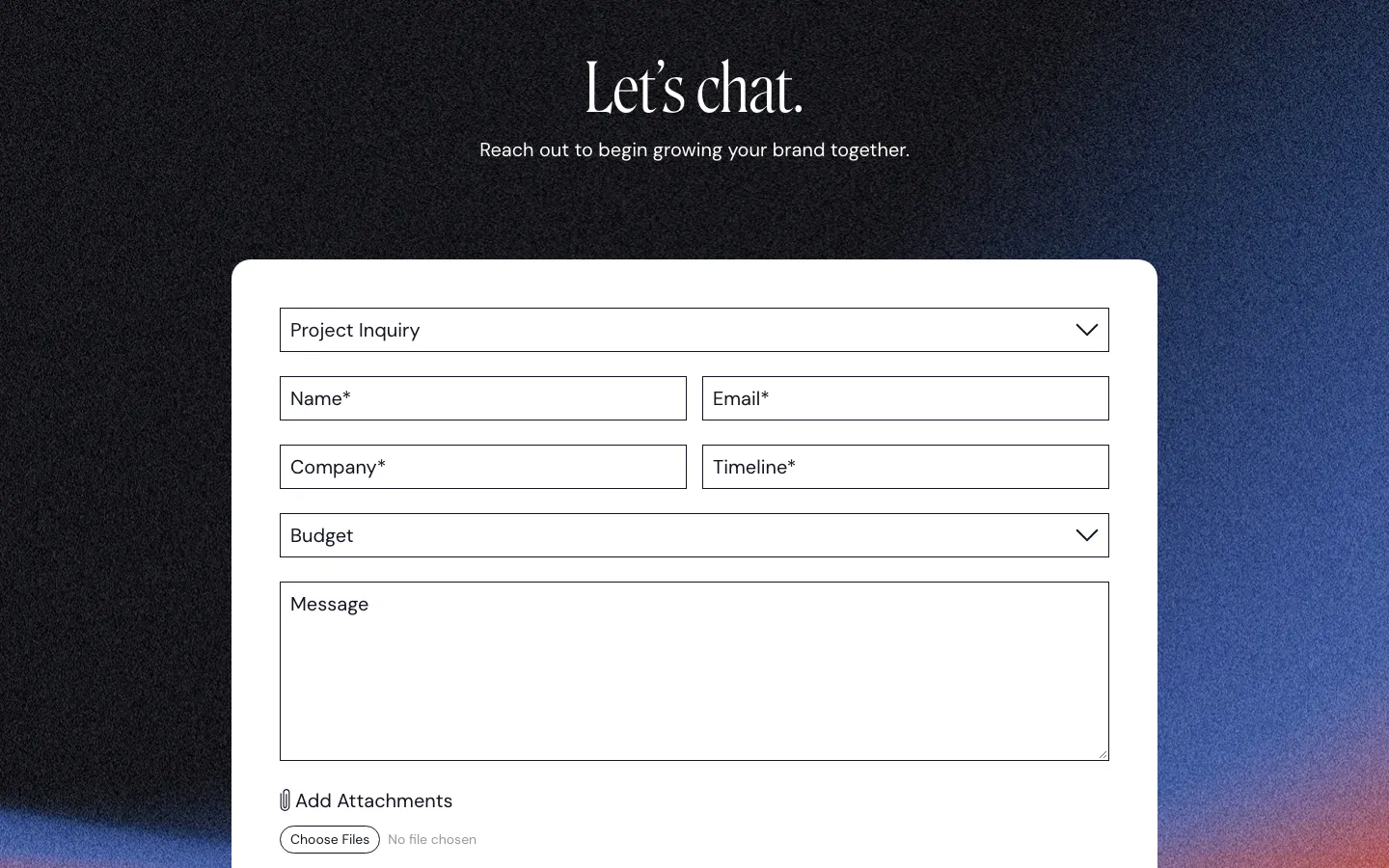
The other nine publish nothing. King & Partners, FINE, Crown Creative, Spherical and Anagrama all run intake forms that ask what you want and never what you can spend. Colt's contact page carries no form at all, just an email address. Mucca's carries a newsletter field and a jobs address. Landor's asks which studio you would like to speak to.
One trap for anyone else checking this: Spherical's About page contains the figures $100,000 to $135,000 and $85,000. Those are salary ranges in job listings, not project prices.
Nobody publishes a duration either. In eleven sites the only concrete timings are a Helms case study describing two years on a single brand, and FINE noting that its client relationships often run years.
Four different things are sold as hotel branding
The agencies below are not competitors in the ordinary sense. They sell four different products under one search term.
1. Brand consulting at group scale. Landor is the reference point: WPP-owned, founded 1941, 1,300 people across 30 locations by its own count, selling consulting, design and experience. Worth knowing before you call: of 38 case studies on its site, exactly one is a hotel brand, the Australian and New Zealand group QT, where the work was a master brand that could unite distinct locations, with custom typefaces per hotel and photography guidelines. It is a formidable firm. It is not a hospitality specialist by its own evidence, and it publishes no web service at all.
2. Brand plus the thing that sells rooms. FINE, Spherical, Crown Creative and Longitude all state that they build what they design, which is the dividing line that matters most in this category.
3. Identity craft. Colt, & Smith, Mucca and Helms Workshop lead with the work. The ceiling here is high and the scope stops earlier.
4. Brand plus the building, or the operation. Crown Creative and Anagrama have spatial practices. FINE goes the other way, into service standards and staff playbooks.
The hospitality-native builders
FINE: the widest scope on this page
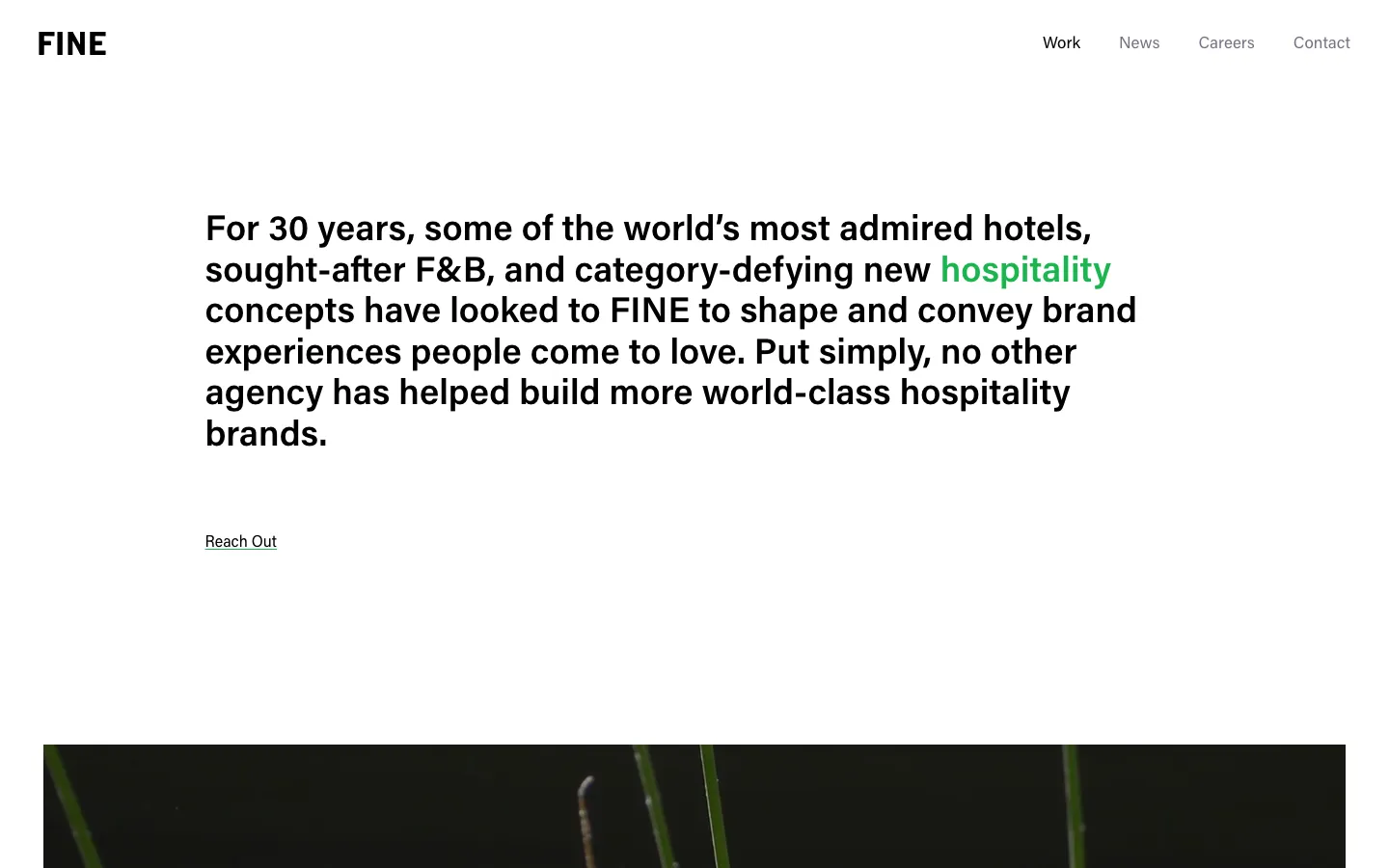
FINE has been at this since 1994, works from Portland and San Francisco, and publishes the most complete hospitality scope here: brand vision, guest experience and operations, identity, websites and digital destinations, and digital marketing. It names brand guidelines as an itemised deliverable, has a dedicated environmental design page, and open-sourced its own Ruby on Rails CMS, which no other agency on this page comes close to as an engineering credential. Named hotel work on its own site includes Canyon Ranch, Hotel del Coronado, Kimpton and the Meritage Collection.
The distinctive part is operational: service narrative and tone for frontline staff, experience standards and playbooks for training and onboarding. That is the part of a hotel brand that usually dies in the gap between the brand book and the front desk.
Best for: groups that want the brand to survive contact with staff and with the booking engine.
Spherical: hospitality-only, brand through to media
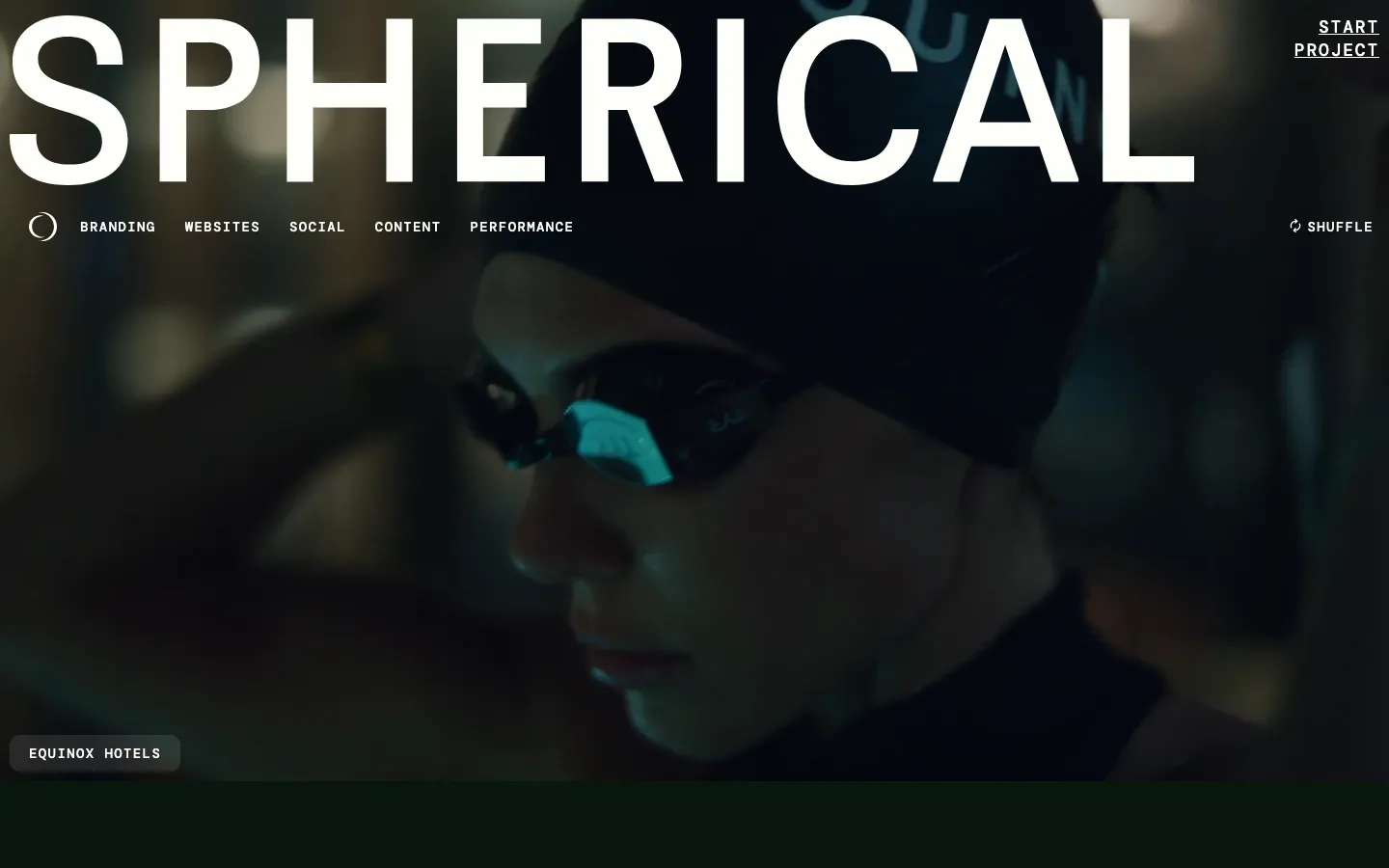
"The Agency for Inspired Hotels," and hospitality-only by construction. Five services: branding, websites, social, content, performance. It states design, build and integrations in one breath and then names the systems, PMS, CRS, CRM, RMS, payments, analytics, which is the tell of a firm that has shipped against hotel tech rather than described it. It shoots its own photo and video, and it buys media. Client page names The Surrey, Monastero Santa Rosa, Meadowlark, Rosewood Calistoga, The Beekman, with Waldorf Astoria New York restaurant brands Lex Yard and Yoshoku in the work.
Naming is not listed as a service. If the property needs a name, ask first.
Best for: an owner who wants one agency accountable from identity through to the paid media that fills the rooms.
Crown Creative: the one with the interiors
New York, London and Belfast, with published addresses for all three and eleven people profiled. Strategy includes F&B concept development and naming. Interiors is a real practice: concept design, space planning, environmental design, 3D visualisation, FF&E and OS&E direction. Web is designed and built in-house. Named work includes St Regis Cap Cana and its restaurant Nina, Waldorf Astoria's Peacock Alley, and The Dead Rabbit.
One thing to know: its "Strategy Sessions" are a free published insight series, not a paid consult, which is easy to misread from a directory listing.
Best for: an opening where the brand, the room and the website should be decided by the same people.
Longitude°: the one that owns hotels
Longitude° says it does not just brand hotels, it builds them, and backs that with hotel ownership: its partners have renovated and repositioned boutique properties of their own, and Hotel Development in the nav links to a separate development company. Its strategy list is the most hospitality-native here: brand architecture, naming, guest experience journey, brand standards, wayfinding and signage, and branded OS&E. BrandGPS® is its documented, trademarked strategy process. A partner has written two books on independent hotels.
Two cautions, both from their own site. Their hotel branding page shows a logo wall of Hilton, Hyatt, Marriott and Sheraton introduced as "owners and operators of hotels brand such as," which is not a claim that those chains are clients, and should not be read as one. And their structured data still carries a different street address from their footer.
Best for: independents under the fifty thousand dollar mark who want an operator's judgment rather than an art director's.
The identity studios
Colt: the most legible scope in the category
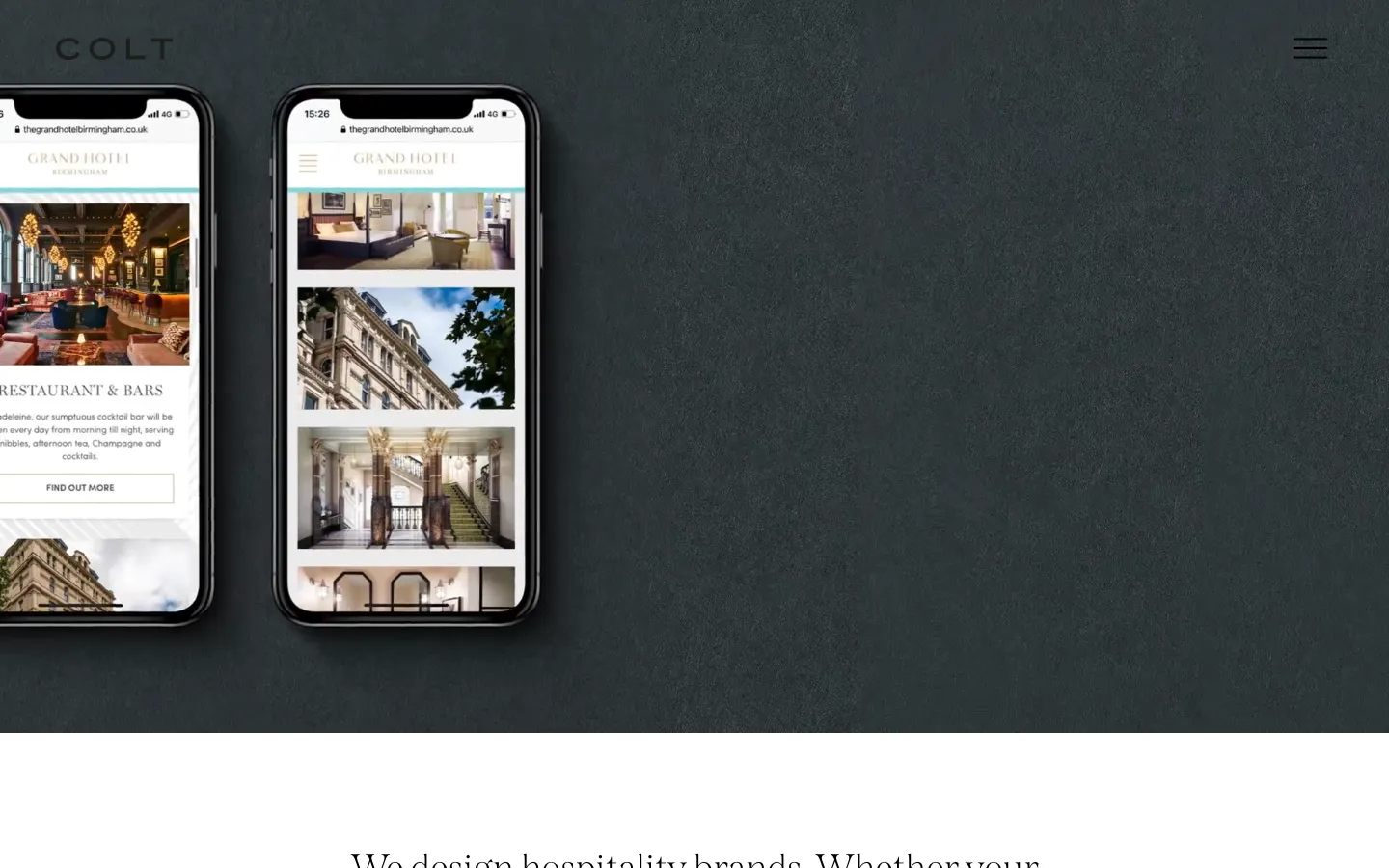
Colt does hospitality and nothing else, from one London office. It publishes the most explicit service list of the eleven, including brand guidelines by name, which only it and FINE do. Better still, its project pages credit the full scope: The Grand Hotel Birmingham lists positioning, identity, tone of voice, website design, email templates, brand guidelines, print and advertising. That makes the shape of an engagement legible without a call, which is the next best thing to a price. Other named work: Pulitzer Amsterdam, Hotel Park Ave New York, Lyle in Washington DC, 100 Shoreditch, Yotel.
Twenty-two blog posts, every one on hospitality branding, make it the strongest content play here. It lists web design without a development claim, so treat build as out of scope until they say otherwise.
Best for: a single property that wants an itemised identity scope and no upsell into media.
& Smith: identity, and a subscription to ideas
"Eating. Drinking. Sleeping. Branding." The London studio behind Dishoom's identity, with Kimpton Atlântico Algarve, Kimpton Aysla Mallorca, LUX* Resorts, GuestHouse, Coworth Park and InterContinental London Park Lane in the work. The structural idea worth stealing is the second door: an Ideas line sold separately from identity, covering one-off creative sprints, restaurant concepts, guest journey work and a "12 month calendar of ideas." It is the only productized shape in this set, and like everything else here it carries no price.
Best for: a group with restaurants as well as rooms that needs a brand and then a reason to be talked about every month.
Mucca: typography first
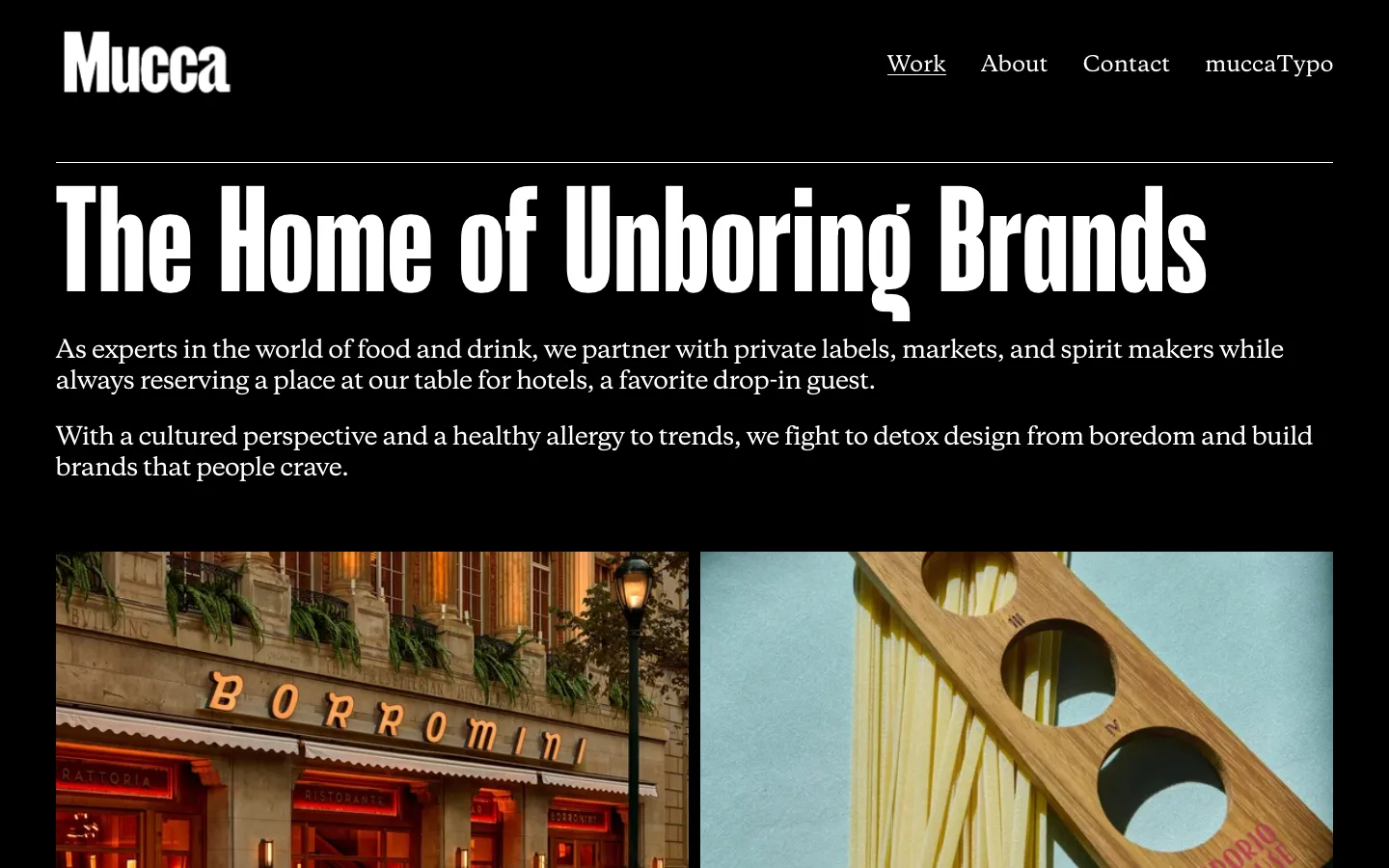
Mucca brands landmark properties: The Hermitage Hotel, the Chicago Athletic Association Hotel, The MC Hotel in Marriott's Autograph Collection, the TWA Hotel's Paris Cafe and Lisbon Lounge, Le Sirenuse. Founder Matteo Bologna is president emeritus of the Type Directors Club and the studio runs its own type foundry, which is why its identities tend to survive being set in something other than Helvetica.
Be clear-eyed about fit. Its own homepage says food and drink is the expertise and hotels are "a favorite drop-in guest." It publishes no services list anywhere, and no project enquiry form. This is a studio you approach because you want what it made for someone else.
Best for: a heritage building whose identity has to be drawn, not assembled.
Helms Workshop: brand, signage, merch, site
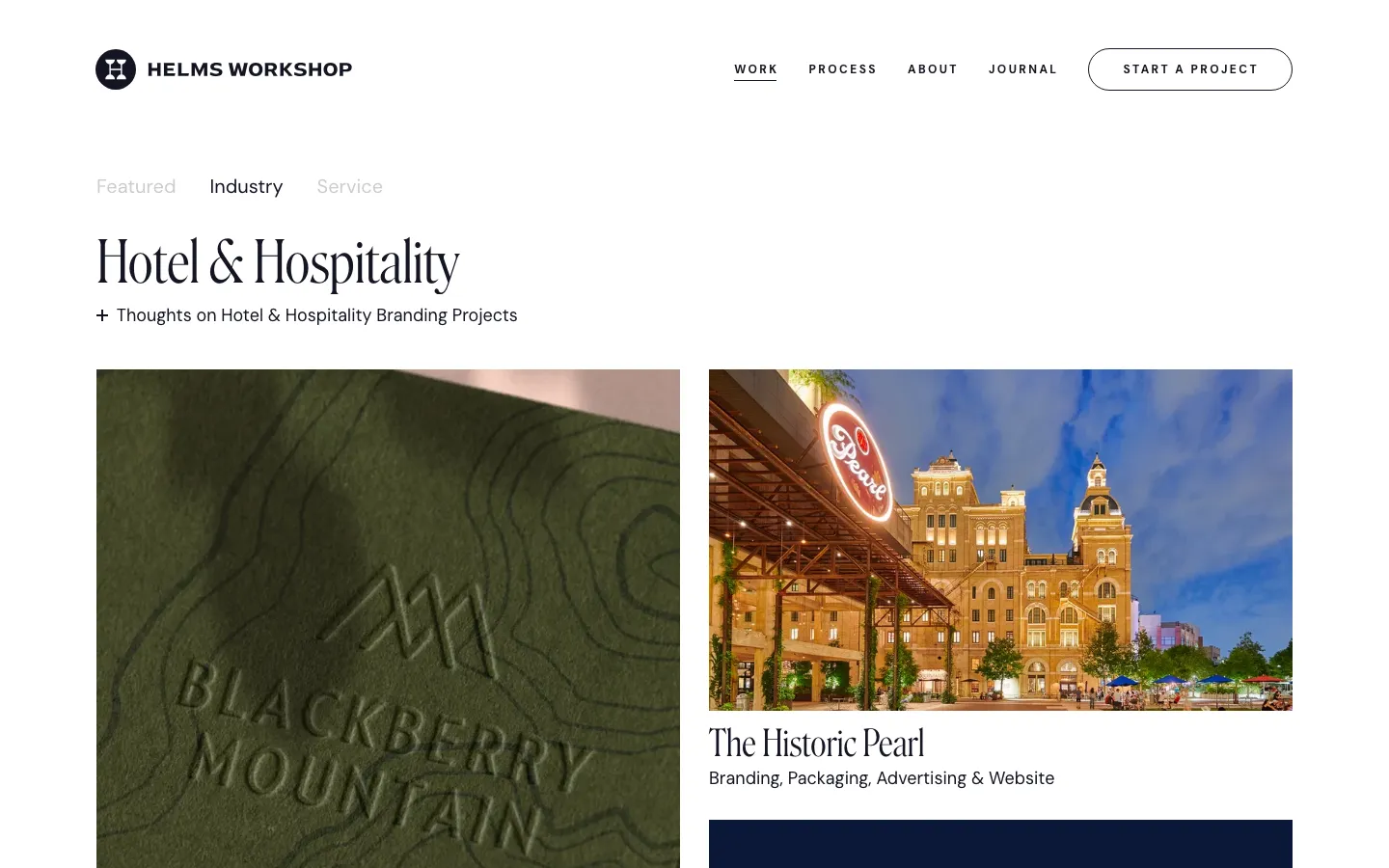
Austin, since 2010, sixteen people named, "a full-service branding agency specializing in consumer goods and hospitality." Capabilities run from brand strategy and naming through packaging, merchandise and apparel, environmental design, signage, photography, and both website design and website development. Eye tracking analytics is listed, which nobody else here offers. Hospitality work includes Blackberry Mountain, The Historic Pearl, Cedar Lakes Estate and Lucky Arrow Retreat, and the Blackberry engagement is described as two years across every touch point.
Best for: resorts and lodges where merchandise and signage are part of the revenue, not an afterthought.
King & Partners: the media practice
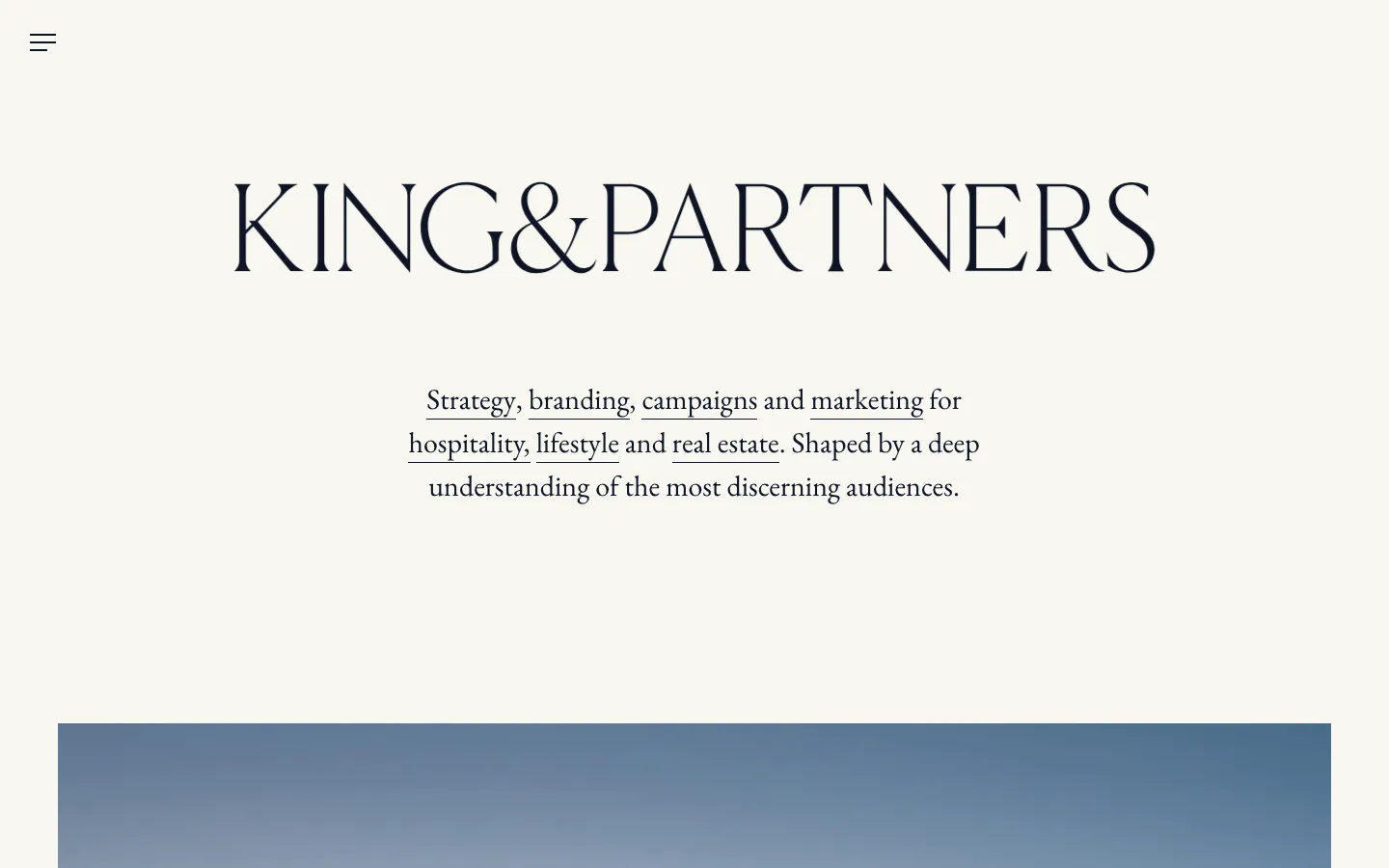
Founded 2010, fifteen people profiled, New York with Miami and Paris. The reason to shortlist it is the media practice, which is the most serious here: media planning and placement, paid search and social, CTV and linear TV, out of home, email and CRM, reported in hotel metrics including ADR, RevPAR, booking windows and pacing. Published performance claims include 400 million digital impressions in 2025 and 7x average paid media ROAS. Hospitality work named on its own site includes Fouquet's Miami, Four Seasons Naples, The Boca Raton, Fairmont, Grand Wailea, Nemacolin, Hotel del Coronado, Auberge, and restaurants including Torrisi.
Membership strategy and brand partnerships sit in the strategy list, which tells you the shape of their typical client: clubs, residences, resorts.
Best for: a luxury property or branded residence that wants brand and demand generation under one roof.
Anagrama: architecture in the same building as the identity
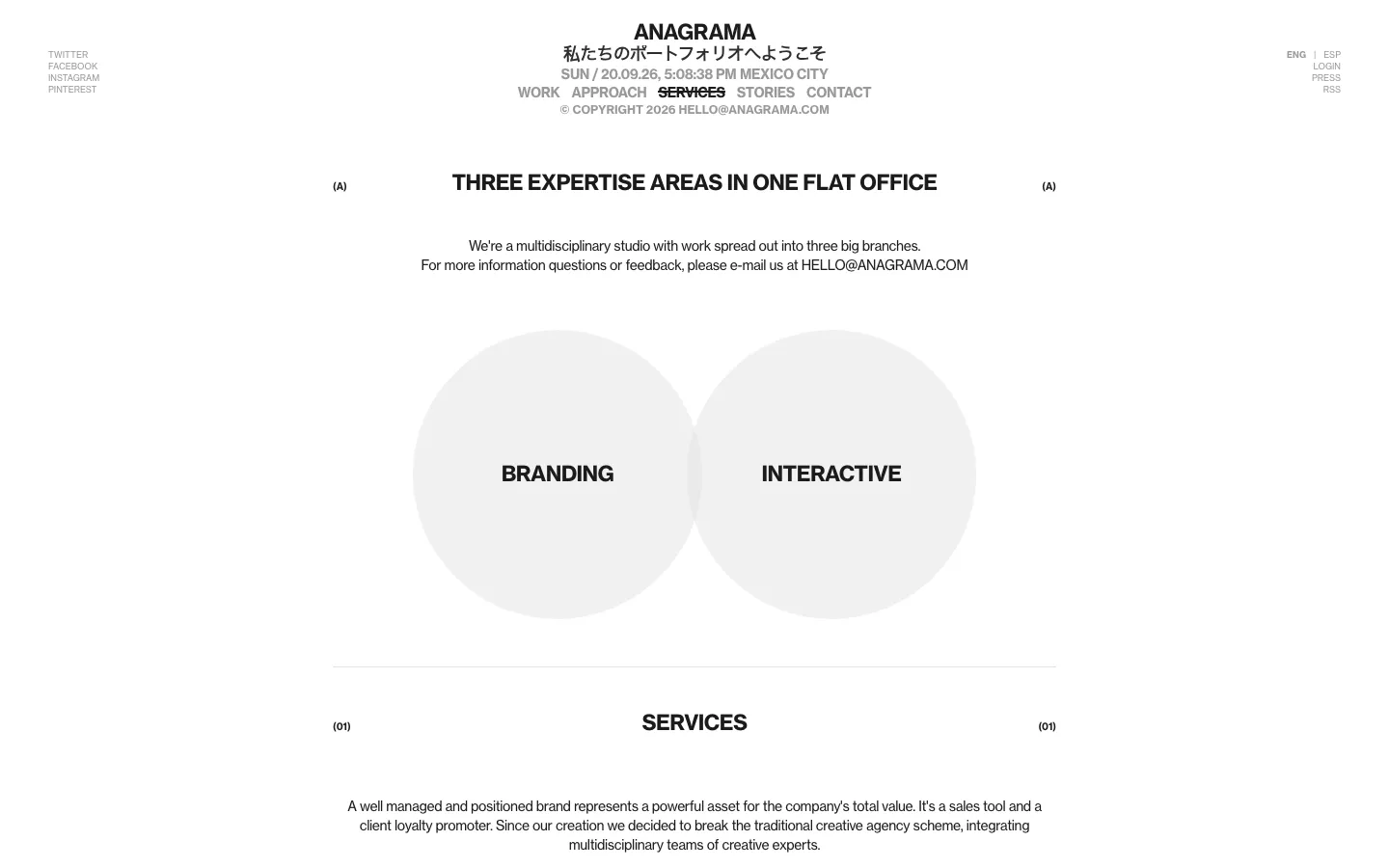
Anagrama runs branding, architecture and interactive as three top-level capabilities, with naming systems named explicitly and front-end and back-end development in house. Cara de Vaca in Monterrey is the demonstration: the dining room, the open kitchen, the terrace and the lighting, plus a custom typeface and a website with reservations, from one studio. Hotel work on its own site is thinner: The Chanler at Cliff Walk, a twenty-room boutique hotel in a nineteenth-century Newport mansion, is the clearest example, alongside restaurant brands including Magno Brasserie and an artisan bakery concept operated by Hyatt.
Two corrections to things you may read elsewhere: that bakery is an F&B unit, not a Hyatt hotel identity, and the "additional services" block listing advertising space rental reads like trademark-class boilerplate rather than a live media practice.
Best for: F&B-led concepts, and any project where the room and the logo should be decided together.
Where we fit, and where we do not
We are a hotel website studio with a branding practice, not a hotel brand consultancy. (For the same comparison outside hospitality, see startup branding agencies.) There are no interiors here, no FF&E or OS&E, no uniforms, no media buying. If your project needs those, three firms above have them and we do not.
What we do differently is publish the number. Startup Branding is $9,500 flat, seven to ten days. Naming and Verbal Identity is $5,000 flat for a week, and what a name costs elsewhere is laid out in what brand naming is. Property Discovery is $15,000 plus travel: a multi-day residency at the property, or on the land where it will stand, walking the guest journey before a pixel moves. Hotel Website Design is $12,000 on our Aurelia template with your brand applied and your booking engine wired in, from $30,000 for a custom design, from $75,000 for a multi-property platform. For a group that wants the direct channel run month to month, the Hospitality Digital Experience Lab is $9,000 a month.
The work behind that: The Resort at Pedregal, where the arrival through the tunnel became the structure of the site; Brush Creek Ranch, four operations and four front doors on 30,000 acres; and Hotel El Ganzo, where a recording studio in the basement set the shape of the whole site. More at Travel and Hotels, and Bisha Toronto for what an independent identity looks like after it joins a chain collection.
How to choose, in four questions
- Is naming in scope? It is not a line item everyone offers. Longitude, Anagrama, Colt, & Smith, Helms, King & Partners and we do. Spherical does not list it, and Landor lists verbal design rather than naming.
- Who builds the website? FINE, Spherical, Crown Creative, Anagrama, Helms, King & Partners and Longitude all state a build. Colt and & Smith list design only. Landor does not do web. The brand meets the money on the website, so a seam here is expensive.
- Does the brand have to reach the building? Signage and environmental graphics are common; actual interiors are rare. Crown Creative and Anagrama have them.
- What happens after launch? FINE sells staff playbooks, King & Partners and Spherical sell media, & Smith sells a calendar of ideas, Helms sells ongoing brand management. A brand with nobody to run it reverts to whatever the property was doing before.
Frequently asked questions
At minimum: positioning, naming, visual identity, and the applications that carry the brand into the property. Past that the category splits. Some agencies stop at the identity and hand over guidelines. Some also design and build the website, which matters because the site is where the brand meets the booking. Some run paid media against it, as King & Partners and Spherical do. A few go into the building itself: Crown Creative publishes FF&E and OS&E direction, and Anagrama has architecture and interior design in-house. FINE goes the other direction, into operations, selling service narrative and experience playbooks for staff. Before comparing agencies, decide which of those four jobs you are actually buying, because they are priced nothing alike.
Nobody in this category publishes a price, so treat any specific figure you read elsewhere with suspicion. What does exist, read on 20 September 2026, are two intake forms with budget bands. Helms Workshop offers $50K to $100K, $100K to $250K, and $250K and up, which puts its practical floor at fifty thousand dollars. Longitude offers under $20k, $20k+, $50k+ and $100k+, the lowest entry point published by any agency here. King & Partners, FINE, Crown Creative, Spherical, Anagrama, Colt, & Smith, Mucca and Landor publish no budget field at all. Our own numbers are published in full: Startup Branding at $9,500, naming at $5,000, a property residency at $15,000 plus travel.
Read from each agency's own site on 20 September 2026: FINE states it both designs and builds, has open-sourced its own CMS, and lists hotel-tech integrations. Spherical states design, build and integrations across PMS, CRS, CRM and RMS. Crown Creative states it builds responsive sites and has web developers on staff. Anagrama lists front-end and back-end development. Longitude lists website design in its services and website design and development in its intake form. Helms Workshop lists website design and website development as separate capabilities. King & Partners lists technical development and names a CTO. Colt and & Smith list web design with no development claim, and Landor offers no web service at all. Do not infer a build from the words web design.
A generalist can make a beautiful hotel identity. What a hospitality specialist brings is the unglamorous part: knowing that the brand has to survive a channel manager, an OTA listing that strips your typography, a uniform supplier, signage fabrication tolerances, and a rate plan called Advance Purchase Non-Refundable. Longitude goes furthest here, since its partners own and operate hotels. Spherical names the systems by acronym. FINE writes the staff playbooks. If your project is a single identity for a single property, craft matters more than category fluency, and Mucca, Colt and & Smith are as good as it gets. If it is a group, a rebrand, or an opening on a date, category fluency starts to matter more than the portfolio.
Branding decides what the property stands for, what it is called, how it looks and how it speaks. Website design decides how a stranger comparing five hotels on a phone experiences that, and whether they book direct or leave for an OTA. The brand is upstream and the site is where it earns money, which is why the agencies that only do one of the two hand you a seam. Our own view, having designed hotel sites for twenty years, is that the seam is where most of the value leaks: a beautiful identity rendered by a booking engine nobody styled is a brand that stops at the moment of purchase.
Give them the three things that actually determine cost: the number of properties, whether naming is in scope, and whether the deliverable ends at guidelines or has to run through signage, print, uniforms, packaging and the website. Then ask each agency for a fixed scope against a fixed number rather than an hourly estimate. If an agency will not put a number on a defined scope, that is information. Two agencies here publish budget bands before you ever speak to them, and one, ours, publishes the prices themselves.
Want to talk to SUUR directly?
We work with founders shipping product, not just decks.