Brand Identity Design Services: What You Get at Each Price
Compare brand identity services by the decisions and deliverables included: positioning, marks, typography, color, applications, usage rules and rights. A logo-file package and a multi-team brand rollout are different purchases even when both are called “branding.”
The subscription figures below were checked on 20 October 2026. They illustrate different buying models, not firm price boundaries between them. For named packages and wider first-year costs, see branding costs.
Why the label is insufficient for budgeting
A logo-file purchase and a researched identity rollout differ in decisions, applications and handoff. Price alone does not establish strategic depth. Ask which problem the engagement must settle and what another designer, printer or developer should be able to produce from the result.
Compare scope before price
- Who decides the positioning and writes the brief?
- Which working assets and usage rights are delivered?
- What revisions, applications and handoff support are included?
Model 1: logo makers
Logo makers sell generated marks and packages of files or applications. Inspect vector delivery, editable source, font licenses and commercial-use terms before comparing fees. A failed automated price fetch does not establish that a supplier lacks a public price.
A maker can help explore directions or produce a simple mark. Review the output against the audience, competitors, small-size use and rights. Do not assume either full strategic support or an unusable result from the tool category alone.
Model 2: marketplaces and contests
Marketplaces offer direct engagements and contests with different selection and revision processes. Compare the brief, designer access, concept review, refinement and delivered rights. Copyright assignment, refund eligibility and third-party assets depend on the agreement; a search-result price annotation does not establish them.
The attraction is a choice of directions. The task for the buyer is to judge those directions against a brief, small-size use, one-color reproduction and the product context. Confirm whether strategic guidance and refinement are included rather than assuming that more options produce a stronger identity.
Model 3: design subscriptions
On October 20, 2026, ManyPixels listed monthly Advanced at $699, Business at $1,199 and Assigned Designer at $1,399, with different output or staffing arrangements. Penji listed $995, $1,995 and $4,500 monthly plans with two, three and four active workstreams respectively. These are advertised capacity models, not a guarantee that a complete identity finishes within one billing period. Confirm the branding brief and applicable terms.
What you buy depends on the plan's capacity and scope. A queue can support ongoing brand applications, but a full identity may require several requests and revision rounds. Some suppliers include strategic input or development; do not assume either inclusion or exclusion from the subscription label. Compare the actual brief with the current subscription prices and capacity definitions. Primary plan references are ManyPixels and Penji.
Model 4: a scoped studio engagement
A studio may quote diagnosis, positioning, audience research, voice, identity and applications together or separately. Ask for the scope and evidence behind each decision. A missing public price establishes neither a minimum fee nor the amount of strategic work.
Our own package sits in this tier, and we publish the number: $9,500 flat, covering the logo in its working forms (primary, horizontal, and favicon-scale marks), the color palette, the typography system, a brand book with usage rules, and final files in vector and raster formats. First concepts land two business days after the brief, and the full package typically wraps in 7 to 10 business days including revisions. The terms are on the branding for startups page. If the brand needs a name and a voice before it needs a mark, naming and verbal identity is $5,000 flat.
What a package looks like when it lands is easier to show than to describe:
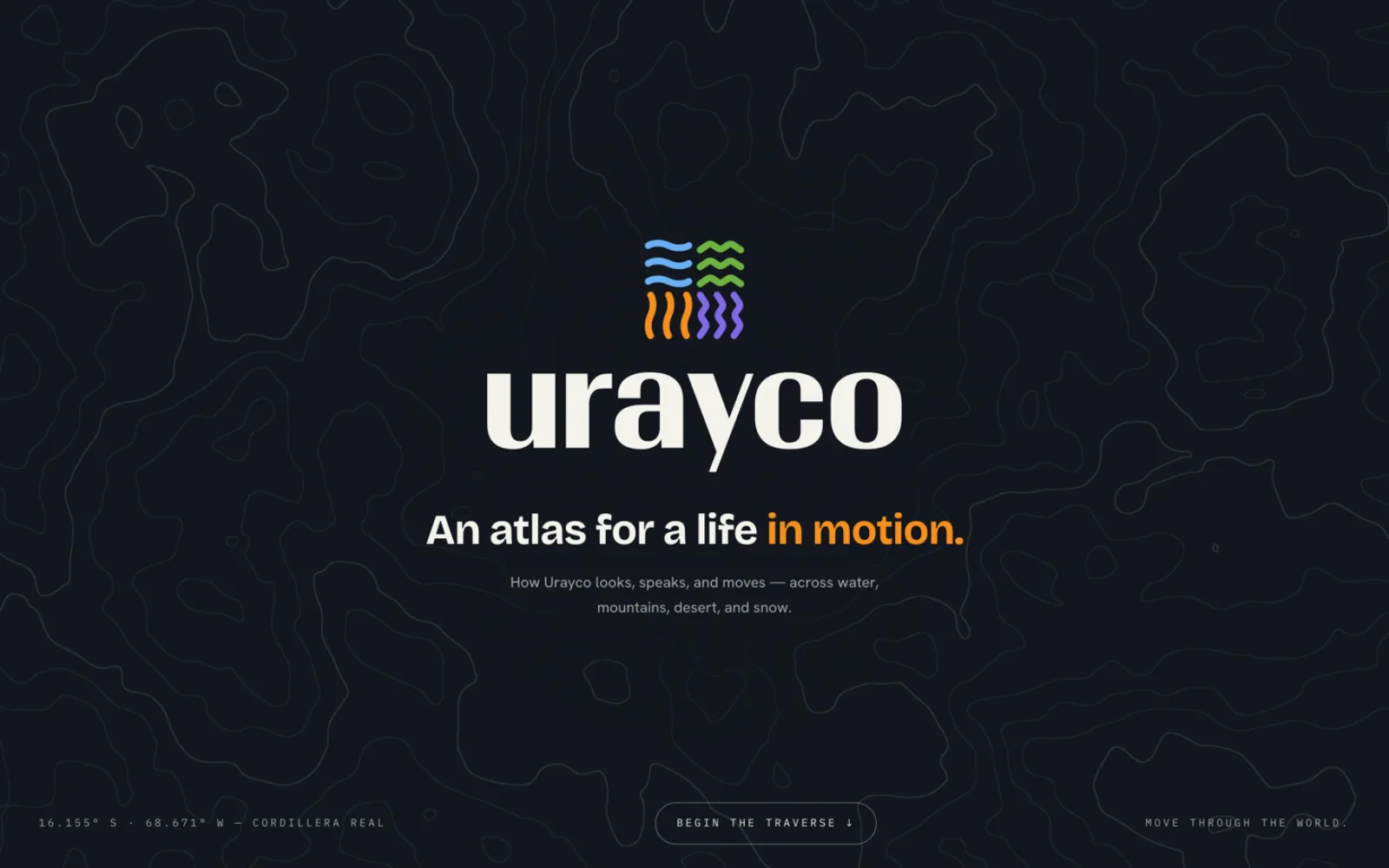
That is Urayco, an active-travel brand: a symbol built from four terrains, a palette named after the places it moves through, route-glyph iconography, and the guidelines delivered as an interactive field atlas rather than a PDF. LOVU got the same treatment for a romance-travel platform, a mark with four meanings and a voice that reads like an invitation. Both are the size of package the flat fee buys, and both are public so you can judge the tier by the work instead of by a price list.
Tier 5: a wider agency engagement
Agency scopes vary; there is no universal $50,000 minimum. A wider engagement may include research, strategy, naming, identity, localization and rollout across several teams. Ask which of those is necessary for your organization and how the quote allocates the work. The newer branding-cost comparison records named packages at several agency price points.
What you get at each price
| Buying model | Historical example or scope | You receive | Who decides |
|---|---|---|---|
| Logo maker | Current package fee | Files and applications listed in the package | Agree what the tool and operator supply |
| Contest or marketplace | Project or contest quote | Concepts, refinement and rights as contracted | Agree selection and direction |
| Subscription | Plan-specific commitment | Defined capacity and eligible deliverables | Confirm strategy and brief ownership |
| Studio | Our advertised example is $9,500 | Marks, palette, typography, brand book and files as scoped | Shared review and named approval owner |
| Agency | Quote against the actual scope | research, identity and rollout as contracted | agree strategy ownership and approvals |
Is $500 too much for a logo?
The scope decides. A $500 budget can buy a defined logo task, but it does not establish the amount of strategy, revision or usage rights included. Compare the deliverables and agreement rather than assuming that a price is either excessive or insufficient. A logo is a mark. An identity includes the type, color, imagery, voice and rules that help a team apply it consistently.
What to ask about strategic work
Ask who defines the audience and distinction, compares directions and tests applications. A useful system specifies type, color roles, imagery and recurring patterns, then explains their use. People can use tools in this work; neither human authorship nor automation establishes process depth. Request the decisions and evidence, not just the final mark.
How much does a branding consultant cost?
Consultants may charge by time, phase or project. Compare the research, decisions and artifacts. Our naming-and-verbal-identity offer is a $5,000 example, with screening and messaging work; it does not replace every strategy engagement or legal clearance.
How to choose, by situation
A simple mark with strategy settled: compare maker packages and tightly scoped designer proposals.
Several visual directions to evaluate: compare a contest with commissioned exploration, including who selects and refines the result.
Recurring brand applications: compare subscription and retainer capacity against a representative month of work.
Unsettled positioning and visual direction: compare engagements explicitly covering those decisions. Ask for a past handoff and application examples.
Several teams or markets: estimate coordination, localization and rollout. No employee count implies a universal agency fee or timetable.
The same ladder logic holds for the site that carries the identity; we priced every rung of that in what a website costs in 2026.
The one-paragraph answer
Buy the scope that matches the decisions you still need to make. Compare positioning, identity assets, application examples, revision limits, rights and handoff before comparing totals. Naming, domains, clearance and filing may be separate; check the inclusions and use the first-year branding budget to list those costs.
Brand identity is one purchase; ongoing graphic design is another. For the models and prices on the second, see graphic design services in 2026.
If the name comes before the identity, start with what brand naming is: the four stages, what each route costs, and what a trademark filing actually runs in the US and the EU.
Have a product idea?
Designed, built, and shipped in about 5 days.