Graphic Design Services in 2026: Every Model, Priced
Graphic design services come in seven shapes, and the price tells you who does the work and who carries the risk. At the bottom, AI and template tools like Canva, free or $144 a year per person on 12 September 2026, where you are the designer. Then freelancers, priced by the hour. Then subscriptions, $699 to $5,995 a month for unlimited requests handled one at a time. Then flat-fee sprints, a page, a brand, or a product at a price fixed before the clock starts, $3,500 to $9,500 with us. Then partners, one senior on your product month to month, $4,900 to $6,500. Then agencies, a team at $100 to $199 an hour behind $10,000 to $25,000 minimums on Clutch's list today. At the top, an in-house designer at a $62,960 median salary, the Bureau of Labor Statistics' May 2025 figure, plus everything a salary hides. Below: what each costs, what it is for, and which one you are actually shopping for.
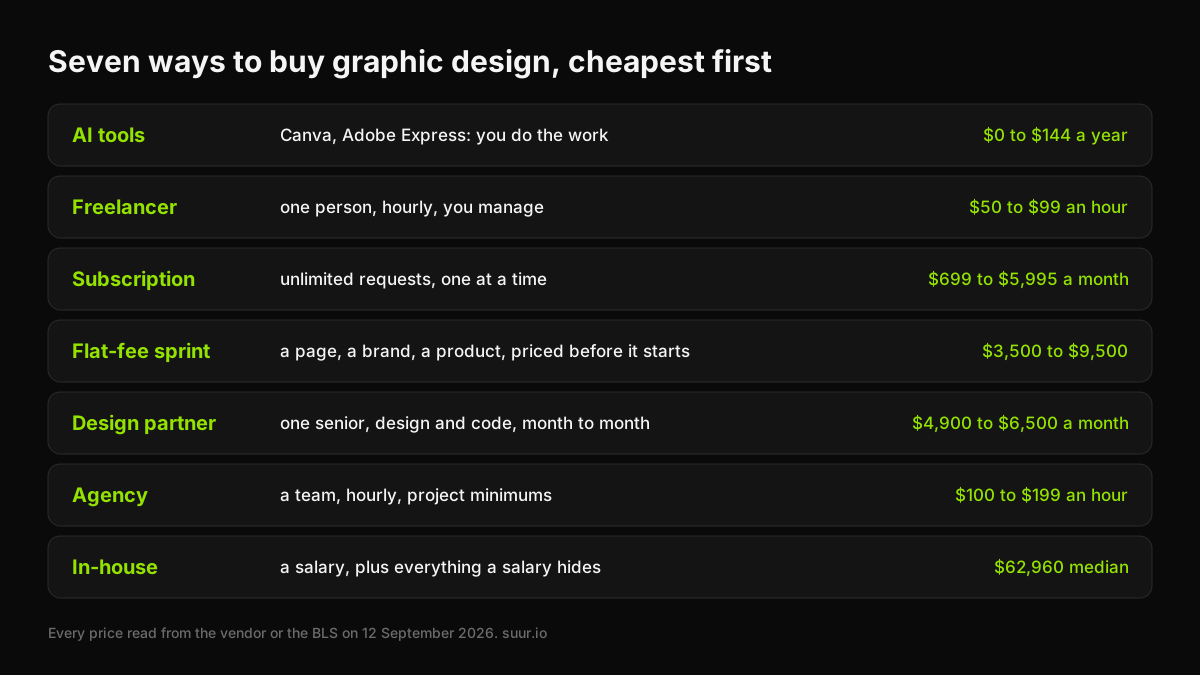
The seven models at a glance
| Model | What you pay | Who does the work | Best for |
|---|---|---|---|
| AI and template tools | $0 to $144 a year per person | You | Social posts, decks, the daily churn |
| Freelancer | Hourly, from about $50 | One person you manage | Defined jobs with a clear brief |
| Subscription | $699 to $5,995 a month | A queue, one request at a time | A steady stream of production work |
| Flat-fee sprint | $3,500 to $9,500 per outcome | One senior, fixed scope | A page, a brand, a product first version |
| Design partner | $4,900 to $6,500 a month | One senior, embedded | A product that ships every month |
| Agency | $100 to $199 an hour, $10,000 to $25,000 minimums | A team with a PM | Campaigns and rebrands with many hands |
| In-house | $62,960 median salary, plus overhead | An employee | Design that never stops |
Every vendor price was read from the vendor's own page on 12 September 2026; the salary is the BLS figure for May 2025.
1. AI and template tools: you are the designer
Canva's plans page on 12 September 2026 listed a free tier, Pro at $144 a year for one person, and Teams at $250 a year per person. Adobe's Creative Cloud All Apps was $69.99 a month on an annual plan billed monthly, with a $34.99 promotion for the first three months, a single app at $22.99 a month, and Adobe Express at $9.99. Both now ship generative features that produce a passable social post from a sentence.
This is graphic design service in the sense that the software serves; the taste, the brief, and the hour are yours. It is the right answer for the daily churn, and the wrong one the moment the output has to carry the brand somewhere that matters. Most of the companies that hire us at the next four rungs are still on Canva for everything else, which is correct.
2. Freelancers: one person, by the hour, managed by you
A freelancer is the cheapest way to get a real designer on a defined job. The honest price anchor is the salary: the Bureau of Labor Statistics puts the median graphic designer at $62,960 a year as of May 2025, which is about $30 an hour salaried, so a freelancer covering their own taxes, benefits, software, and unbilled hours has to charge roughly double that to earn the same. The smallest studios on Clutch's graphic design list today quoted $50 to $99 an hour with minimums from $1,000, and individual freelancers sit at or below that band.
What the rate does not include is management. A freelancer needs a brief, feedback, files, and a decision from you every day the job runs, and the variance in what comes back is wider than the variance in price. It works when the job is defined and you have someone who can direct it.
3. Subscriptions: unlimited requests, one at a time
This is the model Designjoy made famous: a flat monthly fee, unlimited requests, delivered one at a time from a queue. On 12 September 2026 Designjoy listed $4,995 a month as a limited-time rate against $5,995 standard. Penji was $995, $1,995, or $4,500 a month. ManyPixels was $699, $1,199, $1,399, or $2,599 a month on yearly billing. Kimp listed $1,397 and $1,697 a month with a 50 percent discount on the first four months advertised on its homepage. Design Pickle publishes no number and quotes on a call.
At the top of the category, Superside is a different animal: subscriptions start at a $15,000 monthly minimum on an annual term plus a $1,000 a month software fee, a Dedicated tier from $30,000 a month, and a $20,000 three-week Quick Start, all from its pricing page today.
What subscriptions are for: a steady stream of production work, social, ads, decks, one-pagers, where turnaround matters more than authorship and the queue never empties. What they are not for: the one thing that has to be right, because one-at-a-time means your brand identity waits behind Tuesday's banner. Our design subscription comparison and the Designjoy alternatives page go vendor by vendor.
4. Flat-fee sprints: one outcome, priced before it starts
This is the model we built the studio on. Instead of a queue or an hour, you buy an outcome at a number you know before day one: a Landing Page Sprint at $3,500 in about three business days, a Design Sprint at $6,000 for a product's screens in about five, Startup Branding at $9,500 in seven to ten days, and a Product Sprint at $9,000 for a first version designed, coded, and live in five. Naming is $5,000 for a week. All of them are done by one senior person, which is the reason the days are what they are.
Flat fees are for the things that have a finish line. They are the wrong purchase for work that never ends, which is what the next rung is for. The website design cost post puts the sprint prices against builders, freelancers, and agencies for a site specifically, and the brand identity post does the same for a brand.
5. Design partner: one senior, month to month
A retainer buys continuity: the same person, on your product, every week. Ours come in two shapes. Cadence is $4,900 a month for one design cycle a month, scoped on the first, shipped by the end. The Design Partner is $6,500 a month for a senior designer who also writes the front-end code, embedded in your team, month to month, with 75 percent of the month back if you leave in the first seven days. Neither is unlimited and neither is a queue; the price buys a person, not a ticket system, and that is the difference between this rung and the one above it.
It is the right model for a product that ships every month and does not yet justify a hire. It is the wrong one for a company with a single campaign to run.
6. Agencies: a team, hourly, behind a minimum
Clutch's graphic design list on 12 September 2026 is the cleanest public view of agency pricing: DD.NYC and AtticSalt Branding at $150 to $199 an hour with $10,000 and $25,000 minimums, Concentric Design, ThompsonStenning, and IKM at $100 to $149 with minimums from $1,000 to $10,000, andstudio and League Design Agency at $50 to $99 with $10,000 minimums. An agency brings a project manager, several hands, and a process, and bills for all three.
That is the right purchase for a campaign with many deliverables, a rebrand with many stakeholders, or work that needs a team in a room. It is an expensive way to get one good designer, which is most of what most companies need.
7. In-house: a salary, plus everything a salary hides
The BLS median for graphic designers was $62,960 a year as of May 2025, with 253,100 jobs in the country and employment projected to fall 2 percent from 2025 to 2035. The salary is the visible part. Benefits, payroll taxes, software, equipment, recruiting, and the months of ramp typically add a quarter to forty percent, so the real number for a mid-level hire in a US city lands well above the median before the first file is delivered.
An in-house designer is the right answer when the design work never stops and the context is the job: a product team shipping weekly, a brand with a constant content load. It is the wrong answer for a company that needs great design for two months of the year, which is most of them, and it is why the subscription and partner rungs exist. Our subscription versus in-house comparison runs the numbers over a year.
Which one you are actually shopping for
- The daily churn of posts, decks, and internal docs: rung 1, and keep it there.
- A defined job with a clear brief and someone to direct it: a freelancer.
- A steady stream of production work where speed beats authorship: a subscription, and read the one-at-a-time rule before you sign.
- One thing that has to be right, a page, a brand, a product's first version: a flat-fee sprint.
- A product that ships every month without a hire yet: a design partner.
- A campaign or a rebrand with many hands: an agency, and budget for the process.
- Design that never stops: hire, and count the whole cost.
The honest test of any graphic design quote is whether it names who does the work and what happens when you stop paying. A queue, an hour, a person, and a salary are four different answers, and the price on the page is only the first of them.
Have a product idea?
Designed, built, and shipped in about 5 days.