Mobile App Development Services: What $10k, $50k and $250k Buy
Mobile app development services price the same idea anywhere from $10,000 to $250,000, and the spread is mostly about who is in the room, not what is on the screen. At $10,000 you get one senior person, one platform, and a focused first version, which is what a US contractor MVP costs in BuildFire's guide (updated 25 August 2026) and what our own $9,000 Product Sprint ships. At $50,000 you get a small team for a quarter: two platforms or a cross-platform build, accounts, payments, notifications, and a backend, which is where the agencies on Clutch's iOS list start, with minimum project sizes of $10,000 to $50,000 and hourly rates from $25 to $199 on 9 September 2026. At $250,000 you get an agency team for six to twelve months, with compliance, real-time features, analytics, and a release cadence. Below: what each tier includes, what it leaves out, and three apps we shipped to the App Store as the receipts, with the store's own data on each.
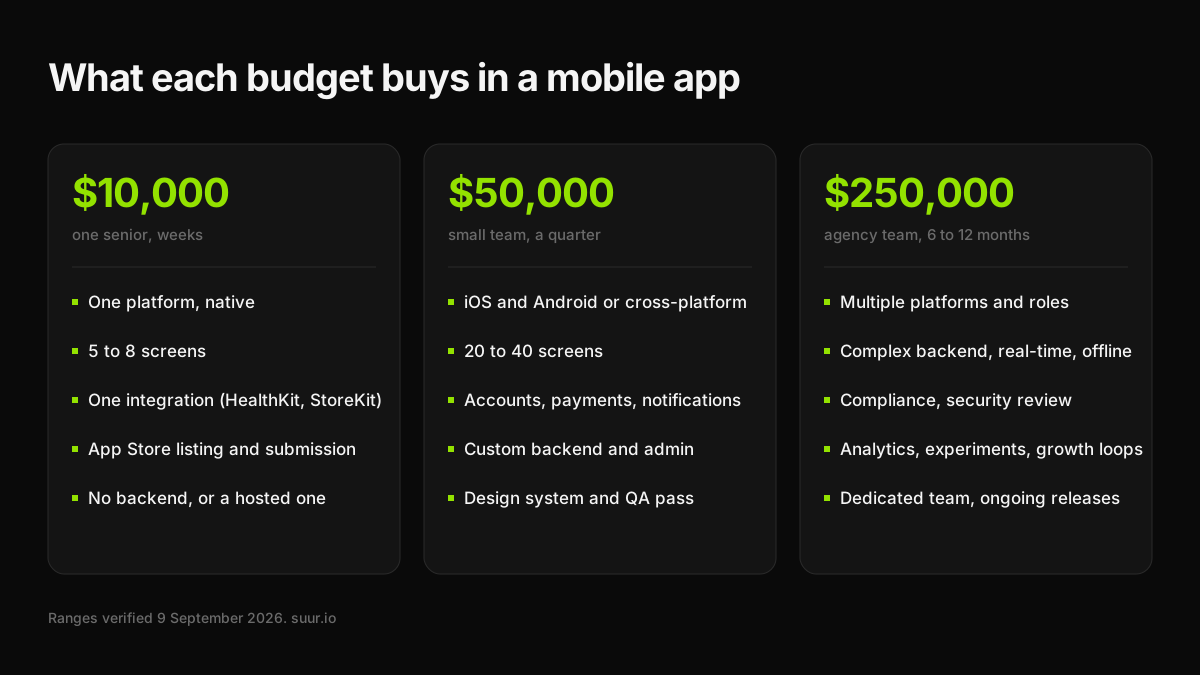
The three budgets side by side
| Budget | Who builds it | How long | What ships | What it leaves out |
|---|---|---|---|---|
| $10,000 | One senior, or a contractor | 1 to 6 weeks | One platform, 5 to 8 screens, one integration, the store listing | A custom backend, a second platform, growth tooling |
| $50,000 | Two or three people | About a quarter | Both platforms or cross-platform, 20 to 40 screens, accounts, payments, notifications, a backend and admin | Compliance, analytics maturity, a release cadence |
| $250,000 | An agency team with a PM | 6 to 12 months | Multiple platforms and roles, real-time or offline, security review, experiments, ongoing releases | Nothing, except the certainty that anyone wanted it |
Every price in this post was read from the vendor's live page on 9 September 2026, and the App Store figures come from Apple's own lookup API the same day.
What $10,000 buys
One senior person and a narrow brief. BuildFire's cost guide, updated 25 August 2026, puts a US MVP or prototype at "$10,000" and simple utility apps at "a few thousand dollars"; the cheapest agencies on Clutch's iOS list the same day quoted $25 to $49 an hour with a $10,000 minimum, which at those rates is 200 to 400 hours.
What that buys, done well: one platform, native, five to eight screens, one integration that makes the app real (HealthKit, StoreKit, notifications), the icon, the screenshots, the listing copy, and the submission itself. No custom backend, or a hosted one like CloudKit or Supabase. The store is part of the scope or it is not a $10,000 app; it is a $10,000 prototype.
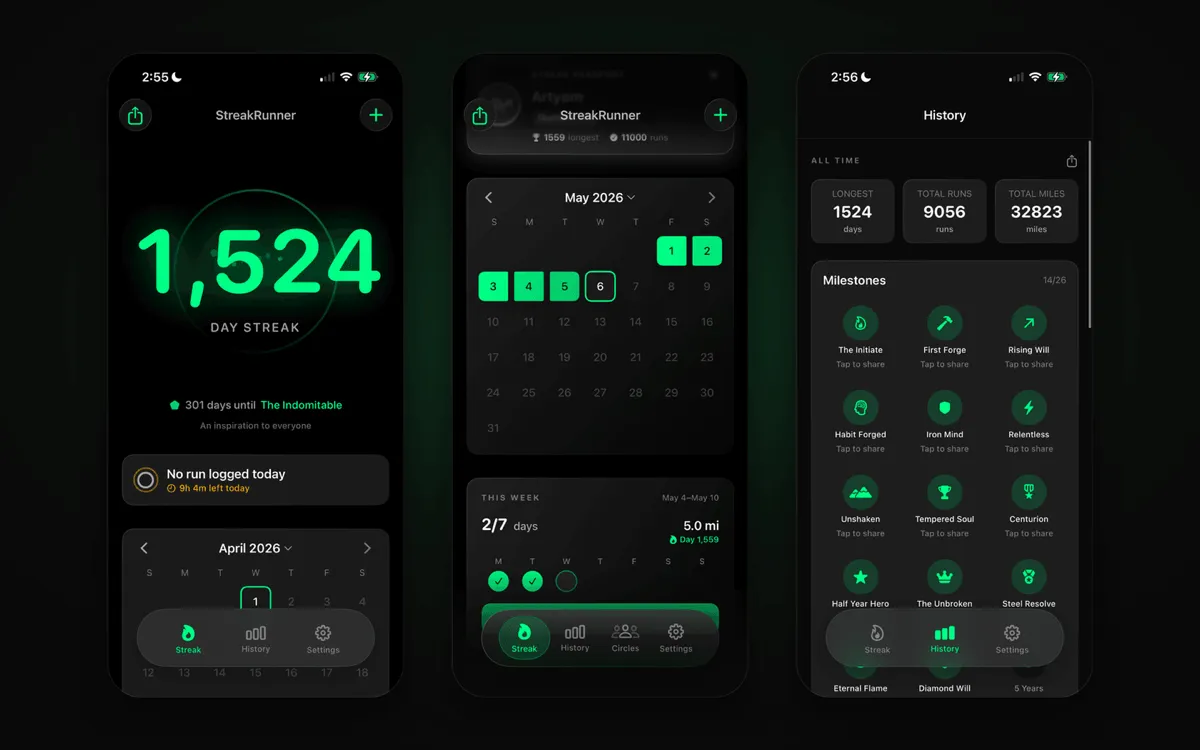
The receipts are two of our own. Streak Runner has been on the App Store since 9 March 2026, HealthKit and widgets included, at 12.8 MB, with version 1.3.1 shipped on 31 August. PaceCalc, a race pace calculator, went live on 19 May 2026 at 6.3 MB, version 1.6 on 26 August. Both were designed, built, and submitted by one person, both are free, and both are the shape of app this tier is for: one job, done natively, on the store.
Our own prices sit here and just above it. The Product Sprint is $9,000 flat for a working first version in five days, which for an app means a single flow. The iOS App product is $22,000 flat and takes a native app from concept to a live App Store listing in about four weeks, SwiftUI and the real integrations included, which is a $10,000-tier scope with a $50,000-tier finish, by the one person who did both of the apps above.
What $50,000 buys
A small team for a quarter, and this is where most agencies begin. On Clutch's iOS developer list on 9 September 2026, Goji Labs and AppMakers USA quoted $100 to $149 an hour, Mercury Development $50 to $99, Kingsmen Digital Ventures $150 to $199, and Utility $100 to $149 with a $50,000 minimum. At $100 to $149 an hour, $50,000 is 335 to 500 hours: two or three people, part-time, for about three months.
What it buys: iOS and Android, or one cross-platform build in React Native or Flutter; twenty to forty screens; accounts, payments, and push notifications; a custom backend with an admin behind it; a design system and a proper QA pass. What it leaves out: compliance work, analytics beyond installs, and any plan for what ships in month four.
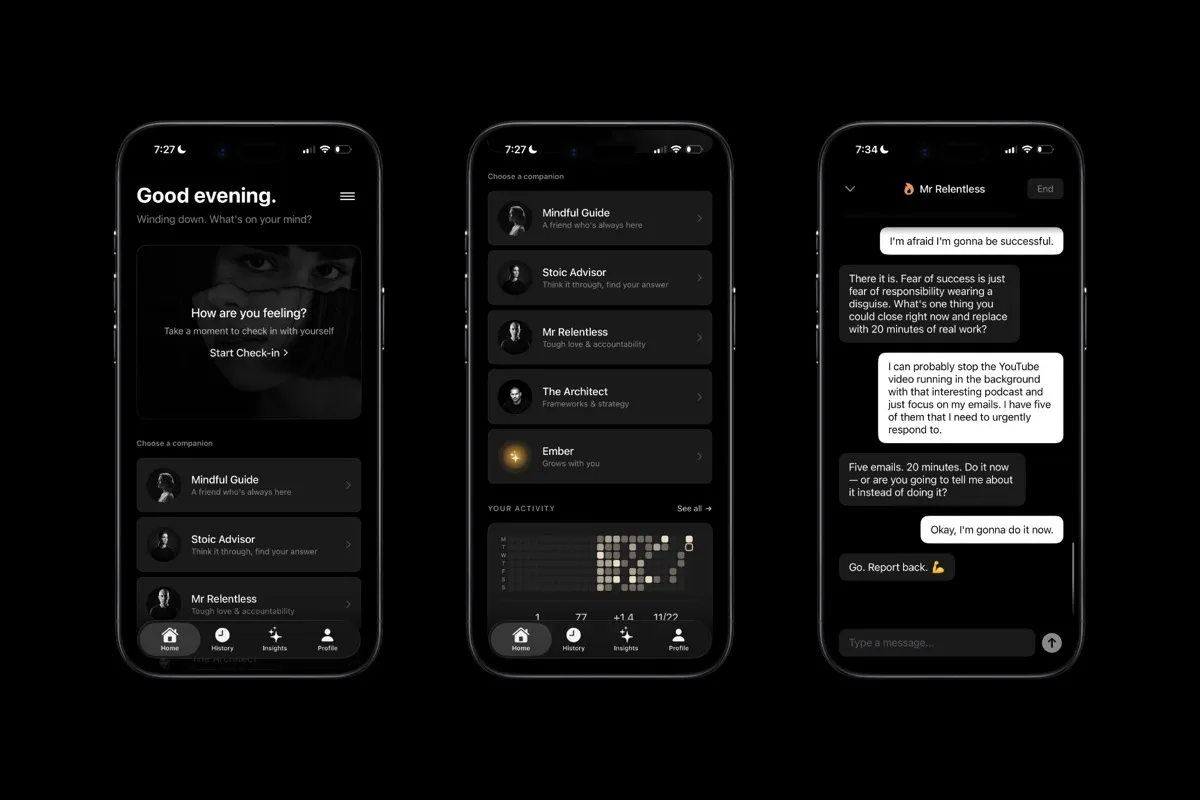
The receipt is ILTY, an AI mental-health companion with five personalities: a native SwiftUI iOS app, a 226-page website in seven languages, and the admin behind both, with 744 tests across the app and the platform. It went from concept to the App Store in eight weeks and has been live since 14 April 2026, at 255.9 MB, with version 1.8.5 shipped on 6 September. That is a $50,000-tier scope. It was designed and built by one person, which is the argument this whole post is making: the tier is defined by the work, and the price is defined by how many people it takes to do it.
What $250,000 buys
An agency team for six to twelve months: a project manager, a designer, two or three engineers, and QA. BuildFire's guide puts "large-scale native apps with agency teams" at "$100,000+", and at $150 an hour, $250,000 is about 1,650 hours, a four-person team for a quarter or one engineer for a year.
What it buys that the tiers below cannot: multiple platforms and user roles, a complex backend with real-time or offline sync, a security and compliance review for regulated data, analytics, experiments, and growth loops, and a release cadence that continues after launch. It is the right budget for a two-sided marketplace, a health app that touches records, a hardware companion, or an enterprise product with procurement behind it.
It is the wrong budget for an idea nobody has used yet. At this tier you are paying for a process, and the process will produce a polished version of whatever you asked for in month one. The cheapest thing you can buy before it is a $9,000 sprint that tells you whether month one was right, and our MVP cost breakdown covers what that sprint ships and what it does not.
The costs after launch nobody quotes
The Apple Developer Program is $99 a year, verified on Apple's page on 9 September 2026, and for a backend-less utility that is close to the whole running cost. BuildFire's annual estimates for an app with a real backend are the ones to budget against: servers $12,000, data storage $3,600, a CDN $3,600, push notifications $2,400, and maintenance at 20 percent or more of the original build each year, with bug fixing at 10 to 20 percent. A $250,000 app is a $50,000-a-year app afterwards. A $10,000 app can be a $99-a-year app, which is a design decision made on day one, not an accident.
Which budget you need
- You have an idea and no users. The $10,000 tier, on one platform, with the store in scope. A Product Sprint for a single flow, the iOS App product if it needs the real integrations and a listing.
- You have users and need accounts, payments, or a second platform. The $50,000 tier. Get the scope written down before the clock starts; the hourly rates above are only a price when the hours are known.
- You have regulated data, two sides of a market, or a procurement team. The $250,000 tier, and hire the process on purpose.
- You have an app that is not working. None of the above yet. Read the five red flags that an app needs a redesign and get a product UX audit, $3,000 in three business days, before you buy a rebuild of the wrong thing.
The honest test of any mobile app development quote is whether it names the platform, the screen count, the integrations, and the store. A quote that names a team size and a month count is pricing the room.
Have a product idea?
Designed, built, and shipped in about 5 days.