Hotel Web Design: A Practical Brief for Independent Hotels
Good hotel web design helps a guest decide whether the property fits their trip, choose a suitable room and reach a booking they understand. Start the project by specifying those decisions, the information behind them and who owns each part of the journey. The visual direction should grow from that brief.
A hotel can have beautiful photography and still leave a guest wondering whether the room fits a family, where to park or why their selected dates vanished when they clicked Book. Those are useful problems to put in a design brief. “Make the website feel more premium” leaves much more open to interpretation.
I design hotel websites, and this is the planning process I would use with an independent property before approving layouts or a development estimate. It ends with a hotel website brief you can download and adapt.
Key takeaways
- Plan pages around guest questions; an eight-page package is not a universal sitemap.
- Specify room facts, photography and booking behavior together.
- Test the transition into the booking engine on a phone, including unavailable dates.
- Give every promise in the brief an owner and a way to check it.
Start with the guest and the reason to choose your hotel
Name the guests you want to serve and the property facts that help them choose. This gives the designer a basis for deciding what belongs on the first screen, in the navigation and on each room page.
A downtown hotel might need to explain late arrival, parking and access to nearby venues. A remote retreat might need to explain transfers, meal arrangements and what a stay includes. A wedding venue needs a route for planners whose next step is an enquiry rather than a room reservation.
Write down the questions your reservations team repeatedly answers. Separate facts the website can answer from questions that need a person. That distinction is more useful than adding a chatbot before the content is clear.
For boutique hotel website design, identity needs evidence. A claim such as “immersed in local culture” becomes more useful when the site shows the makers, food, neighborhood or programme that makes it true.
In our historical 2017 design for The Maven in Denver, a credited local artist occupied the opening screen. Arrival and departure fields sat beside a plain Reserve Now action. The same screen could introduce the hotel's character and show a route to booking.
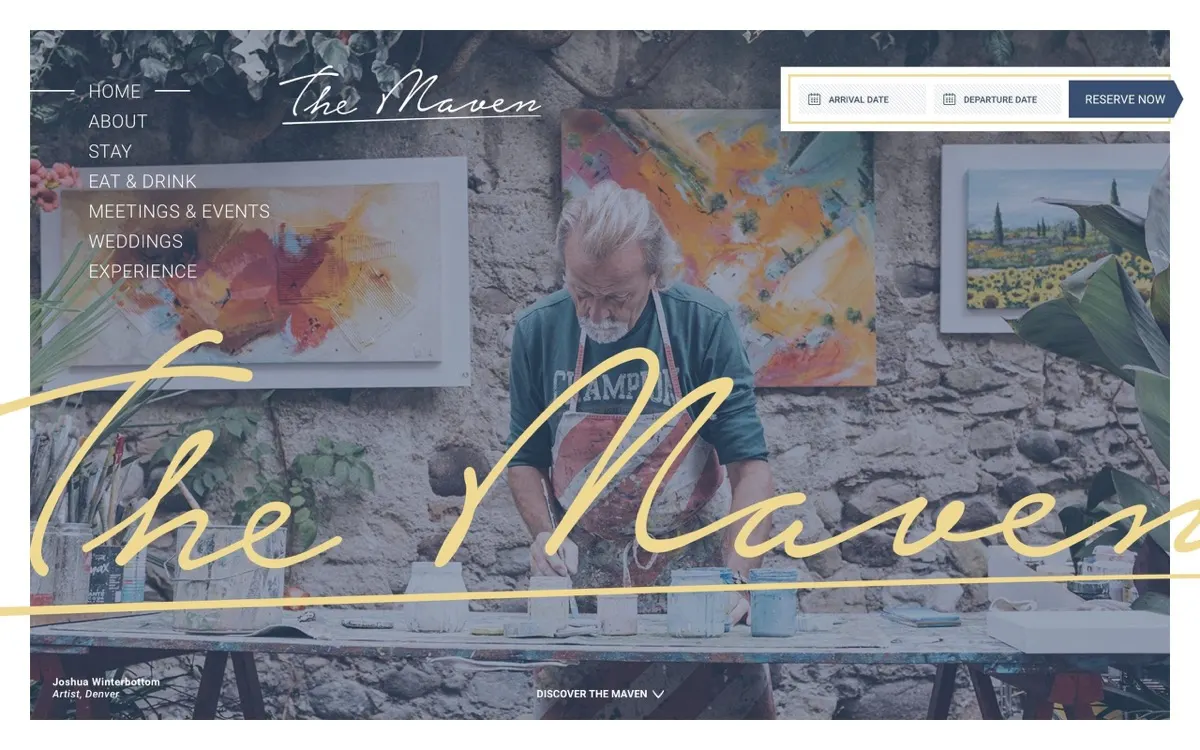
The Maven, original 2017 design screen. This illustrates visual hierarchy and booking placement; it does not establish current site behavior or a measured booking increase.
For your own brief, complete this sentence: “A guest should choose us because of ___, and the website can demonstrate it with ___.” If the second blank is empty, the project needs content work as well as design.
Choose the pages that answer real booking questions
A hotel website needs coverage of the stay, rooms, location, practical details and booking. The number of pages depends on how much useful information the property has and how different its audiences are.
Use this as a planning map, then combine or expand sections where the content justifies it:
| Page or section | Guest's question | What the brief should specify |
|---|---|---|
| Home | Is this the right kind of hotel for my trip? | Property identity, location, room overview and a visible booking route |
| Rooms and room details | Which room fits us? | Meaningful differences, accurate photos, occupancy and availability action |
| Offers | Is there a suitable package or reason to book direct? | Inclusions, eligibility, dates and the matching booking destination |
| Dining and amenities | What will the stay include? | Facilities, opening arrangements, charges and reservation requirements |
| Location | How do we get there and move around? | Address, arrival instructions, transport and verified local context |
| Gallery | Can I picture the actual stay? | Labeled room, bathroom, dining and shared-space photography |
| Practical information | What do I need to know before booking? | Check-in, pets, parking, property access and relevant policy links |
| Contact | How do I ask something the site cannot answer? | Working contact routes and who handles each type of enquiry |
Add weddings, meetings, spa or experiences when there is a real offer to explain. A separate wedding page earns its place when it can show spaces, capacities, practical arrangements and a useful enquiry route. A generic paragraph and a stock photograph rarely justify a new section.
Do not turn every item into a top-level navigation link. Practical information can sit beside the relevant decision and remain accessible from the footer. A compact property might combine dining and amenities; a resort with several restaurants may need individual venue pages.
Our hotel website design examples show different approaches to property identity and navigation. Use them to compare decisions, then choose a structure that fits your inventory and guests.
Make room pages useful enough to support a choice
A room page should explain what the guest is choosing, how it differs from the alternatives and how to check availability for that room type.
Include the facts that affect the stay: bed configuration, maximum occupancy, room size with units, bathroom arrangement, relevant access features, view and any meaningful limitations. Confirm those details with the property team. A photograph of one room should not imply that every room in the category has the same view or layout.
Give the photographer a shot list based on those questions. An atmospheric close-up may express the brand; a clear view of the room and bathroom helps someone understand the space. Use both where they serve different purposes.
Here is an illustrative room-content brief, not a description of a real hotel's inventory:
The Garden King category has one king bed and a maximum occupancy of two adults. A courtyard outlook is available in some rooms, so the page must distinguish a guaranteed view from a request. The room action should open availability for Garden King where the engine supports that selection. If that category is unavailable, explain the result and let the guest compare other rooms or dates.
That small brief gives the content writer, designer, reservations team and developer something they can all check. “A luxurious escape with every comfort” does not explain the same purchase.
If you display a starting price, define the stay conditions and how the number stays current. A static price with no clear basis can become misleading as inventory changes. Where a useful rate cannot be maintained, make checking availability straightforward. For a deeper look at rate presentation, see why an OTA can look cheaper than the hotel's own website.
Treat the booking handoff as part of the design
Hotel website development should include an agreed booking journey, not just a working link to another system. Specify what information should carry across and what the guest should see when their first choice is unavailable.
The public website and booking engine may have different owners. Put both in the brief. Identify who can change the engine's appearance, room names, rate plans, tracking and confirmation behavior, and which changes need the vendor's help.
Some engines support links that preserve a selection. For example, Mews documents booking-engine deeplinks with supported parameters for dates and other choices. That makes preselection something to investigate with your provider. It does not prove that your installed configuration already carries every selection correctly.
Ask the team to demonstrate these paths on a phone:
- A room-led booking: open a room page, choose dates and verify the intended room category in the engine.
- A changed plan: adjust dates or guest numbers and confirm the displayed selection updates clearly.
- An unavailable stay: show a useful explanation and an appropriate route to alternatives or assistance.
- A return to the website: check what happens when the guest goes back to compare rooms or policies.
- A completed reservation: use the provider's approved test process to verify the confirmation and the reservation record. Agree beforehand how test bookings and payments are handled.
Record the expected behavior and which team owns each failure. If the engine cannot support part of the intended journey, make that limitation visible before approving the design.
Put mobile, accessibility and search into acceptance criteria
Define checks that the team can demonstrate before launch. “Mobile friendly,” “accessible” and “SEO ready” are too broad to function as acceptance criteria on their own.
For mobile, review the actual room information, gallery and booking controls on representative phones. Test menus, date selection, text enlargement and slow connections. Check that a sticky booking button does not obscure content or another control. A desktop layout squeezed into a narrow screenshot does not complete this review.
For forms, require clear labels for arrival, departure, guests and enquiry fields. W3C's guidance on labeling controls explains the relationship between a field and its label, including support for assistive technology. Include keyboard operation, visible focus and understandable errors in the project's accessibility review. These examples are a starting point for a defined review, not a claim of complete conformance.
For search, agree descriptive page titles, sensible URLs, crawlable links and useful text about the actual property. Google's SEO Starter Guide supports these fundamentals. Give room and location pages enough substance to answer their own questions; repeating “luxury hotel” across thin pages does not create useful coverage.
The hotel's public content should describe the property and destination in guest language. “Hotel web design” is what an owner searches for when commissioning a website; it is not a phrase to insert into every guest-facing page.
On a redesign, include an inventory of existing URLs and a plan for pages that move or disappear. Our hotel website refresh diagnostic helps decide which problems need a targeted repair and which warrant a broader project.
Give content, measurement and maintenance an owner
The website brief is incomplete until it says who keeps the information accurate and how the team will assess the result.
Assign someone to approve room facts, replace seasonal offers, update dining hours and maintain event information. Have that person demonstrate the relevant editing tasks before handover. Include access to the site, domain, analytics and provider accounts in the delivery checklist.
Define what each measurement means. A click on Book is a handoff, not a completed reservation. Ask which booking outcomes the engine can report and how the site and engine will be connected in analytics. Google Analytics documents cross-domain measurement for journeys across domains; its setup requires compatible tagging and configuration. Verify the actual vendor arrangement before promising a complete funnel.
Keep a baseline where reliable data exists. Compare room-page visits, booking starts, confirmed bookings and qualified enquiries while noting changes in rates, campaigns and availability. Those factors affect interpretation; a rise after launch does not by itself prove that the design caused it.
Use this hotel website design brief before requesting quotes
Send prospective partners the same scope so their proposals describe comparable work. Include the booking provider and content responsibilities before discussing a launch date.
Download the editable hotel web design brief. It covers:
- Property and guests: the reason to choose the hotel, priority audiences and the questions they need answered.
- Pages and content: the sitemap, room categories, photography, copy and who approves each.
- Booking journey: the provider, selections to preserve, unavailable-stay behavior and test process.
- Quality checks: mobile tasks, accessibility review, search basics and any existing URLs to retain or redirect.
- Delivery and ownership: build scope, third-party fees, account access, editing, support and acceptance evidence.
- Measurement: the baseline, confirmed outcomes and known reporting gaps.
For hotel website design cost, compare those responsibilities rather than a page count alone. Copywriting, photography, migration, engine configuration and post-launch support can change the scope even when two proposals show the same sitemap. Ask each partner to state what is included, what depends on the vendor and what remains the hotel's job.
SUUR's hotel website design service brings product planning, visual design and development into the same engagement. I can help translate the property's identity into a clear site, work through the booking handoff and build the agreed experience. The first useful conversation is about the stay you sell, the questions guests ask and what your current systems can support.
Have a product idea?
Designed, built, and shipped in about 5 days.