Buy the Result, Not the Agent: A Bet for 2027
The companies that could use AI most are not asking for agents. They are asking to buy finished work from someone who is accountable for it. The job market is rough right now, and I do not mean the headlines; I mean the people I talk to. Candidates cannot find roles that match their experience, and employers cannot tell who to hire, because they are still re-learning how work gets done: what to hand to AI, where a person is still needed, who checks the result. Into that confusion walk vendors selling agent implementations. From inside the AI bubble it sounds obvious. The executives I talk to want something else. They want to pay for the result and stop managing every step of getting there. So my bet for 2027 is a specific kind of agency: one that builds AI into its own process first, then takes over a whole function for other companies, with human accountability inside the subscription. We run one. The numbers are below.
The market, from the ground
Nobody I speak to is hiring with confidence. On one side, experienced people cannot find roles that match what they have done, because the roles are being rewritten while they apply. On the other, employers who do need people cannot say what the job is anymore, because they have not decided what a person does versus what a model does, and who is responsible when the model is wrong.
Until that is settled you cannot even write the job description. So the role sits open, the work piles up, and somebody senior does it badly at eleven at night.
What companies are actually re-learning
Every company is quietly redoing the same exercise. Take a function, say inbound requests, and ask three questions. Which part is repetitive enough to hand to a model? Where does a person still have to think? Who signs off, and what happens when the output is wrong?
That is not a technology question. It is an operations question, and it takes months to answer honestly, because the answer is different for every function and it changes every time the tools improve. Most companies do not have a spare person to run that exercise. The people who could run it are the ones already carrying the function.
Why agent implementations do not sell
The pitch is that the tools are here and the ceiling is high, so let us build you an agent. Both halves are true. The problem is what it asks of the buyer.
An automation project is one more project. It needs a sponsor, a budget, someone to define the edge cases, someone to test it, someone to own it when the vendor leaves, and someone to babysit it when a model update changes its behaviour on a Tuesday. The executives I talk to already have a full plate. They do not want to learn agents. They want the inbox handled, the reports written, the leads answered, and a name to call when it goes wrong.
They want to buy the result. And with it, the right to stop managing every step of getting there.
The opening: take over a function
So the shape I would build, and the shape I am building, is an agency that does two things in order. First, it builds AI into its own process until the repetitive part of a function runs without a person touching every item. Second, it takes over that function for other companies, on terms the client can understand: the scope, the turnaround, and who is accountable.
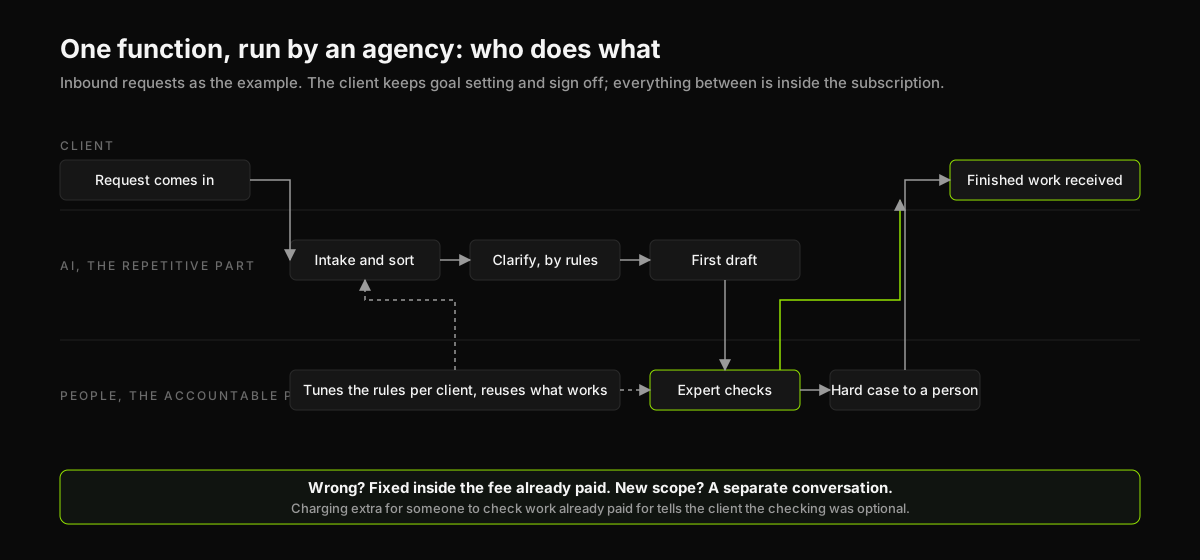
Inbound requests are the clean example. Intake, clarification, response, with the hard cases escalated to a person, delivered under a monthly fee. The client keeps goal setting and sign off. The agency keeps everything between.
Inside the agency
Inside, the division of labour is the one the client could not work out for themselves.
AI does the repetitive part: reading, sorting, drafting, checking against rules, producing the first version of everything. Experts tune it per client, because every client's rules are different, and they check the output, because the model is confidently wrong at a rate that is low but not zero. The weird cases go to a person, and the person is senior, because weird cases are where the client's reputation lives.
A process that works for one client gets reused across similar clients. That is the economics. More volume does not mean proportionally more people; it means the same people checking more output from a system that gets better with every client it serves.
Accountability has to be inside the subscription
This is the part that decides whether the model works, and it is the part vendors get wrong.
If the system gets it wrong, the agency fixes it as part of the work already paid for. Not as a change request, not as an hourly line, not as a support tier. The fix is the product. New scope, a change of strategy, a serious rebuild of the process: that is a separate conversation, and it should be. But charging extra for someone to check work you already paid for kills the whole thing, because it tells the client the checking was optional, and the checking is the reason they hired you instead of the tool.
My bet for 2027
Agencies like this become a real alternative to hiring for a chunk of office and knowledge work. Not a replacement for the people who set goals and sign off; a replacement for the open role nobody can define. You plug in the function with clear terms, you keep judgment in house, and you stop running a recruitment process for a job that is still being invented.
The companies that win will not be the ones with the best agents. They will be the ones with the clearest terms.
If you are learning AI right now
That is the opening. Not building agents to sell, but taking on the work other companies are finding harder and harder to organise themselves, and running it with AI inside your own process where nobody else has to understand it. They want to buy the result. Give them a scope, a turnaround, a price, and a name.
How we run it
We are a small studio, so the honest version of this is small, and it is measured.
Since 31 August we have published one researched page a day on this site. The repetitive part is done by AI inside our own process: pulling the schedule, reading vendor pricing pages, capturing screenshots, running the checks, drafting. The expert part is done by me: every price is read live and dated, every screenshot is our own, every claim is checked, and anything that cannot be verified is cut. The first three weeks produced 33 new pages. In the audit we ran on 19 September, page impressions in Google were up 83 percent against the equal period before, non-brand impressions up 138 percent, and 20 of those pages were already indexed. Zero clicks yet, which the audit says as plainly as it says the rest. A process that produces a verified page a day is the machine; publishing the audit, including the part that is not flattering, is the accountability.
The retainers we sell are the same shape, one function each, a price and a turnaround published before the first call. The Website Care Plan is $1,500 a month: hosting, updates, monitoring and eight senior hours, so the site is a function someone else runs. Conversion Optimization is from $3,500 a month for one shipped test a month, not a report about tests. The SEO and GEO retainer is $4,500 a month after an audit from $3,000, and the audit carries a published guarantee. The two newest are the shape of the essay itself: the Verified Content Desk, one checked page a week from $7,500 a month, and the Inbound Desk, your inbound answered by a person from $2,500 a month. Cadence is $4,900 a month for one design cycle a month, scoped in writing.
How the rest of the market sells the same thing, and what it publishes, is in product development agencies: how they work and cost. The rule across all of them is the one above. If it is wrong, we fix it inside the fee. If it is new, we talk. Nobody pays twice for the checking.
If you have a function you would rather buy than staff, tell us which one. The scope, the turnaround and the price come back in writing, and the name on it is mine.
Have a product idea?
Designed, built, and shipped in about 5 days.