AI Receptionists: The Future Is in the Follow-Through
AI receptionists can turn a phone call into a booked appointment, a qualified enquiry or a useful handoff. My view is that their next competitive advantage will come from completing those jobs reliably and giving staff control over the result. The voice gets someone through the conversation. The product has to carry the promise into the business.
That is an exciting design problem. A small service company can explore answering calls while its owner is working. A founder can build a receptionist for a specific industry, with the right questions and business rules built in. Both need to decide what the assistant can do, what requires a person, and how anyone knows the work actually happened.
Key Takeaways
- Choose between a ready-made receptionist and a platform for building one before comparing prices.
- Test the booking record, the human handoff and the recovery path alongside the conversation.
- Build custom software when your workflow or customer experience justifies owning the product and maintaining it.
In this article: The future of the front desk · Tools and vendors · What to evaluate · A worked booking flow · Buy or build · Working with SUUR
The future of the front desk is a shared workflow
I expect AI to take on more routine intake and scheduling, with people handling exceptions, relationships and decisions that need judgment. That is a product direction, not a forecast that every receptionist role will disappear.
Consider a home-service business. Its receptionist does more than answer. They establish whether a caller is in the service area, understand the job, find an appropriate slot and know when to involve a technician. An automated greeting covers a small part of that work. A useful AI receptionist needs access to the rules and systems behind the rest.
The ingredients already exist. Vapi's tool documentation describes assistants invoking actions such as looking up records, booking appointments and transferring calls. Crucially, it also tells developers to validate caller-influenced values at the destination. Connecting an assistant to an API gives it a capability; the application still has to decide which requests are valid.
That is where I see room for better products: a receptionist that understands one business well, makes its actions visible and leaves a clear next step for the team. Voice is the interface. Scheduling, customer records and staff decisions determine whether the service is useful.
Choose the kind of tool before choosing a vendor
A ready-made AI receptionist and a voice-agent platform solve different buying problems. The first provides a service you configure. The second gives you components from which to build a service and its surrounding software.
I publish AI Receptionists Ranked through SUUR LLC to make that market easier to inspect. The directory separates receptionists, voice-agent platforms and contact-center products. Its positions reflect published pricing and the completeness of public information, not our test calls or a performance score. Use it to create a shortlist, then test the shortlisted products against your own work.
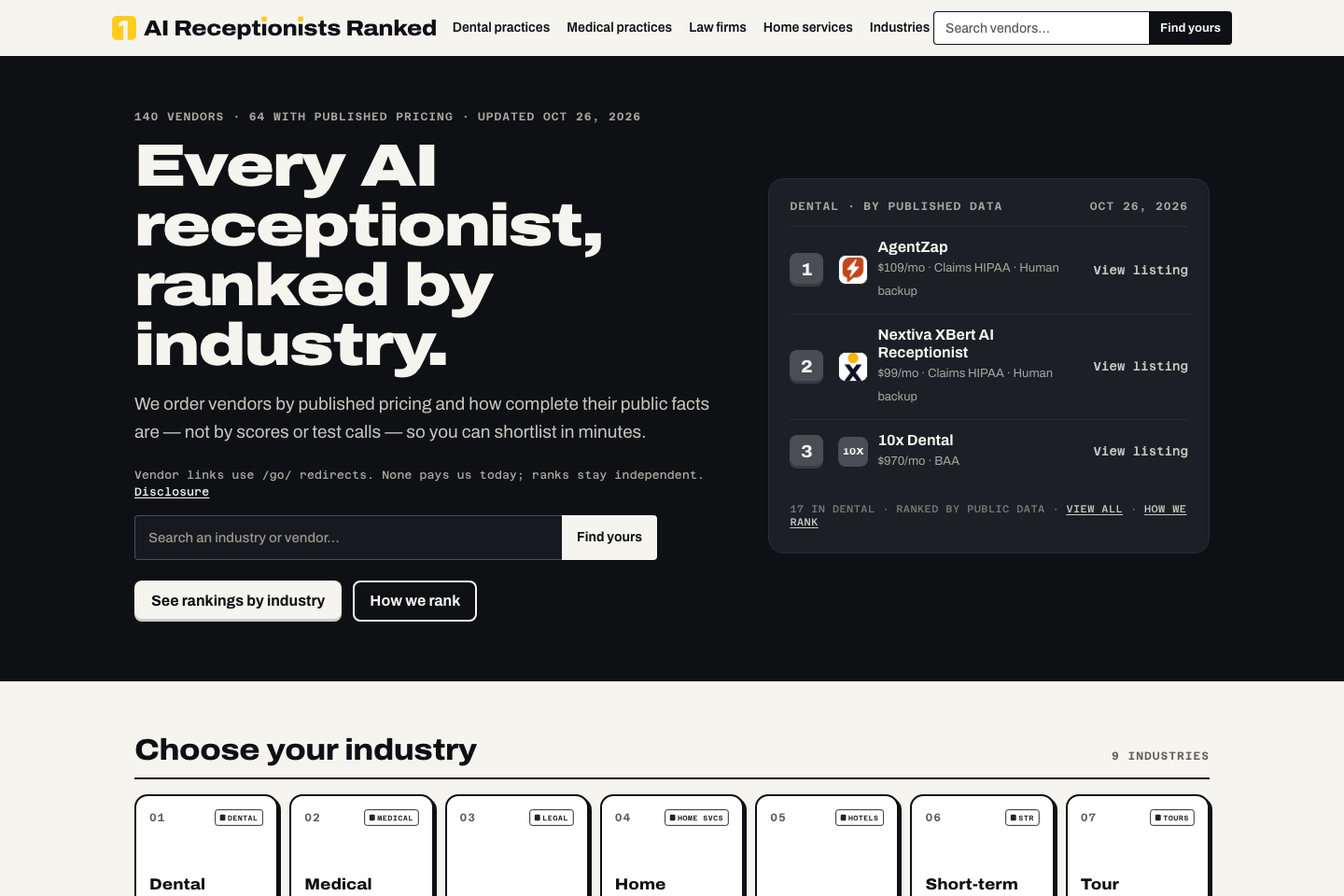
Our directory, captured October 28, 2026. This is a view of its listings, not evidence that we tested the products.
These four examples illustrate the choices. Product descriptions and prices below come from the vendors' own pages, checked October 28, 2026; this is a documentation comparison, not a hands-on ranking.
| Tool | What the vendor documents | What to establish before choosing it |
|---|---|---|
| Goodcall | A configured AI phone agent, with Starter at $79/month for 100 unique customers and $0.79 per additional customer | Whether its included tools connect to your workflow, and how its unique-customer billing maps to your callers |
| Smith.ai | AI intake, qualification and booking, with access to a live-agent network | Which calls reach its staff, how escalation is configured and which human involvement incurs an additional charge |
| Retell AI | A platform for building voice agents, with usage pricing and options for models, voices, telephony and add-ons | The full configuration cost and who will build and maintain the business integrations |
| Vapi | Configurable call transfers, including different warm-transfer modes and provider-dependent fallback behavior | Whether the chosen transfer mode works with your carrier and what happens when nobody answers |
For a business buying coverage, start with an industry list such as AI receptionists for home services. A plumbing company's service-area and dispatch rules differ from a hotel's room enquiries. An industry label is a starting filter; ask the vendor to demonstrate your actual calendar or operating system.
For a founder creating a product, the voice AI platform directory is the more useful starting point. Compare the infrastructure you can build on, then decide what your own product needs to own: onboarding, rules, integrations, staff controls and customer experience.
What matters once a real customer calls
Judge an AI receptionist by the business state it leaves behind. A fluent call can still end with the wrong appointment, an unanswered transfer or a message nobody owns.
Booking must mean a saved booking
Define success as an appointment saved in the correct system, for the agreed service, time and customer. Ask the assistant to read back important details. Require a successful system response before it says the booking is confirmed.
The integration also needs to handle a slot disappearing between lookup and confirmation. If a request times out, it should check whether the booking already exists before retrying. Otherwise, a helpful-sounding retry can create two appointments. Those are application design requirements; a prompt alone cannot guarantee them.
Human backup needs an owner and an outcome
“Can transfer calls” leaves several questions unanswered. Who takes the call? What context do they receive? What happens when the line is busy, goes to voicemail or nobody is on duty?
Retell's transfer documentation exposes choices such as how long the destination rings, what the receiving person hears and how an agentic transfer handles a timeout. Those settings are part of the customer experience. Choose them deliberately and test them with the people who will receive calls.
A missed handoff should create an assigned follow-up with the caller's request and an honest next step. A transfer attempt and an accepted handoff should appear as different outcomes in the staff interface.
Conversation quality includes correction
Test people interrupting, correcting their name, changing their mind and asking the same question differently. Include background noise and the languages your callers actually use. Evaluate whether they complete the task and understand what happened.
Design a short opening that identifies the business and the automated assistant. Let a caller request a person without navigating a verbal maze. When the system lacks an answer, give it a useful route: ask a clarifying question, take a message or transfer according to an agreed rule.
Data access should match the job
A receptionist taking a routine enquiry should collect only what that task needs. Decide who can read recordings and transcripts, how long they are kept, what can be deleted and which systems receive the information. Test those controls, including staff access, before using real customer data.
Treat sensitive workflows as a separate scope. A vendor badge does not specify your recording practices, permissions or entire data flow. Have the responsible business and its advisers establish the requirements before launch. This article evaluates product design; it does not certify a regulated deployment.
Cost follows the billing unit
Model your expected traffic against the actual charging rule. Goodcall's published Starter allowance counts unique customers, while Retell's pricing is based on voice-agent usage and selected components. These numbers cannot be compared as though they buy the same finished service.
For example, under Goodcall's published Starter rule, 150 billable unique customers would cost $79 + (50 × $0.79) = $118.50 before any other applicable charges. That is an illustration of one plan's arithmetic, not a quote or a comparison of product quality.
For a custom build, also budget for implementation, ongoing review and maintenance. Track cost per correctly completed task alongside the phone bill. Cheap minutes are of limited value if staff must reconstruct the conversation afterward.
A booking flow worth prototyping
Start with one complete customer job and design its failure paths at the same time. The following is an illustrative scope for a home-service company, not a report of a SUUR client deployment or a tested vendor.
A caller wants an appointment to repair a leaking tap. The business handles routine repairs within a defined service area. Its staff have approved the questions and escalation rules.
| Moment | Intended behavior | Evidence the operator should see |
|---|---|---|
| Understand the request | Confirm the repair type and service address; route excluded requests to the agreed alternative | Structured request and service-area result |
| Offer a slot | Read available appointments from the booking system, including the relevant time zone | Availability response and selected slot |
| Confirm the appointment | Read back details and save once; announce confirmation only after success | Booking ID and saved appointment |
| Handle a failed save | Check for an existing booking; offer another slot or explain that a person must follow up | Failure reason and assigned next action |
| Reach a person | Send context to the right staff member and track whether they accept | Accepted handoff or a pending callback with an owner |
The operator needs a small, usable workspace for that evidence. A call summary should show what the caller wanted, which action succeeded and what remains unresolved. Staff should be able to correct a detail and resolve a follow-up without reading an entire transcript.
This also creates a test plan. Run the same scenarios before and after changes to prompts, integrations or providers. Count bookings only when the booking system confirms them. Review a sample of calls for incorrect details and abandoned tasks. Define the pilot's acceptance criteria before looking at its results.
When to buy, and when to build
Buy a ready-made receptionist when an existing product covers your call types, integrations and operating rules well enough. A business that needs basic after-hours answering should test that path before commissioning its own software.
Build a custom product when owning the workflow creates value: unusual qualification rules, several connected systems, a distinctive service experience or software you intend to sell to an industry. You can still buy the voice infrastructure. The custom work can concentrate on the business logic and the interfaces your customers and staff use.
Write down the gap you are paying to close. “We want AI” is too broad. “A caller can book the right technician across three locations, and the dispatcher can review exceptions” is specific enough to investigate. Our guide to scoping an MVP shows how to turn that outcome into a release and a cut list.
How SUUR can design and build it
SUUR can help turn that defined workflow into a product: map the service, design the caller and staff experiences, connect the chosen infrastructure and build the software around it. The first step is agreeing on one useful outcome and proving that the required systems can support it.
Our TripLeads.AI work is relevant experience in conversational intake and the interface that makes its output useful to a team. It is a travel enquiry product, not evidence that we have deployed the phone receptionist described above. The transferable design question is how a conversation becomes structured work somebody can act on.
For an AI receptionist, I would scope the work in four parts:
- Service and conversation design. Identify caller needs, required details, business rules, tone and escalation paths. Define the behavior for a correction or an unsupported request.
- A focused working flow. Connect the voice platform to the necessary calendar or CRM, validate actions and make success and failure explicit. Start with one business workflow and controlled test calls.
- The operator experience. Build the call inbox, outcome view and follow-up queue. Add permissions and the settings staff need to manage hours, approved answers and routing.
- A measured pilot. Agree on a limited rollout, review actual outcomes and resolve failures before widening the scope. Include ownership of support, usage costs and future changes in the handover.
A narrow first version may fit a SUUR Product Sprint after we confirm scope and integration access. An unfamiliar phone system, sensitive-data requirements or a platform serving many customer businesses needs its own estimate. For continuing product design and engineering, Product Partner provides an ongoing engagement.
Bring the calls you want to handle, the systems you already use and the moment where work currently gets lost. We can use those to define a receptionist that delivers a useful result for the caller and a manageable workload for your team.
Have a product idea?
Designed, built, and shipped in about 5 days.