MVP vs Prototype vs Proof of Concept: Which First?
Start with the experiment that addresses the most consequential uncertainty at a reasonable cost. A proof of concept emphasizes feasibility, a prototype explores a proposed experience, and an MVP supports a bounded real-world learning objective. Their forms overlap: a prototype can contain code, a PoC can involve users, and an MVP need not test payment. There is no mandatory sequence. Supplier labels also differ, so the dated price examples below should be compared by scope.
Key Takeaways
- Match the experiment to the uncertainty, not a fixed sequence.
- Record what is real, simulated or manually supported.
- A working artifact alone does not prove demand or scalability.
- Compare supplier deliverables and terms before comparing labels or prices.
Three questions, three different things
The labels emphasize different purposes, but an artifact can inform more than one question. A coded prototype might reveal usability and integration problems; a manually supported MVP might test demand without a complete backend. Eric Ries's MVP guide places customer learning at the center, rather than prescribing a particular software form.
| Proof of concept | Prototype | MVP | |
|---|---|---|---|
| Typical question | Can a critical approach work under specified conditions? | How do people understand or use this proposed experience? | What happens when real users encounter the limited offer or service? |
| Possible form | A technical test, integration or model evaluation | Sketches, clickable screens or coded interaction | Limited software, manual service or a combination |
| Participants | Engineers and, where relevant, users or domain specialists | Target users, team members or other stakeholders | People in the intended use context |
| Evidence | Outputs against acceptance conditions | Observed tasks, comprehension and reactions | Behavior relevant to the learning question |
| Common limit | Feasibility does not by itself establish demand | Stated interest does not prove sustained adoption | Small-scope results do not establish scalability |
| Published prices, 18 October 2026 | just under $4,000 for seven days (HouseofMVPs) | $5,000 to $15,000 (Purrweb); $10,000 (Upsilon) | From just under $4,000 (HouseofMVPs) to the $80,000 top of Purrweb's range |
Estimate both the cost of the experiment and the consequence of leaving the uncertainty unresolved. Technical feasibility may come first for an unusual integration; demand may come first when engineering is familiar but the customer need is uncertain.
What studios charge for each, on 18 October 2026
The names in a supplier's catalogue are not a common specification. These dated examples illustrate that ambiguity; they do not establish a price or timetable for every PoC, prototype or MVP. Compare the actual experiment, code quality, data handling, deployment and handoff before treating two packages as equivalent.
These five suppliers had published examples in our October 18, 2026 check. Primary pages: HouseofMVPs, Ronas IT, Upsilon and Purrweb. Our own offers are included and identified. "No tier" means none on the page checked; figures are historical advertised terms, not current quotes or independently experienced delivery.
| Studio | Proof of concept | Prototype | MVP |
|---|---|---|---|
| HouseofMVPs | just under $4,000 fixed, 7 days | No tier | Validate just under $4,000 in one week, Launch $7,499 in two, Scale from $14,999 |
| Ronas IT | No tier; an analysis phase that includes a technical feasibility assessment, $1,000 to $2,000 | No tier; a design concept on one or two key screens from $1,000 | Basic MVP from $5,000, from two weeks; extended from $10,000 |
| SUUR | Not sold on its own | Design Sprint $6,000: up to about 15 screens, design only, about five business days | Product Sprint $9,000: up to 10 screens, design and code, five business days |
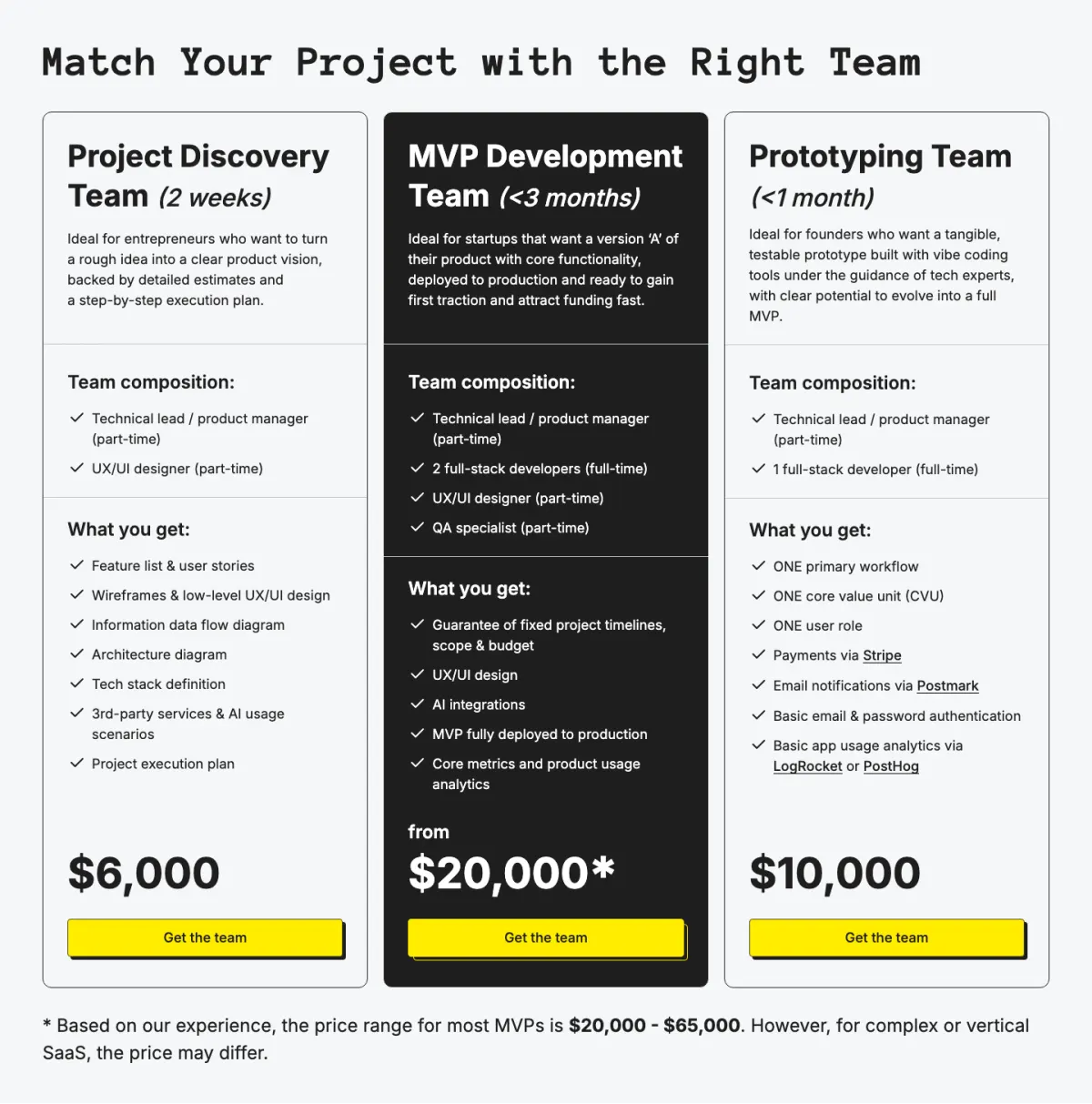
| Upsilon | No tier; a two-week discovery team for $6,000 | Prototyping Team $10,000, under a month | From $20,000, under three months; "most MVPs" $20,000 to $65,000 |
| Purrweb | No separate price; a "killer feature" prototype is part of its MVP process | $5,000 to $15,000, three to six weeks, per its FAQ | $25,000 to $40,000 on its estimate; $30,000 to $80,000 and three to four months in its FAQ |
Three things stand out.
The labels do not line up. Upsilon's captured prototype offer includes Stripe payments, sign-in and usage analytics for one workflow and role. Those capabilities could support a real-world experiment, but its readiness and purpose still need agreement. The label alone does not make it equivalent to another supplier's MVP.
One studio lists similarly priced PoC and MVP offers. HouseofMVPs advertised both at just under $4,000, with a one-week scope and a core feature delivered to production. Its PoC offer also described user access at launch and credit toward a later MVP. Similar prices and descriptions do not establish identical terms; confirm the specific experiment and handoff.
Purrweb describes particular deliverables. Its captured FAQ distinguishes a Figma simulation from working software with accounts and data. The historical ranges were $5,000 to $15,000 and $30,000 to $80,000 respectively. These are that supplier's categories, not universal definitions.
When a studio quotes an experiment, ask what will exist, who will use it, what evidence it should collect and what is excluded. Sign-in and payment are features, not sufficient definitions of an MVP. The MVP supplier comparison adds scope and price examples.
Which comes first, by situation
| Your situation | Build first | Why |
|---|---|---|
| A model, OCR engine or data source may not meet the task requirements | Feasibility test | Evaluate representative inputs and explicit acceptance conditions before relying on the output |
| It needs an integration with a closed or poorly documented system: a bank, a hotel PMS, a device | Proof of concept | Test the real connection before designing screens that assume it works |
| A new kind of interaction most users have not seen | Prototype | Confusion shows up in a clickable test, for the price of screens rather than code |
| A familiar workflow, with uncertain switching or payment | A real-world pilot or offer test | Choose observable commitments suited to the question; stated preference is weaker evidence |
| A two-sided marketplace | Test the uncertain side first | Recruitment or a manually brokered transaction may answer an earlier question than a full platform |
| An internal tool replacing a spreadsheet | Prototype or limited pilot | Verify workflow, data and integration assumptions rather than presuming they are settled |
| You need to explain an investment proposal | A clearly labeled demonstration | It can explain the concept; do not present simulated use as traction |
Where each one goes wrong
The proof of concept promoted without review. Experimental code may omit protections needed for broader use. Inspect error handling, data boundaries, maintainability and tests before reuse. Some code should be replaced; some can be retained after appropriate work.
The prototype whose evidence is overstated. Stated interest is a reaction under the session's conditions. Task observations provide different evidence, and either can be useful. Record recruitment, prompts and simulated behavior before drawing conclusions about real adoption.
The MVP with no learning decision. Define the assumption, evidence and next action. Evidence may include qualitative observations as well as a numerical metric. What an MVP means explains the distinction from simply shipping a small first version.
What we build for each stage
We do not sell a proof of concept on its own. When the technical risk is a model call, the MVP can test it: our Product Sprint page says that increasingly, what the sprint builds is "a product whose core feature is a model call, with the prompts, the streaming interface, the failure states, and a small eval suite shipped in the same five days."
Our Overseer concept for Apstra illustrates a prototype spanning a world view down to device detail. It demonstrates a proposed interface, not live global operations or proof of agreement from every stakeholder. For this kind of design work, our Design Sprint offers an agreed scope of up to about fifteen Figma screens and their specified states in about five business days for $6,000, design only. Define which decisions user testing should inform.
For implementation, the Product Sprint is $9,000 for an agreed five-business-day scope: one or two core flows, up to ten screens, design and code handoff. Deployment and mobile release responsibilities must be specified; external approvals are not guaranteed by the build window. The MVP scope estimator provides an initial scope check, not a feasibility or delivery guarantee.
Quick answers
Is a prototype the same as an MVP?
They usually answer different questions, but suppliers use the labels differently. A prototype can test comprehension or interaction, while an MVP supports a bounded real-world learning objective. Some coded prototypes also collect usage evidence. State what the experiment can establish instead of relying on the name alone.
Which comes first, a proof of concept or a prototype?
Start with feasibility work when a technical uncertainty could invalidate the proposed approach. Start with a prototype when understanding or interaction is the more consequential uncertainty. Other questions may call for a different experiment altogether.
Can a prototype turn into an MVP?
Sometimes. Review which design decisions and code remain useful, and which need replacement before the intended use. Reuse depends on implementation quality, permissions, reliability and scope, not the artifact's original label.
How long does each take?
On the pages we read: seven days for HouseofMVPs' PoC; under a month at Upsilon or three to six weeks at Purrweb for a prototype; and from one week to three or four months for an MVP, with our Product Sprint at five business days. What moves the price of an MVP is in how much an MVP costs.
Sources, read on 18 October 2026: the pricing pages of HouseofMVPs, Ronas IT and Upsilon (dedicated teams), and Purrweb's MVP development page including its FAQ; SUUR prices from suur.io/design-sprint and suur.io/mvp; the Overseer case study at suur.io/work/overseer-2020. Studio prices in US dollars as each page displayed them.
Have a product idea?
Designed, built, and shipped in about 5 days.