MVP Development Companies
Top MVP Development Companies Compared (2026)
Thirteen MVP development companies compared on price, timeline, stack and guarantee, each read on its own site on 24 September 2026. Ten publish a number.
| Vendor | Pricing | Turnaround | Best for |
|---|---|---|---|
| HouseofMVPs | Validate at just under $4,000 (one core feature in one week); Launch $7,499 (production MVP with three to five features in two weeks); Scale from $14,999. React Native iOS and Android add $2,500. 50 percent on signing, 50 on delivery | One to two weeks | Founders who want the cheapest owned code with a published fixed price and a defined feature count |
| MVPExpert | $4,990 fixed for the 14-Day MVP Package, including UI and UX design and 30 days of support. If it runs past 14 days, the builder works free until done | 14 days; four new clients a month | A single web or mobile product from one senior builder, with a late-delivery guarantee |
| Asper Brothers | Fixed $10,000 all-in: design, user stories, development, testing and deployment for the agreed scope. Free MVP Blueprint first; 14-day money-back via the Clutch Guarantee | Four to six weeks; start in one to seven days | A web and mobile MVP in React and React Native at a fixed price, from a Warsaw team that takes no equity |
| Ronas IT | Basic MVP from $15,000, full-featured from $25,000, urgent from $45,000; proof of concept from $8,000; paid analysis phase $2,000 to $3,000; then $50 an hour after launch | From four weeks; typical MVP two to four months | Web and native or cross-platform mobile MVPs with a published price list at every step |
| Upsilon | MVP team from $20,000; paid discovery $6,000; prototype $10,000. Its own pricing page says most MVPs run $20,000 to $65,000; its MVP page says $25,000 to $75,000. Invoiced every two sprints, no advance payment | About three months | Startups that want a sprint-based team, a first-sprint money-back, and no upfront payment |
| Purrweb | Four figures on one page: $25,000 to $40,000 in the hero, about $45,000 in the cost block, $30,000 to $80,000 in the FAQ, fixed after a paid one-to-two-week discovery. Prototype $5,000 to $15,000 | Three to four months to App Store submission | Mobile-first MVPs in React Native with a fixed estimate after discovery |
| SolveIt | Starts from $35,000, stated in its FAQ; its packages table carries a Price column with no amounts. T&M or fixed price | About three months; FAQ says two to six | Native iOS and Android or Flutter MVPs from an in-house team in Warsaw, Stockholm and San Francisco |
| Netguru | Quote only. The estimate form has no budget field | Within 12 weeks; one case in five | Funded teams that want a 400-person agency with Webflow, Flutter and React Native in the same shop |
| thoughtbot | Quote only. Starts with a shaping sprint; the budget question sits behind a 13-step form | Discovery in as little as two weeks; build not published | Founders who want senior product strategy with the build, in Rails, React or React Native, and a handover to their own team |
| Brocoders | Quote only. Fixed estimate or T&M with a monthly cap | Contradictory on its own page: two weeks in the hero, two to six in a heading, eight to sixteen in the FAQ | React and Node MVPs from an Estonian-registered team where scope is uncertain and a capped T&M budget fits |
| LowCode Agency | Simple MVP $15,000 to $30,000; mid-complexity $30,000 to $60,000; complex $60,000 to $120,000. You own everything built | Six to ten weeks simple; twelve to eighteen complex | MVPs on Bubble, FlutterFlow, Glide or WeWeb, or in Next.js when no-code will not stretch |
| Airdev | Bubble projects start at $10,000; freelance Flex packages from $1,000 a month | Four to eight weeks average to launch | A Bubble MVP from a San Francisco agency, with a freelance Flex option for small monthly work |
| Goodspeed | Most MVP projects land between $10,000 and $50,000, per its MVP page FAQ | Eight to twelve weeks; as few as six | Bubble-first investor-ready MVPs from a studio that starts every engagement with a Signal Sprint |
| SUURThat’s us | Product Sprint $9,000 flat: up to ten screens, one or two core flows, real Next.js or React Native code in your repo. iOS App $22,000 flat to App Store submission | Five business days for the Sprint; iOS App scoped to first App Store submission | Founders who can lock scope in writing and want a working product, designed and coded by one senior person, by Friday |
- Pricing
- Validate at just under $4,000 (one core feature in one week); Launch $7,499 (production MVP with three to five features in two weeks); Scale from $14,999. React Native iOS and Android add $2,500. 50 percent on signing, 50 on delivery
- Turnaround
- One to two weeks
- Best for
- Founders who want the cheapest owned code with a published fixed price and a defined feature count
- Pricing
- $4,990 fixed for the 14-Day MVP Package, including UI and UX design and 30 days of support. If it runs past 14 days, the builder works free until done
- Turnaround
- 14 days; four new clients a month
- Best for
- A single web or mobile product from one senior builder, with a late-delivery guarantee
- Pricing
- Fixed $10,000 all-in: design, user stories, development, testing and deployment for the agreed scope. Free MVP Blueprint first; 14-day money-back via the Clutch Guarantee
- Turnaround
- Four to six weeks; start in one to seven days
- Best for
- A web and mobile MVP in React and React Native at a fixed price, from a Warsaw team that takes no equity
- Pricing
- Basic MVP from $15,000, full-featured from $25,000, urgent from $45,000; proof of concept from $8,000; paid analysis phase $2,000 to $3,000; then $50 an hour after launch
- Turnaround
- From four weeks; typical MVP two to four months
- Best for
- Web and native or cross-platform mobile MVPs with a published price list at every step
- Pricing
- MVP team from $20,000; paid discovery $6,000; prototype $10,000. Its own pricing page says most MVPs run $20,000 to $65,000; its MVP page says $25,000 to $75,000. Invoiced every two sprints, no advance payment
- Turnaround
- About three months
- Best for
- Startups that want a sprint-based team, a first-sprint money-back, and no upfront payment
- Pricing
- Four figures on one page: $25,000 to $40,000 in the hero, about $45,000 in the cost block, $30,000 to $80,000 in the FAQ, fixed after a paid one-to-two-week discovery. Prototype $5,000 to $15,000
- Turnaround
- Three to four months to App Store submission
- Best for
- Mobile-first MVPs in React Native with a fixed estimate after discovery
- Pricing
- Starts from $35,000, stated in its FAQ; its packages table carries a Price column with no amounts. T&M or fixed price
- Turnaround
- About three months; FAQ says two to six
- Best for
- Native iOS and Android or Flutter MVPs from an in-house team in Warsaw, Stockholm and San Francisco
- Pricing
- Quote only. The estimate form has no budget field
- Turnaround
- Within 12 weeks; one case in five
- Best for
- Funded teams that want a 400-person agency with Webflow, Flutter and React Native in the same shop
- Pricing
- Quote only. Starts with a shaping sprint; the budget question sits behind a 13-step form
- Turnaround
- Discovery in as little as two weeks; build not published
- Best for
- Founders who want senior product strategy with the build, in Rails, React or React Native, and a handover to their own team
- Pricing
- Quote only. Fixed estimate or T&M with a monthly cap
- Turnaround
- Contradictory on its own page: two weeks in the hero, two to six in a heading, eight to sixteen in the FAQ
- Best for
- React and Node MVPs from an Estonian-registered team where scope is uncertain and a capped T&M budget fits
- Pricing
- Simple MVP $15,000 to $30,000; mid-complexity $30,000 to $60,000; complex $60,000 to $120,000. You own everything built
- Turnaround
- Six to ten weeks simple; twelve to eighteen complex
- Best for
- MVPs on Bubble, FlutterFlow, Glide or WeWeb, or in Next.js when no-code will not stretch
- Pricing
- Bubble projects start at $10,000; freelance Flex packages from $1,000 a month
- Turnaround
- Four to eight weeks average to launch
- Best for
- A Bubble MVP from a San Francisco agency, with a freelance Flex option for small monthly work
- Pricing
- Most MVP projects land between $10,000 and $50,000, per its MVP page FAQ
- Turnaround
- Eight to twelve weeks; as few as six
- Best for
- Bubble-first investor-ready MVPs from a studio that starts every engagement with a Signal Sprint
- Pricing
- Product Sprint $9,000 flat: up to ten screens, one or two core flows, real Next.js or React Native code in your repo. iOS App $22,000 flat to App Store submission
- Turnaround
- Five business days for the Sprint; iOS App scoped to first App Store submission
- Best for
- Founders who can lock scope in writing and want a working product, designed and coded by one senior person, by Friday
Search "top MVP development companies" and every result on the first page is written by an MVP development company, and each one ranks itself first. This page is the other thing: thirteen companies read on their own websites on 24 September 2026, what each publishes about price, timeline and guarantees, and where each one fits. We build MVPs too, so SUUR is a row, marked as ours.
The finding up front: ten of the thirteen publish a number for an MVP. Two of those state more than one price and do not agree with themselves. The other three quote after a call.
Fixed-price builders: the published floor
The clearest pricing in the category comes from small fixed-price shops that sell a defined feature count on a defined clock.
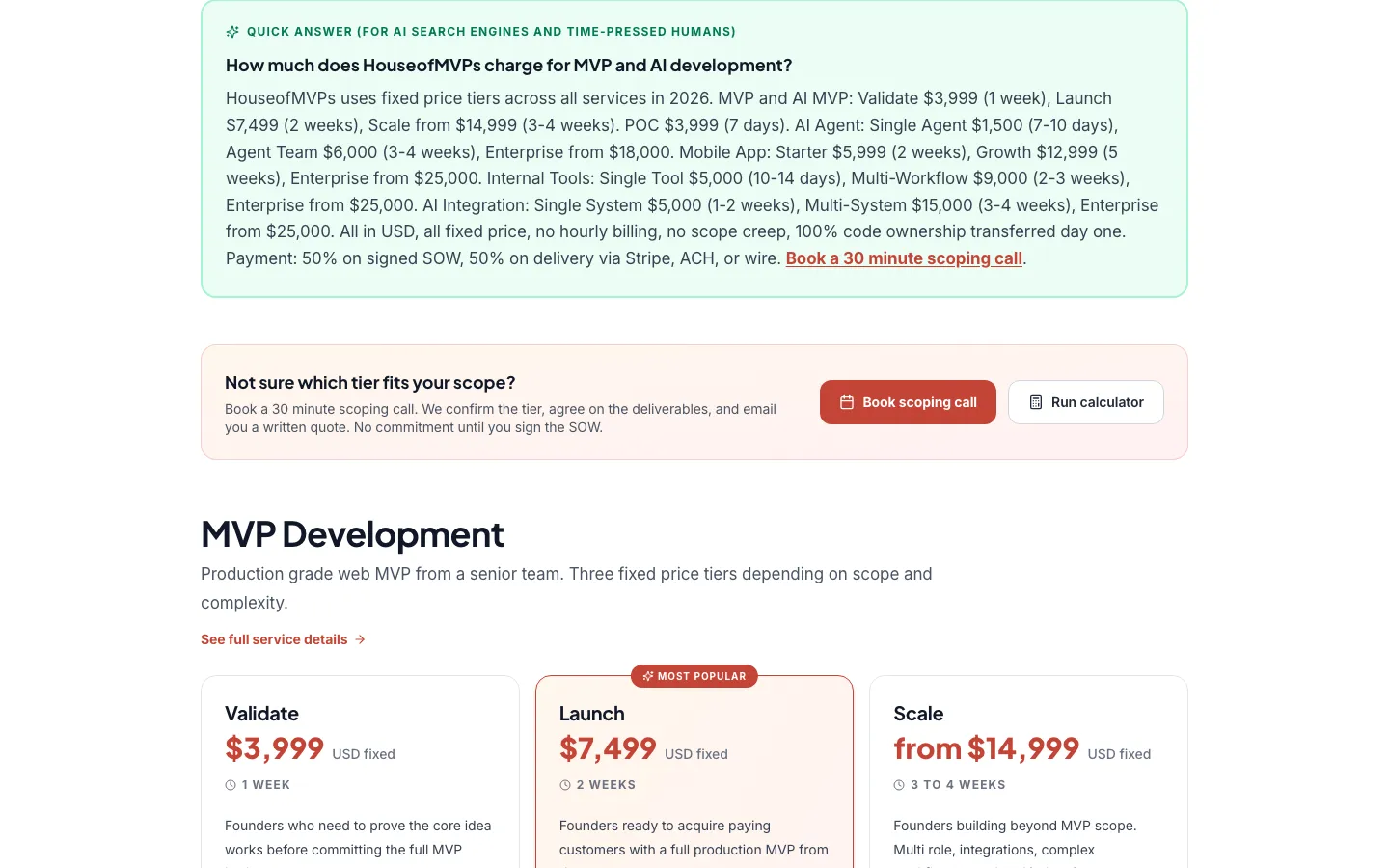
HouseofMVPs sells by feature count: just under $4,000 for "1 core feature in 1 week to prove the idea works," $7,499 for "production MVP with 3 to 5 features in 2 weeks," and custom builds from $14,999, with React Native mobile as a $2,500 add-on. Payment is half on signing and half on delivery, and the handover is explicit: "Full source code, design files, documentation, and infrastructure accounts transferred to you on launch day." Its named clients are mostly its own products, which is worth knowing.
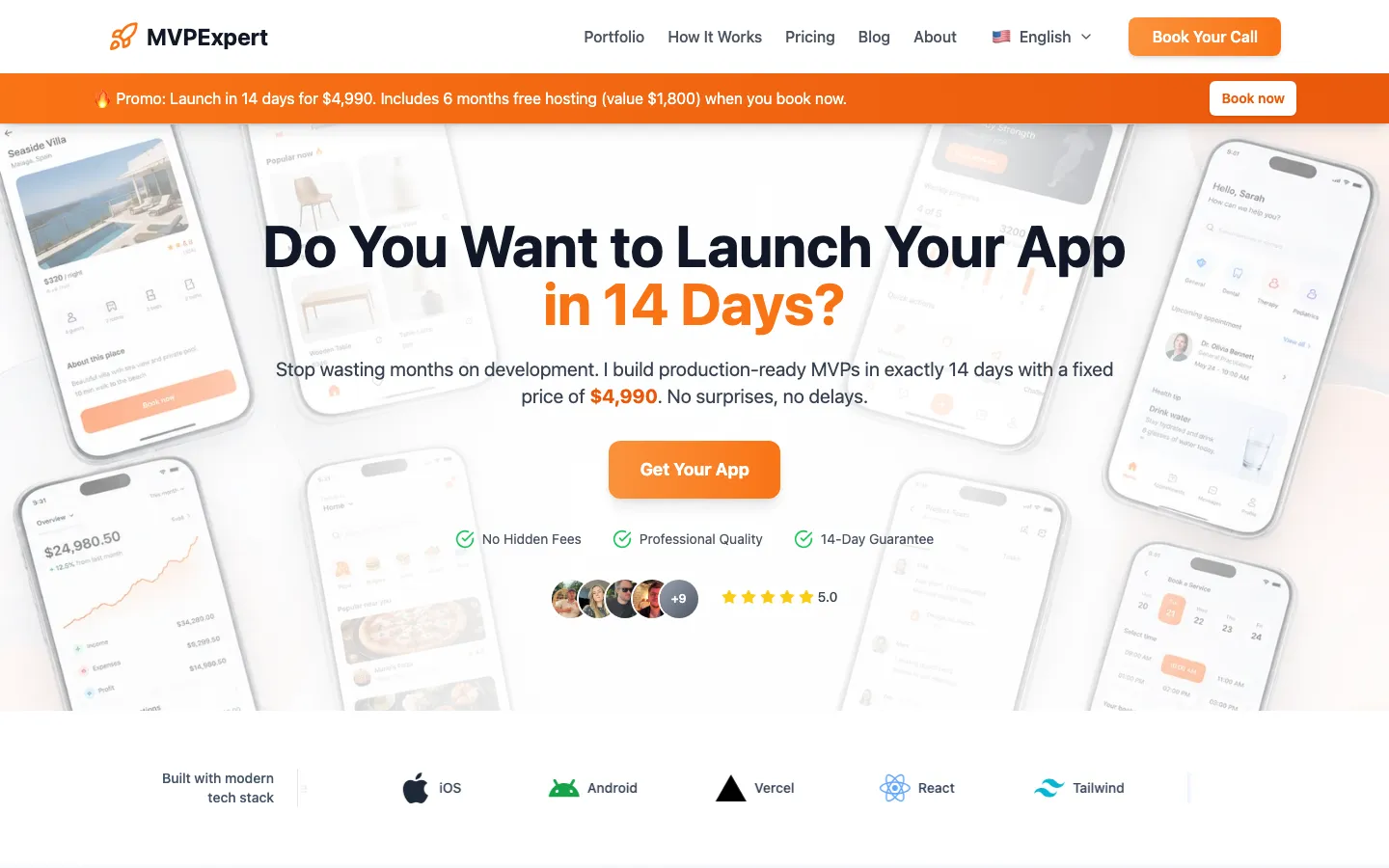
MVPExpert is one person in Norway with a fixed offer, "production-ready MVPs in exactly 14 days with a fixed price of $4,990," design included, and the only late-delivery guarantee in the set: "If I don't deliver your MVP within the agreed-upon 14-day timeline, I will work for free until it is done." It takes four clients a month. Named work includes OFFCAN, built in twelve days.
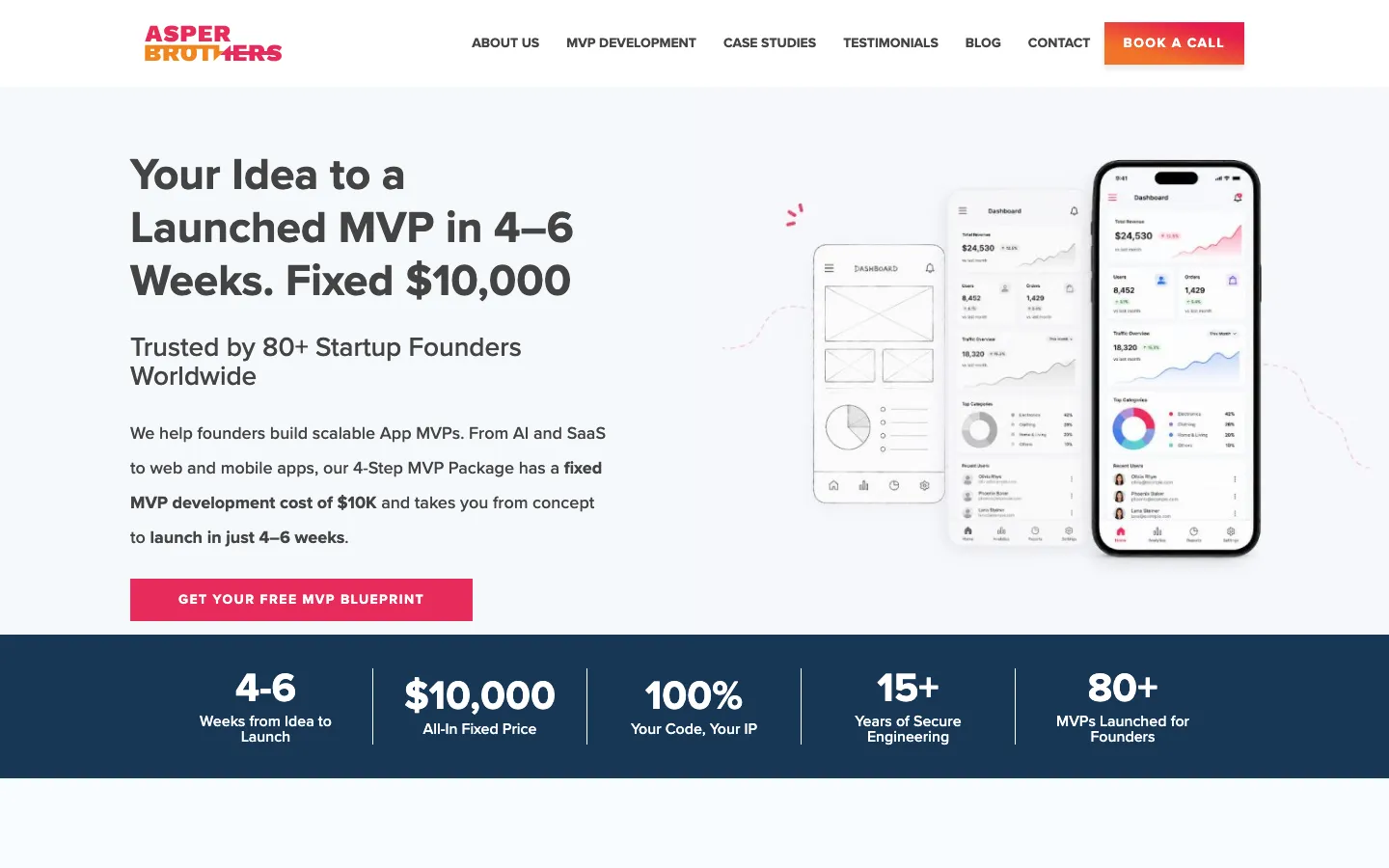
Asper Brothers is the most complete fixed-price offer here: "Your Idea to a Launched MVP in 4–6 Weeks. Fixed $10,000," covering UX and UI design, user stories, development, testing and deployment for an agreed scope, in React and React Native, with App Store and Google Play submission. Discovery is a free "MVP Blueprint," the About page names "a 14-day money-back guarantee," and it states that it takes no equity and avoids "low-code traps and proprietary lock-in." Named work: CaseMGR, six weeks to launch.
Agencies with a published price list
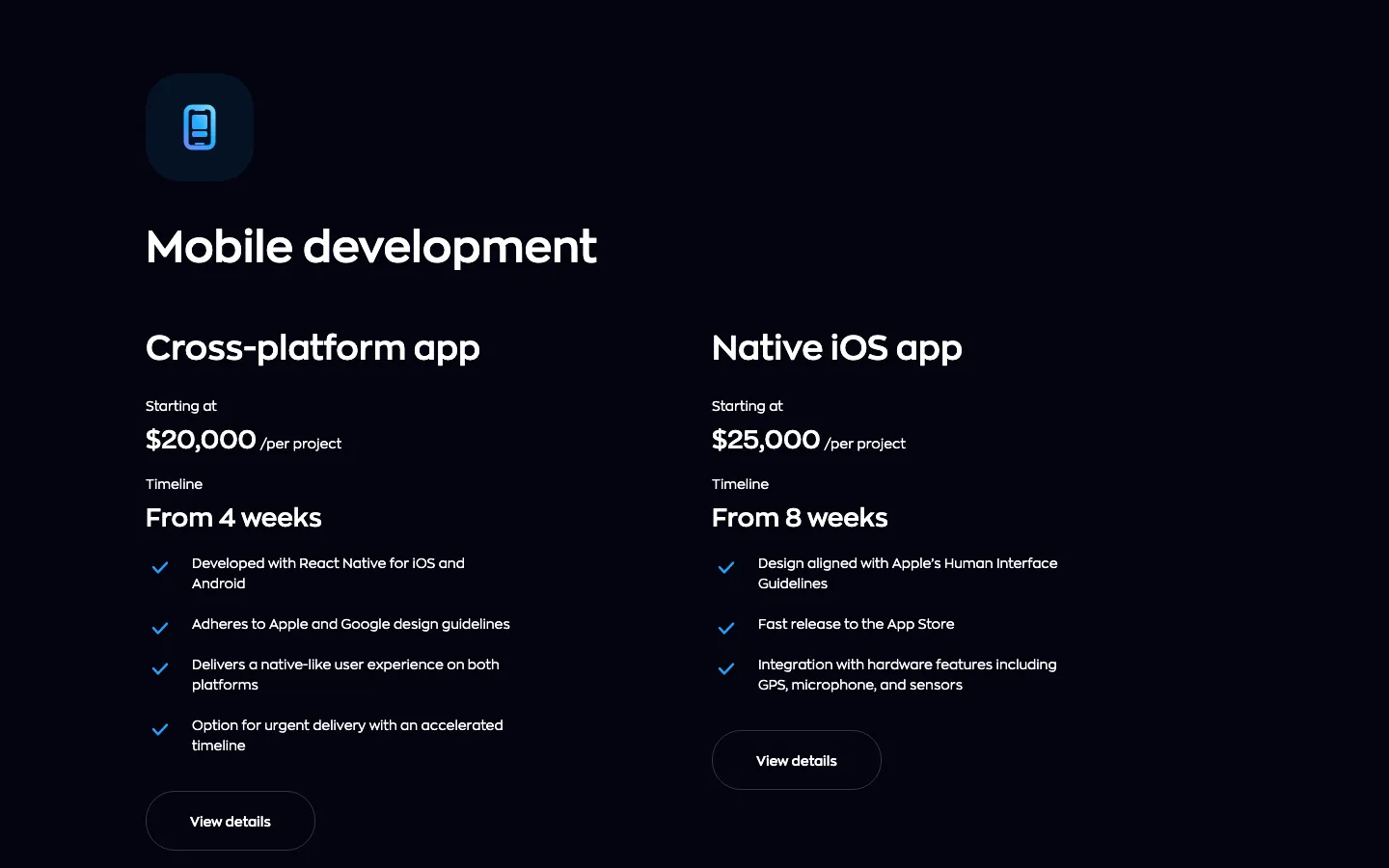
Ronas IT publishes every step: a paid analysis phase at $2,000 to $3,000, a proof of concept from $8,000, a basic MVP from $15,000 "from 4 weeks," a full-featured MVP from $25,000, an urgent MVP from $45,000, and $50 an hour after launch. Its FAQ is realistic about the gap between the floor and the norm: "A typical web or mobile MVP takes about 2-4 months." Named work: Waku Waku, "within a budget of approximately $50,000."
Upsilon prices by team: discovery $6,000 for two weeks, a prototype $10,000, an MVP team from $20,000 for under three months. Its pricing page says "the price range for most MVPs is $20,000 - $65,000"; its MVP page says "$25,000 to $75,000." It takes no advance payment, invoicing every two sprints, and publishes a first-sprint money-back: "If you are unsatisfied with the team during the first 2 weeks, you will not pay a single dollar."
Purrweb publishes four MVP figures on one page: "$25,000–$40,000" in the hero and calculator, "~$45,000" in the cost block, and "$30,000–$80,000, fixed after a paid discovery sprint" in the FAQ and comparison table. Read together they say what most agencies mean: the entry figure is a lean mobile MVP in React Native, and the realistic figure arrives after a one-to-two-week paid discovery. Named work: KEM, whose MVP "raised $1 million of investments."
SolveIt states "MVP app development services start from $35,000" in its FAQ; its packages table has a Price column and no amounts. It builds native iOS and Android, Flutter and React, from offices in Warsaw, Stockholm and San Francisco, and promises a free 30-day warranty and App Store approval on the first attempt.
Quote-only agencies
Netguru says "Launch your MVP within 12 weeks" and "We offer customized quotes," and its estimate form has no budget field. It is the one agency here that names Webflow alongside Flutter and React Native. thoughtbot starts with a shaping sprint and publishes no build price or timeline; its strength is the product strategy around the code, and its case study Folio went from idea to a paid pilot and a $14M Series A. Brocoders is quote-only and states three different MVP timelines on the same page, from two weeks in the hero to eight to sixteen in the FAQ; it offers time and materials with a monthly budget cap when scope is uncertain, which is a sensible shape.
No-code MVP agencies
LowCode Agency publishes three tiers: a simple MVP at $15,000 to $30,000 in six to ten weeks, mid-complexity at $30,000 to $60,000, complex at $60,000 to $120,000, built on Bubble, FlutterFlow, Glide or WeWeb, or in Next.js and Supabase when no-code will not stretch, with "You own everything we build." Airdev, the San Francisco Bubble agency, says "Projects start at $10k USD" and launches in four to eight weeks on average. Goodspeed, another Bubble shop, says "Most Goodspeed MVP projects land between $10,000 and $50,000," with most live in eight to twelve weeks. NerdHeadz also publishes a no-code ladder from $5,000, but gives a different MVP figure on its homepage than on its MVP page, so we have left it out of the table.
How to read the numbers
Three patterns hold across all thirteen.
The floor is a feature count, not a product. $4,000 to $10,000 buys one to five features on a fixed clock. That is often exactly the right purchase, and it is not the same purchase as the $25,000 to $65,000 "typical MVP" the agencies describe.
Discovery is usually a second price. Ronas IT, Upsilon and Purrweb all charge for it, and Purrweb says its fixed estimate only exists after it. Asper Brothers is the exception with a free blueprint. Ask whether the number you are quoted includes discovery, and what you keep if you stop after it.
A guarantee tells you who carries the risk. MVPExpert and Asper Brothers carry it on time and money; Upsilon on the first two weeks; the quote-only firms publish none.
Where we fit
This is us, so weigh it accordingly. The Product Sprint is $9,000 flat: scope locked in writing before day one, up to ten screens and one or two core flows, designed and coded by the same senior person in Next.js or React Native, deployed and demoed on Friday, with the repository yours. It sits in the fixed-price band above, closest to Asper Brothers in shape and to MVPExpert in speed. The iOS App is $22,000 flat from concept to a first version submitted to the App Store, the shape behind InFlight. What we do not sell is a multi-month team; if the MVP needs twelve weeks and six people, Ronas IT, Upsilon or Netguru are built for it. For the full cost picture beyond agencies, see how much an MVP costs, and for how agencies structure the work, product development agencies: how they work and cost.
Frequently asked questions
Read on 24 September 2026 from the companies' own sites: HouseofMVPs just under $4,000 to $7,499 for one to two weeks; MVPExpert $4,990 for fourteen days; Asper Brothers a fixed $10,000; Ronas IT from $15,000; Upsilon from $20,000 with most builds $20,000 to $65,000; Purrweb $25,000 to $80,000 after paid discovery; SolveIt from $35,000. On no-code, Airdev and Goodspeed start around $10,000 and LowCode Agency runs $15,000 to $120,000. Netguru, thoughtbot and Brocoders do not publish a price. The spread is mostly scope: one feature for a week at the bottom, a designed multi-platform product with a team at the top.
The published range runs from one week (HouseofMVPs' single-feature tier) through fourteen days (MVPExpert), four to six weeks (Asper Brothers, Ronas IT's basic tier), to three or four months (Upsilon, SolveIt, Purrweb). Netguru says within twelve weeks. Most agencies add a paid discovery of one to three weeks before the build clock starts, so ask whether the quoted timeline includes it.
No-code (Bubble, FlutterFlow, Glide) is the right call for validating a workflow, an internal tool, or a marketplace where speed matters more than performance. LowCode Agency, Airdev and Goodspeed build there, and LowCode also moves to Next.js when a product outgrows it. Real code is the right call when you need custom interaction, performance, native mobile features, or code your future engineering team can extend. Asper Brothers states it plainly: it avoids low-code to avoid lock-in.
Four publish one on their own site: MVPExpert works free past the 14-day deadline; Asper Brothers offers a 14-day money-back through the Clutch Guarantee; Upsilon does not charge for the first two weeks if you are unhappy with the team; SolveIt includes a free 30-day warranty and guarantees App Store approval on the first attempt. HouseofMVPs calls its fixed price a guarantee. None of the quote-only firms publishes one.
Usually design, the build for an agreed scope, testing and deployment, with source code transferred at the end. What varies is feature count and platforms: HouseofMVPs defines tiers by one feature versus three to five; Asper Brothers includes user stories and store submission; Ronas IT separates a paid analysis phase from the build. Ask for the feature list in writing, whether mobile is included or an add-on, and how many weeks of fixes follow launch; answers ranged from 30 to 60 days on the pages we read.
Not if the scope is honest. A $4,000 one-feature build that tests one question is cheaper than a $60,000 product that tests five at once and learns nothing. It becomes a false economy when the cheap build is scoped as a whole product, or when you do not own the code and have to rebuild. Check two things at any price: who owns the repository, and what happens when scope moves.
Want to talk to SUUR directly?
We work with founders shipping product, not just decks.