What a Website Audit Is, and What It Actually Finds
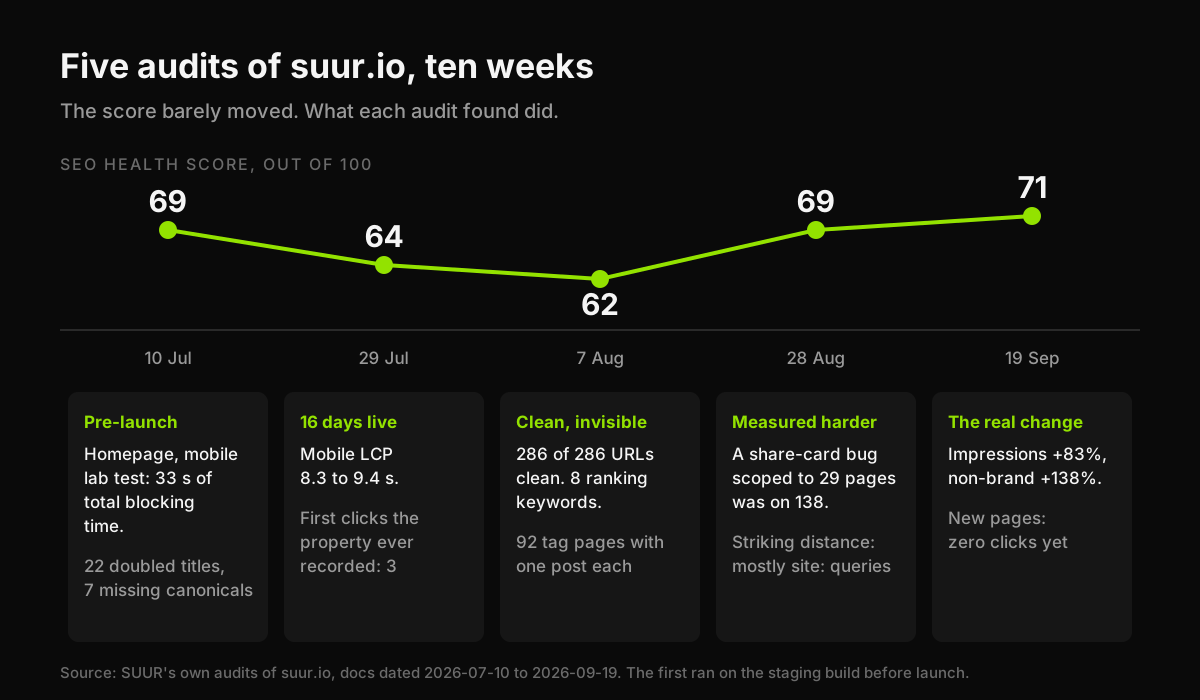
A website audit is a structured check of whether search engines can crawl and understand a site, whether people can load and use it, and whether anything on it is quietly costing traffic or trust. A good one covers technical health, on-page basics, content, speed, structured data, readiness for AI search and images, and says which problems matter. Most end in a score out of 100, and the score is the least useful part. We have audited our own site, suur.io, five times since July. The score went 69, 64, 62, 69, 71. Over the same weeks we found a homepage with 33 seconds of blocking time on mobile, 92 tag pages with one post each, and a site where every URL passed every hygiene check while it ranked for eight keywords. Below: what an audit covers, what those five found, what a score can and cannot tell you, and what an audit costs.
What an audit is, and what it is not
An audit is a diagnosis. It reads the site the way Google and a visitor would, compares what it finds against known failure modes, and ranks the problems by what they cost. The output is a list of fixes in order, not a grade.
It is not a crawl report. A crawler such as Screaming Frog or Ahrefs Site Audit will hand you hundreds of warnings, most of them harmless. The audit is the reading of that report: which three of the four hundred rows are worth a developer's week.
It is also not a strategy. An audit tells you what is broken or missing on the site you have. It does not tell you which searches are worth winning or what to publish; that is the next document, and a good audit ends by pointing at it.
What a website audit covers
Our audits score seven areas, weighted by how much each tends to matter. The weights are the audit's opinion, not a law, but most serious audits cover the same ground:
| Area | Weight | What it checks |
|---|---|---|
| Technical SEO | 22% | Can Google crawl and index every page you want found, and none you do not? Status codes, redirects, canonicals, robots rules, the sitemap, HTTPS |
| Content quality | 23% | Is each page useful, original and credibly written? Thin and duplicate pages, author and evidence signals |
| On-page SEO | 20% | Titles, descriptions, headings, internal links, social share cards |
| Structured data | 10% | Schema markup that is valid and describes the page correctly |
| Performance | 10% | Core Web Vitals: how fast the main content appears, how quickly the page responds, whether it jumps around |
| AI search readiness | 10% | Whether AI crawlers are allowed in, and whether pages are written in passages an AI answer can quote |
| Images | 5% | File sizes, formats, alt text |
Three things this rubric does not score, and an honest audit says so. Off-site authority: who links to you and mentions you. Our 28 August audit noted that it "is not a scored category in this rubric, so the 69/100 understates the problem." Conversion: whether a visitor who arrives does the thing the page is for. That is a UX audit, a different document. Accessibility beyond alt text: contrast, keyboard use, screen readers. Each can matter more than everything in the table.
What five audits of our own site found
We relaunched suur.io on 13 July 2026 and audited it before launch and four times after. Every audit is a dated file in our repository, and the numbers here are copied from them.
10 July, before launch, on the staging build: 69. The homepage's mobile lab test showed 33 seconds of total blocking time: the browser's main thread was busy for most of the load. There were 22 doubled page titles and 7 missing canonicals. The old site had earned 17 clicks from Google in 16 months, and most of its top search queries were for a Dutch recruiter with a similar name.
29 July, sixteen days live: 64. Mobile PageSpeed scores of 59 to 62, with the largest element appearing after 8.3 to 9.4 seconds. The site recorded the first three clicks from search in its history. The score fell five points: content from 72 to 58 and AI readiness from 85 to 55. This audit read the service pages closely and found all nine thin, 376 to 553 words each on an identical template.
7 August: 62. The headline of that audit: "The site is technically excellent and commercially invisible." Every one of 286 URLs returned a clean response, with perfect canonicals, no missing or duplicate titles, and no schema errors. The site ranked for eight keywords. The audit found why: eight comparison pages had one internal link each, 92 tag pages existed for tags used on a single post, 229 image files were over 500 KB, and ChatGPT named six competitors and not us for the query our flagship is built for.
28 August: 69. Content rose from 42 to 72 after fixes. On-page fell from 71 to 65, and the audit is explicit that nothing got worse: a share-card bug the previous audit had scoped to 29 pages was measured across the whole site and affected 138 of 275. Same defect, fuller measurement. It also found that of the 30 searches where we sat close to page one, the largest group, 11, were people typing site:suur.io, which is someone auditing the site, not a market.
19 September: 71. Over two equal windows either side of 31 August, when we started publishing daily, impressions rose 83 percent and non-brand impressions 138 percent, and non-brand queries in the top 20 went from 7 to 47. The new pages had earned zero clicks. The audit's own conclusion: "the score measures hygiene, and the machine's effect is in Search Console, not in hygiene."
What the score tells you, and what it does not
Three lessons from watching one site's score for ten weeks.
A score can fall because the auditor looked harder. On-page fell from 71 to 65 in August because the same bug was counted on more pages, not because anything broke. If an agency shows you a before and after score, ask whether the same pages were measured the same way both times.
A clean score can sit on top of zero traffic. The 7 August site passed every hygiene check and was close to invisible. Hygiene is what stops a site from losing; it does not make a site win. What does is in the parts the score weights lightly or not at all: pages people are searching for, and other sites linking to them.
The results show up somewhere else. The biggest change in ten weeks, impressions nearly doubling, moved the score two points. Read an audit's findings and its Search Console section; treat the number at the top as a summary of hygiene.
What a website audit costs
The honest answer is often nothing. Checked on 28 September 2026: Screaming Frog's SEO Spider "is free" up to 500 URLs, which is the whole site for most companies, and Ahrefs Webmaster Tools gives you "5,000 crawl credits" a month on a site you verify, also free. Google's own PageSpeed Insights and Search Console cost nothing. With those four and an afternoon, a founder can run most of the technical half of the audit above.
What you pay for is the reading, and the parts free tools do not do: the ranking of problems, the SERP and competitor checks, and a written plan. We priced the whole range, from free tools to agency retainers, in what website audit services cost, with every figure checked on the vendors' pages on 7 September 2026.
How to read an audit you are handed
- Find the top five fixes. If the audit cannot name them in order, it is a crawl report with a cover page.
- Check that each finding has a number. "Images are too large" is an opinion; "229 files over 500 KB" is a finding.
- Ask what was measured. How many URLs, which tools, which dates, lab or field data. A score without scope is not comparable to the next one.
- Look for what it did not score. Links from other sites, conversion and accessibility are the usual gaps.
- Look for Search Console. An audit that does not look at what Google actually shows your site is auditing a theory of the site.
Where this comes from
Our SEO and AI search audit is from $3,000, delivered in three business days, and the audit we ran on our own site is published in full as the sample audit, so you can read the deliverable before paying for one. If the question is the product rather than search, the Product UX Audit is $3,000 flat in three business days, and if it finds nothing worth fixing you pay half. For one page, the free page roast is the place to start, and hotels can score their site, booking path included, with the hotel website grader. The performance finding that runs through all five audits became its own post: what WebGL costs a page, measured on this site.
Have a product idea?
Designed, built, and shipped in about 5 days.