Website Audit Services: What They Cost and What You Get
Price a website audit by the questions, pages, user tasks and evidence it covers. A free diagnostic, a software subscription, a one-time expert assessment and an ongoing agency retainer are different purchases. This guide uses dated September 7, 2026 examples; none establishes a market floor or ceiling. Our own audit offer and internal report are included, so this is a studio's comparison with a commercial interest.
Key Takeaways
- Compare deliverables and follow-up, not a monthly fee against a project total.
- Automated findings need context and verification.
- An audit should explain evidence, priorities and unresolved questions.
- Historical lab scores do not establish current field performance or financial return.
The five tiers, and what each one returns
A software subscription, a one-time expert assessment and an ongoing agency retainer are different purchases. The dated prices below illustrate those models; the largest monthly retainer figure is not a market ceiling for a standalone audit. Compare the pages examined, tasks tested, evidence delivered and follow-up included.
| Tier | What it costs | Who reads the site | What you get |
|---|---|---|---|
| Free tools | Free tiers, with limits | Software | Particular diagnostic signals |
| Paid tools | Recurring plan fee | Software interpreted by your team | Crawls, monitoring or research within plan limits |
| Free agency assessment | No initial fee | Verify whether automated or human | Scope varies; often a sales introduction |
| Productized audit | Fixed quote; our advertised example starts at $3,000 | Named reviewer | Agreed analysis and prioritized findings |
| Wider agency engagement | Quote; distinguish audit fee from retainer | Contracted team | Research, assessment and follow-up as specified |
Choose the combination that answers your questions and that someone can act on. Site size alone does not establish the right model.
Tier 1: free diagnostic tools
Free tools provide useful starting evidence, although they do not replace every form of expert assessment.
PageSpeed Insights combines available field data with lab diagnostics for accessible pages. Its automated accessibility checks do not establish full conformance, and a failed fetch is not a page-quality verdict.
Google Search Console provides owner-accessible search and indexing evidence. Without access, an external audit should state its limits rather than imply it has inspected the site's complete search history.
Ahrefs and Screaming Frog provide crawling and related research with plan-specific limits. Check current limits against the site's size and required history before purchasing.
Findings need task context. Missing alternatives on informative images can prevent access to essential content; empty alternatives on decorative images can be appropriate. A slow page also needs investigation. Prioritize the affected users and tasks, severity, evidence and repair effort instead of treating one category as automatically worthless.
Tier 2: paid tools, for people who want the numbers every week
Paid subscriptions vary by crawling limits, research data, projects, history and seats. Compare the current Ahrefs, Semrush and Screaming Frog terms with a defined monitoring job. A software fee excludes the time needed to interpret and resolve findings.
Paid features can be useful for one-off or ongoing work. Identify the capability missing from free tools and who will use its output before choosing a plan.
Tier 3: the free audit from an agency
Free agency assessments vary from automated reports to recorded human reviews. Ask what will be examined and what evidence you receive. A sales introduction can still contain useful observations, but it should not be mistaken for an agreed comprehensive audit.
Check whether a free offer supplies a recorded review, automated output or a sales call. Our page roast addresses one page. The website redesign checklist is a thirty-question self-assessment with coverage-aware grading. The hotel website grader instead inspects one page's source HTML for booking-link, responsive-markup, SEO and HTTPS evidence. It does not run the checklist or test a completed reservation.
Tier 4: the productized audit, and what a real one looks like
A productized audit defines the scope, reviewer, timing and deliverable before the work starts. Ours is the SEO and GEO audit, from $3,000 with an advertised three-business-day schedule once the required access and scope are ready. We applied our rubric to our own site and published a sample. These are historical observations from 28 August 2026.
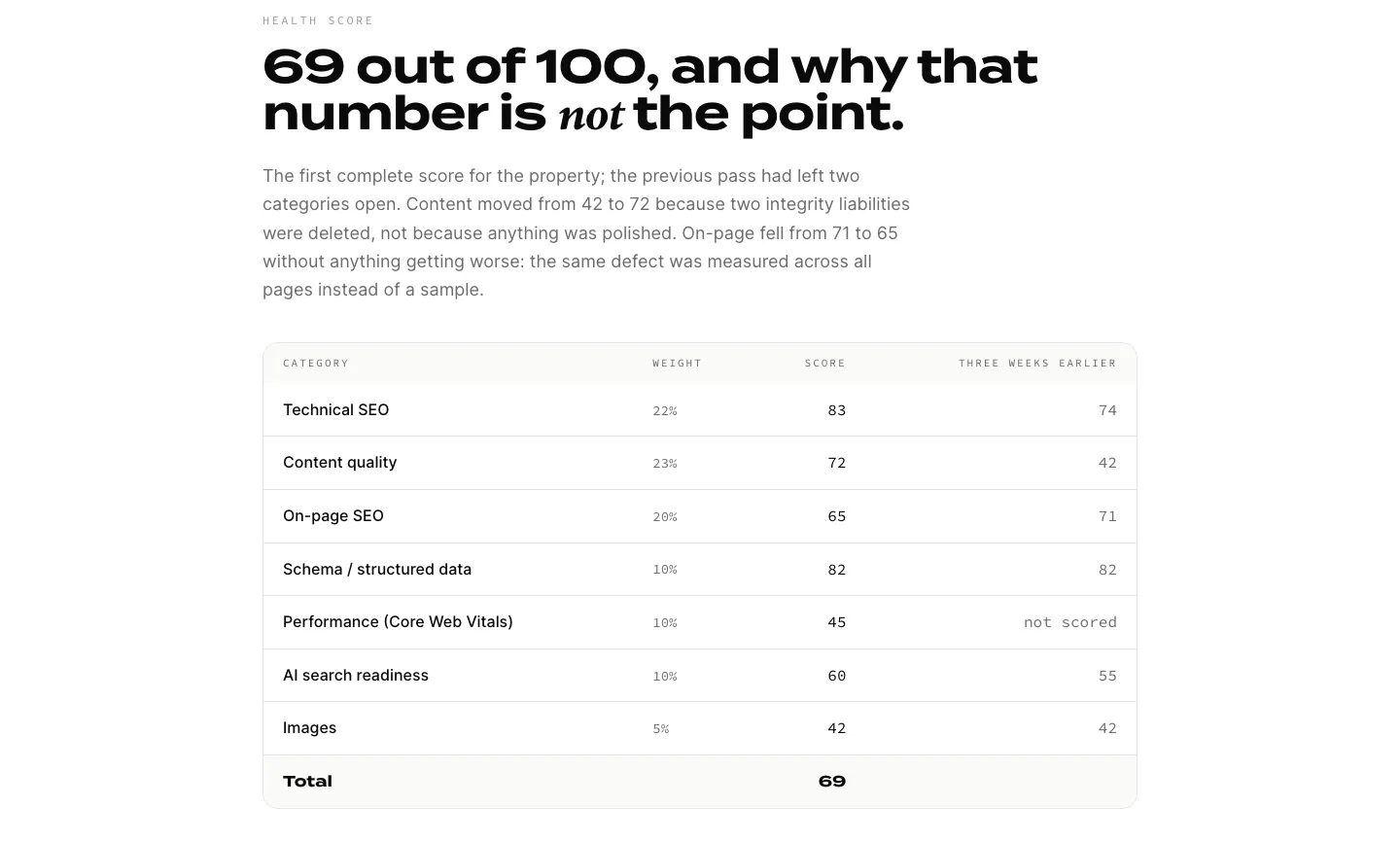
The dated internal audit scored the site 69 out of 100 using our seven-category rubric. It recorded Lighthouse mobile scores of 61 on the homepage, 54 on the flagship product page and 66 on the work index; a comparison page scored 98. Those historical lab runs exposed different page-level bottlenecks on one stack. They did not establish that image payload explained every difference or that all fixes would take one hour. A useful audit states the proposed cause, the change to test and how it will be remeasured.
The finding that reordered the roadmap was about visibility. The retained audit's search-query review contained little clear commercial demand, and its URL inspection found an important comparison page not yet crawled. That made discovery and indexation worth investigating before polishing minor metadata. A citation in one ChatGPT answer was a separate observation, not proof of repeat visibility or sales. The historical evidence extract exposes the later report figures and their limits; it summarizes internal reports rather than raw analytics exports. We cannot assign a measured financial return to a single URL submission from that evidence.
The useful deliverable is a reasoned priority list. The roadmap in our published sample audit includes effort estimates and work we would defer. Those estimates are planning judgments, not measured repair durations. Our published offer includes a half-price condition if it finds nothing worth doing; confirm its applicable scope and terms before purchasing.
The same shape now exists for products. The product UX audit uses your web or mobile app as a new user, recorded, scores it across seven categories, and returns a fix list ranked by effort in hours and impact, in three business days for $3,000 flat.
Tier 5: the agency audit
A wider engagement may combine technical, content, analytics, accessibility and user research work. Separate any initial audit from implementation and ongoing retainers. An advertised monthly minimum is not the cost of every audit and cannot serve as a market ceiling.
Ask for a sample showing reproducible findings, uncertainty, priorities and a usable handoff. A small site with a difficult transactional flow may need specialist work, while a large simple site may benefit primarily from automated crawling and targeted review.
Which one you need
For performance, distinguish lab diagnostics from field evidence. Core Web Vitals measure different aspects of real experience, and a source-HTML check alone cannot establish them. An audit should say which evidence it collected and what remained outside scope.
- You have never looked: tier 1, today, free. PageSpeed Insights on your three most important pages and Search Console's index report will fill an afternoon.
- You are about to spend on a redesign or campaign: compare a focused assessment against the decision and risk. The website design cost guide helps scope subsequent implementation.
- You run paid traffic to a page: a free teardown first, then the landing page experience rules Google actually publishes, then fix the page before you audit it again.
- You have a team that will act weekly: select monitoring tools for its actual questions and commission specialist review when the evidence or risk warrants it.
- You have a large site: price crawl coverage and representative user tasks, separating the audit from any ongoing retainer.
A useful audit helps you decide what to fix, what to investigate and what can wait, with reasons. A long issue list alone is insufficient, but its length does not establish the supplier's motive. For the method and our historical observations, see what a website audit is.
For a narrower editorial critique before commissioning a full audit, see Roast My Site. A wider web accessibility review needs checks beyond visual polish.
Have a product idea?
Designed, built, and shipped in about 5 days.