B2B SaaS Pricing Models Compared: Which to Use
B2B SaaS is priced in six ways: a flat rate, per seat, by tier, by usage, a hybrid of a platform fee plus usage, and, newest, per outcome; the right one is whichever makes the bill grow with the value the customer gets. On 6 October 2026 we read a live example of each from the vendor's own pricing page. Basecamp charges $59 a month for its Studio plan with "no per-user fees, everyone's included." Linear charges $10 or $16 per user a month, billed yearly. HubSpot's Marketing Hub Professional is $800 a month with three seats and a $3,000 onboarding fee. Twilio charges $0.0083 per US text message. Vercel Pro is $20 a month including $20 of usage credit, then metered. Intercom's Fin AI agent is "from $0.99 per Fin outcome" on top of $29 to $132 per seat. Free plans are not a seventh model; they are how four of these six get you in the door.
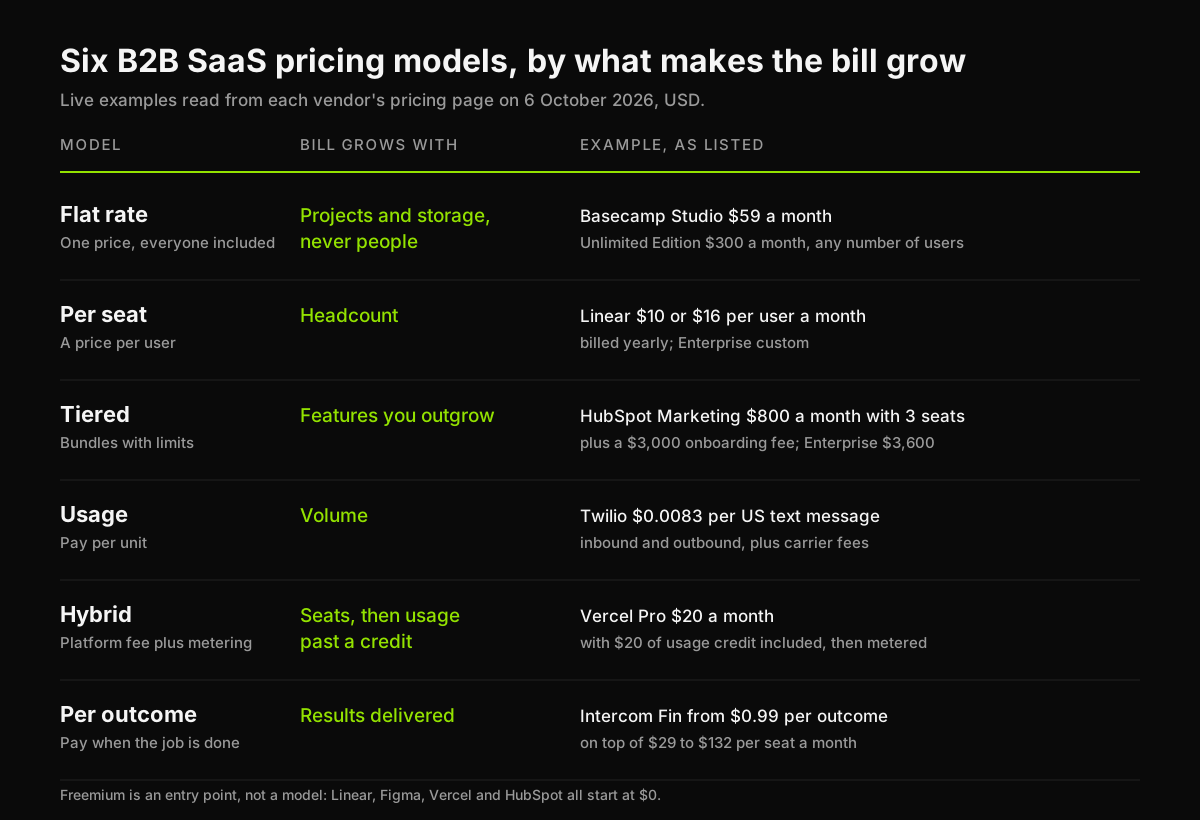
If you want to see how a dozen established companies combine these, we priced twelve of them in what B2B SaaS is. This post is about choosing one for your own product.
The one question that picks the model
Every model answers the same question differently: when your customer gets more out of the product, what goes up? Pricing people call that unit the value metric. Get it right and revenue grows inside each account without a sales call. Get it wrong and your best customers either pay for value they do not get, or get value they do not pay for.
Ask it concretely. If a customer doubles their use next year, what doubled? People using it, work flowing through it, results it produced, or nothing you can count? The answer is the model.
Flat rate: one price, everyone included
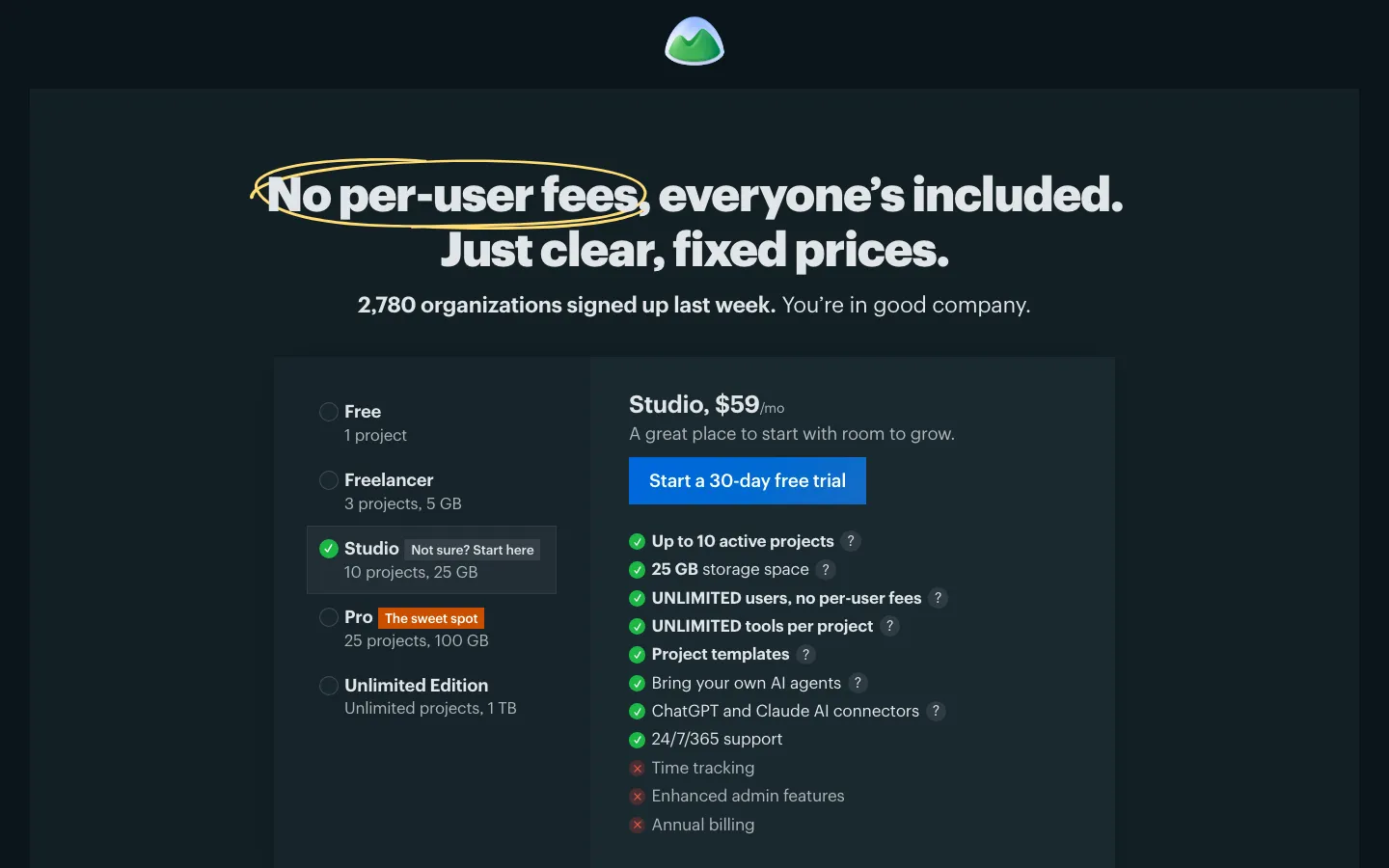
Basecamp is the clearest flat-rate company left. Its plans step up by projects and storage, never by people: the Unlimited Edition is $300 a month, and its own FAQ says a company can "add 500 users" and "still just pay $300/month total."
Fits when the product's value does not scale with headcount, and simplicity is part of what you sell. Fails when a few huge customers use far more than everyone else at the same price. Flat rate is a positioning choice as much as a pricing one; Basecamp's page leads with it as the headline.
Per seat: a price per user
Linear's Basic plan is $10 per user a month and Business is $16, billed yearly; Enterprise is "Custom." Notion lists $10 and $20 per member on yearly billing, $12 and $24 monthly.
Fits when each person who logs in gets roughly the same value, which is true of most collaboration tools. Revenue grows as the product spreads inside a company. Fails when AI does the work: if one person with an agent does what five people used to, seat pricing shrinks your revenue as your product gets better. It also teaches customers to share logins.
Seat types are the modern fix. Figma lists a Full seat at $16 a month on Professional, a Dev seat at $12 and a Collab seat at $3, so a company pays for what each person actually does.
Tiered: bundles with limits
HubSpot's Marketing Hub runs Free, Starter (from $7 a month per seat, a new-customer promotion on the day we read it), Professional at $800 a month including three core seats, and Enterprise at $3,600 a month including five. Professional and Enterprise each carry a one-time onboarding fee: $3,000 and $7,000.
Fits when customers differ by sophistication, not size: a small team that needs basics and a large one that needs permissions, reporting and support. Fails when the features that matter to everyone sit in the top tier, which pushes buyers to the sales call or to a competitor. Tiers almost always hide seats inside them, as HubSpot's do.
Usage: pay per unit
Twilio's US page, marked "Pricing current as of October 2026," lists $0.0083 per outbound or inbound text message, $0.022 per outbound picture message, plus carrier fees, under the line "Only pay for what you use."
Fits when your costs scale with use (messages, compute, API calls) and the unit is something the customer already counts. Fails when buyers cannot predict the bill. Finance teams approve budgets, not curves, which is why most usage-priced companies end up selling committed-spend contracts for their biggest accounts.
Hybrid: a platform fee plus metering
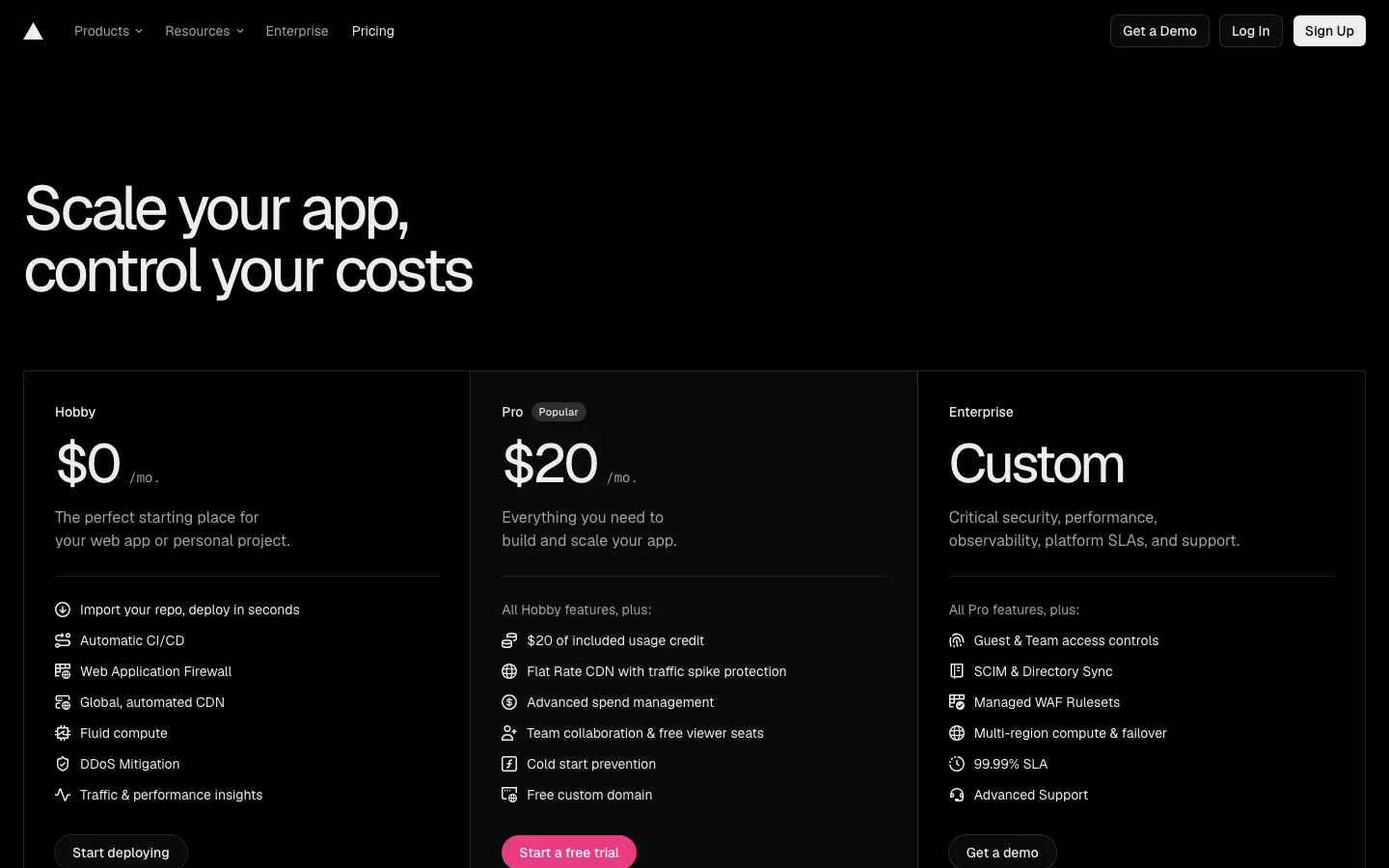
Vercel Pro is $20 a month, which includes "$20 of included usage credit," then metered charges such as "$0.50 per 1M allowed requests"; developer seats are $20 a month and viewer seats are free. The base fee buys predictability, the meter catches heavy users.
Fits when you have both a fixed cost to serve each account and a variable one, which is most infrastructure and most AI products. Fails when the page gets too complicated to estimate a bill from. Hybrid is where most pricing ends up, so it is where pricing page design matters most.
Per outcome: pay when the job is done
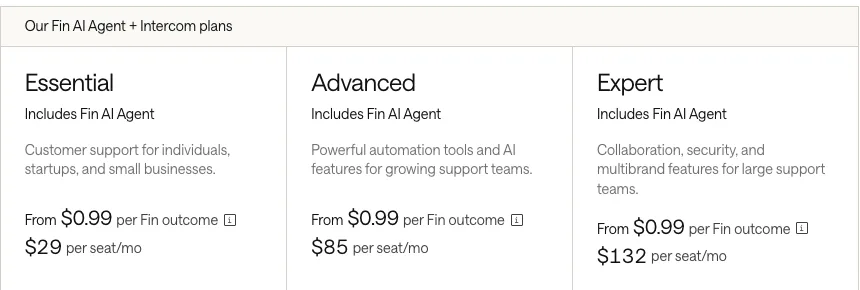
Intercom charges "from $0.99 per Fin outcome" on every plan, with "one outcome per conversation, max," on top of seats for the human team. Zendesk's pricing page describes the same idea for its AI agents, priced "based on the successful outcomes they deliver," though it showed no per-resolution figure.
Fits when an AI feature does a whole job you can count, such as a support conversation resolved without a person. It is the cleanest answer to the seat problem above: you earn more when the product does more of the work. Fails when "outcome" is disputable. The definition is the product; if customers argue about what counted, the model costs you trust.
Freemium: an entry point, not a model
Linear, Figma, Vercel and HubSpot all start at $0. A free tier is not a way of charging; it is a way of getting a team inside before anyone signs. It only works when the free plan is useful on its own and the paid trigger is a limit the customer hits by succeeding (more projects, more seats, more volume), not a feature you hid.
What the model does to your pricing page
The pricing model decides what the page has to explain:
- Flat rate needs the least: one number and what it includes. Basecamp spends its headline on the absence of seat fees.
- Per seat needs a seat calculator or a clear per-user line, and an answer to "who counts as a user?"
- Tiered lives or dies on the comparison table, and on which feature sits where.
- Usage and hybrid need a worked example or an estimator, because a unit price alone does not tell a buyer what they will pay.
- Per outcome needs the definition of an outcome on the page, not in the contract.
Pages that hide the top tier behind "Custom" or "Contact sales" (Linear, Notion, Vercel on 6 October 2026) are telling you who the company really sells to. If you publish your top price, as Basecamp and HubSpot do, the page has to carry the whole sale on its own.
That page does more selling than any other on a SaaS site, and it is often the least designed. We design and build them as part of SaaS website design, and we tore down fourteen SaaS websites in the best SaaS website designs. If the product itself needs a usage view or billing dashboard so customers can see what they will pay, that is a SaaS Dashboard project.
The short answer
Pick the unit that grows when your customer's results grow. Seats if each person gets the value, usage if work flowing through the product is the value, outcomes if an AI does a countable job, a flat rate if simplicity is the product, and tiers or a hybrid to combine them. Then design the pricing page so a buyer can work out their own bill without calling you.
Sources, read on 6 October 2026: the pricing pages of Basecamp, Linear, Notion, Figma, HubSpot (Marketing Hub), Twilio (US SMS), Vercel, Intercom and Zendesk. All prices in US dollars as displayed.
Have a product idea?
Designed, built, and shipped in about 5 days.