The Hotel Tech Stack: What Each Layer Does and Costs
A hotel tech stack is the set of systems that takes a booking and runs the stay, and for an independent hotel it comes down to five layers. A property management system (PMS) holds the rooms, the guests and the bills. A booking engine takes reservations on the hotel's own website. A channel manager keeps rates and availability in sync across Booking.com, Expedia and the rest. A revenue management system (RMS) sets the rates. Chains add a central reservation system (CRS). On 16 October 2026 the published prices ran from free, for Sirvoy's one-room plan with a booking engine, to €8 a room a month for Apaleo's PMS, from $135 a month for SiteMinder's channel manager at five rooms, and $241.50 a month for RoomPriceGenie's revenue management at 20 rooms. Mews now quotes behind a form, and none of the CRS vendors we checked publishes a price. Only one layer, the booking engine on your own site, sells a room without an OTA in the middle.
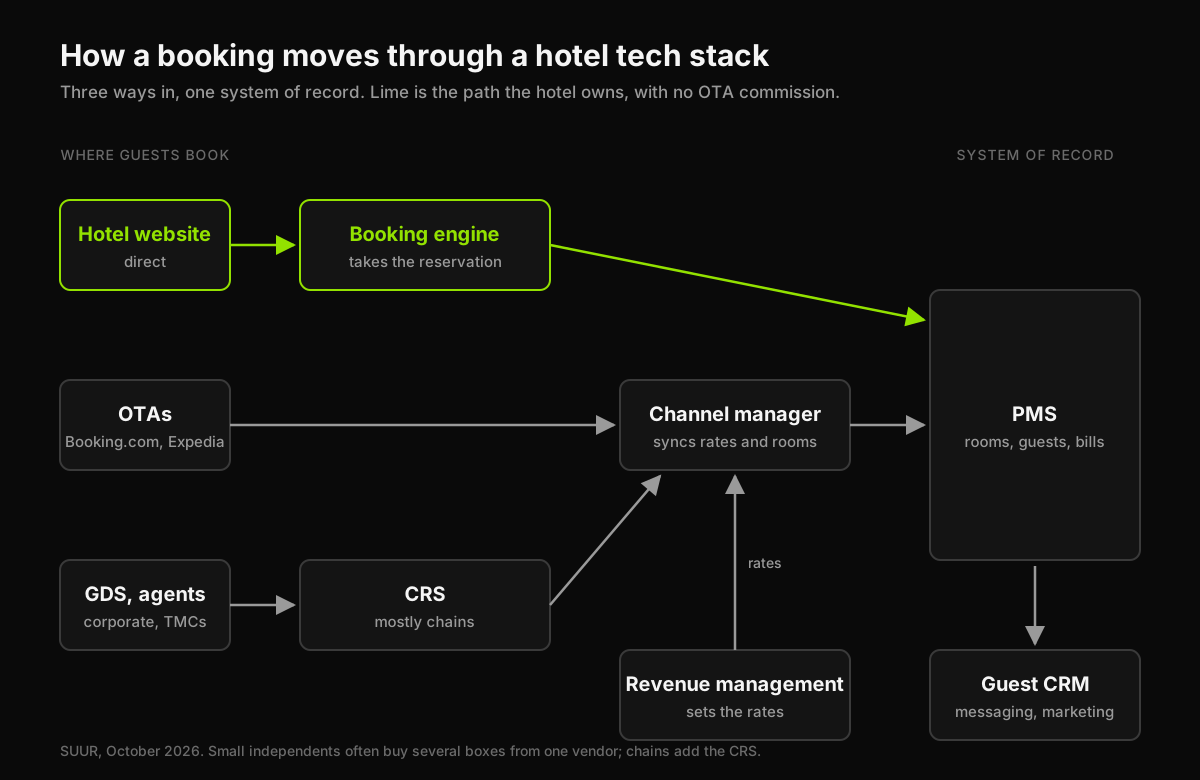
Three ways in, one system of record
Every booking reaches a hotel by one of three routes. A guest books on the hotel's website, through its booking engine. A guest books on an online travel agency, and the channel manager passes the reservation on. Or a travel agent or corporate booker books through a global distribution system (GDS), which at a chain usually runs through a CRS.
All three end in the PMS, the system the front desk lives in. That is why the PMS is the first decision and the hardest to reverse: everything else connects to it.
What each layer costs
We read each vendor's own pricing page on 16 October 2026. Where a vendor quotes rather than publishes, we say so; most do.
| Layer | What it does | Published prices, 16 October 2026 |
|---|---|---|
| PMS | Rooms, reservations, check-in, folios, housekeeping status | Apaleo €8 a room a month, from €400 a month. innRoad: "typically falls around $150 per month." Sirvoy Starter $15 a month at one room. Mews: quote by form |
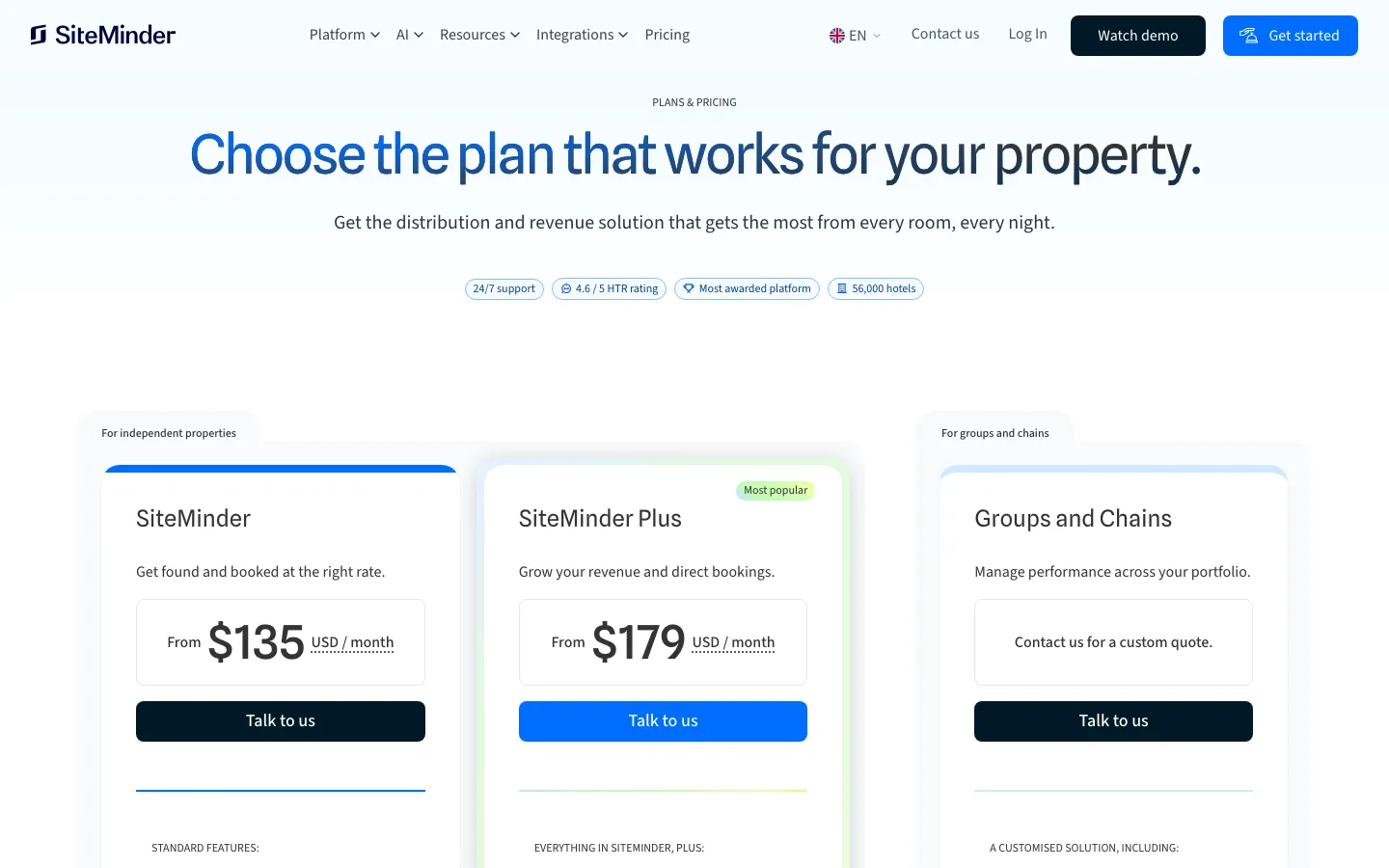
| Channel manager | Pushes rates and availability to OTAs, pulls bookings back | SiteMinder from $135 a month at five rooms. HotelRunner 0.75% to 1.25% of booking revenue, minimums $19.95 to $39.95 a month |
| Booking engine | Takes direct reservations on the hotel website | SiteMinder Plus from $179 a month, adding direct bookings and a website builder. Sirvoy Free: $0 at one room, 0% commission |
| Revenue management | Recommends or sets the rate for each night | RoomPriceGenie $241.50 per property per month at 20 rooms, annual commitment |
| CRS | Central rates and inventory for many properties, GDS connection | No published price from Aven Hospitality (SynXis), SHR or Amadeus (TravelClick) |
| All in one | PMS, channel manager, booking engine and payments from one vendor | RoomRaccoon Entry from $197 a month, billed annually |
Two cautions on reading that table. Most prices scale by room count, so the five-room and 20-room figures above are each vendor's own example, not a quote for your property. And some of the cost is usage-based: SiteMinder's page says metasearch and its channel marketplace charge a commission "on completed stays," on top of the subscription.
The layers, one at a time
PMS: the system of record
The PMS holds the room inventory, every reservation, the guest profile and the bill. Pricing is almost always per room per month. Apaleo publishes it plainly: €8 a room, a €400 monthly minimum, and "no setup fees, no license fees, no maintenance fees, no integration fees." innRoad prices by quote but gives an estimate on its own page. Mews now shows a form headed "Get pricing tailored to you," and notes its prices are "indicative of a 10-room property."
Choose the PMS for the integrations it has, not the screens. A PMS with an open API can take a better booking engine or RMS later; a closed one decides the rest of your stack for you.
Channel manager: one inventory, many shops
Without a channel manager, a room sold on Booking.com is still for sale on Expedia until someone updates it by hand. The channel manager closes that gap in both directions. SiteMinder is the default for independents, from $135 a month for a five-room property, with its Plus plan adding a booking engine, a website builder and metasearch for $179. HotelRunner prices on revenue instead, a percentage of bookings above a monthly minimum. Channex, an API-first channel manager that software companies build on, charges a $130 platform fee plus $7 a connected property.
Booking engine: the layer that pays you back
The booking engine is the one layer that takes a booking without an OTA's commission. On a $500 stay, a 15 percent OTA commission is $75; what each OTA charges is in our book-direct math. That makes the engine, and the website in front of it, the place where a better design returns money directly. We compared nine engines, with prices, in the best hotel booking engines; many come bundled with a PMS or channel manager, which is often the right call for a small property.
Revenue management: who sets the rate
An RMS reads your pickup, the calendar and competitor rates and recommends a price for each night, or sets it. RoomPriceGenie publishes its prices: $241.50 a property a month for a 20-room hotel on an annual commitment, rising to $551 for its highest listed plan. Smaller properties often start with the dynamic pricing built into a PMS bundle, which RoomRaccoon includes from its Essentials plan.
CRS: the chain layer
A central reservation system holds rates and inventory for many properties at once and connects them to the GDS, where travel agents and corporate travel tools book. It matters to groups and to hotels with heavy corporate business, and little to a 20-room independent. None of the three CRS vendors' sites we checked shows a price. One change worth knowing: SynXis now sits with Aven Hospitality, which describes itself as "formerly Sabre Hospitality," and its site now offers SynXis rates and availability to AI agents through the Model Context Protocol.
Everything around the core
Beyond the five layers sit the tools that run the stay: guest messaging and CRM, housekeeping, point of sale, door locks, upselling, reputation. Each is its own market, which is where the stack gets hard to map.
Finding the vendors
Mapping that market is why I launched TravelTechCompanies, an independent directory of travel technology companies. It lists 145 hotel software companies across 33 categories, from 25 PMS systems to four CRS vendors, plus agency, tour, airline and corporate travel software. Profiles record where each company is based, when it was founded and how it prices, with a source for each fact, and are still being filled in. Listing is free and paid placements are labelled. It is a starting list; the prices in this post were read on each vendor's own page, the same day.
All in one, or best of breed
There are two ways to buy the stack. A bundle, such as RoomRaccoon's PMS, channel manager, booking engine and payments from $197 a month billed annually, or Sirvoy, free at one room with the channel manager on its $54 Pro plan, is cheaper to start and has one support line. Separate tools, such as an Apaleo PMS with a SiteMinder channel manager and a RoomPriceGenie RMS, cost more and take integration work, but let you replace one layer without replacing all of them.
For most independents under about 50 rooms, the bundle wins until a specific layer holds you back. The layer that holds hotels back most often is the one guests see: a booking engine on a website that does not show a price, does not say why to book direct, and loses the guest on a phone.
Where the website comes in
The tech stack decides what a hotel can sell. The website decides whether a guest buys it there or on Booking.com. Of twelve admired hotel websites we checked on 10 October 2026, none showed a nightly rate on the homepage; we wrote up why Booking.com looks cheaper than the hotel website even when it is not. Our free hotel website grader checks the booking path on your own site in about a minute.
When the website is the weak layer, that is what we fix. Our hotel website design tiers are published: $12,000 for a site on our Aurelia template with your brand and your real booking engine wired in, from $30,000 for a custom design, and from $75,000 for a multi-property platform.
Sources, read on 16 October 2026: pricing pages of Apaleo, innRoad, Mews, Sirvoy, SiteMinder, HotelRunner, Channex, RoomPriceGenie and RoomRaccoon; the websites of Aven Hospitality, SHR and Amadeus Hospitality; category counts from TravelTechCompanies. Prices shown in the currency each page displayed to us.
Have a product idea?
Designed, built, and shipped in about 5 days.