Are UX Designers Being Replaced by AI? The Data
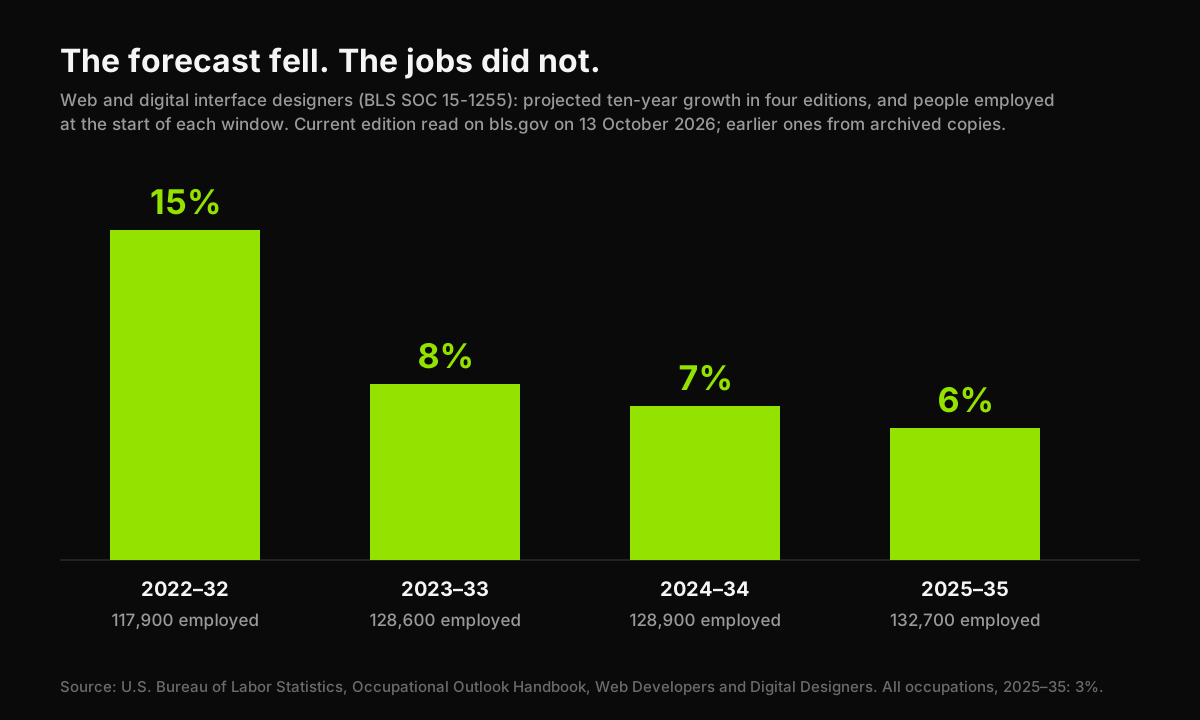
No. On the data available on 13 October 2026, AI is replacing the drawing part of design faster than the deciding part, and UX designers sit mostly on the deciding side. The U.S. Bureau of Labor Statistics counted 132,700 web and digital interface designers in 2025, up from 117,900 in 2022, at a median wage of $104,000, and it still projects 6 percent growth to 2035, twice the 3 percent for all occupations. What fell is the forecast: three editions ago the same projection was 15 percent, and the current edition is the first of the four to name AI as a reason growth may soften. The World Economic Forum's 2025 survey of employers ranks UI and UX designers eighth among the fastest-growing jobs to 2030, and graphic designers eleventh among the fastest-declining. Indeed's software development postings are 45 percent below the day ChatGPT launched, but they had already fallen 39 percent from their 2022 peak before it did.
The question gets asked as if it had one answer. It has three, from three kinds of source, and they agree more than the headlines do. Here is each one, what it measures, and what it cannot tell you.
1. The government count: more UX jobs, slower expected growth
The Bureau of Labor Statistics tracks the occupation closest to a UX designer as "web and digital interface designers," SOC code 15-1255: people who "develop, create, and test website or interface layout, functions, and navigation for usability." We read the current Occupational Outlook Handbook page on 13 October 2026 and compared it with three earlier editions saved by the Internet Archive.
| Edition | Employed at start | Projected 10-year growth | Median wage |
|---|---|---|---|
| 2022–32 | 117,900 | 15% | $98,540 (May 2023) |
| 2023–33 | 128,600 | 8% | $98,090 (May 2024) |
| 2024–34 | 128,900 | 7% | $98,090 (May 2024) |
| 2025–35 | 132,700 | 6% | $104,000 (May 2025) |
Two things are true at once. The number of people doing the job went up in every edition, by 14,800 over three years, and the latest wage figure is the first rise in the series. And the expected growth rate was cut by more than half.
The current page says why, in a paragraph the earlier three do not have:
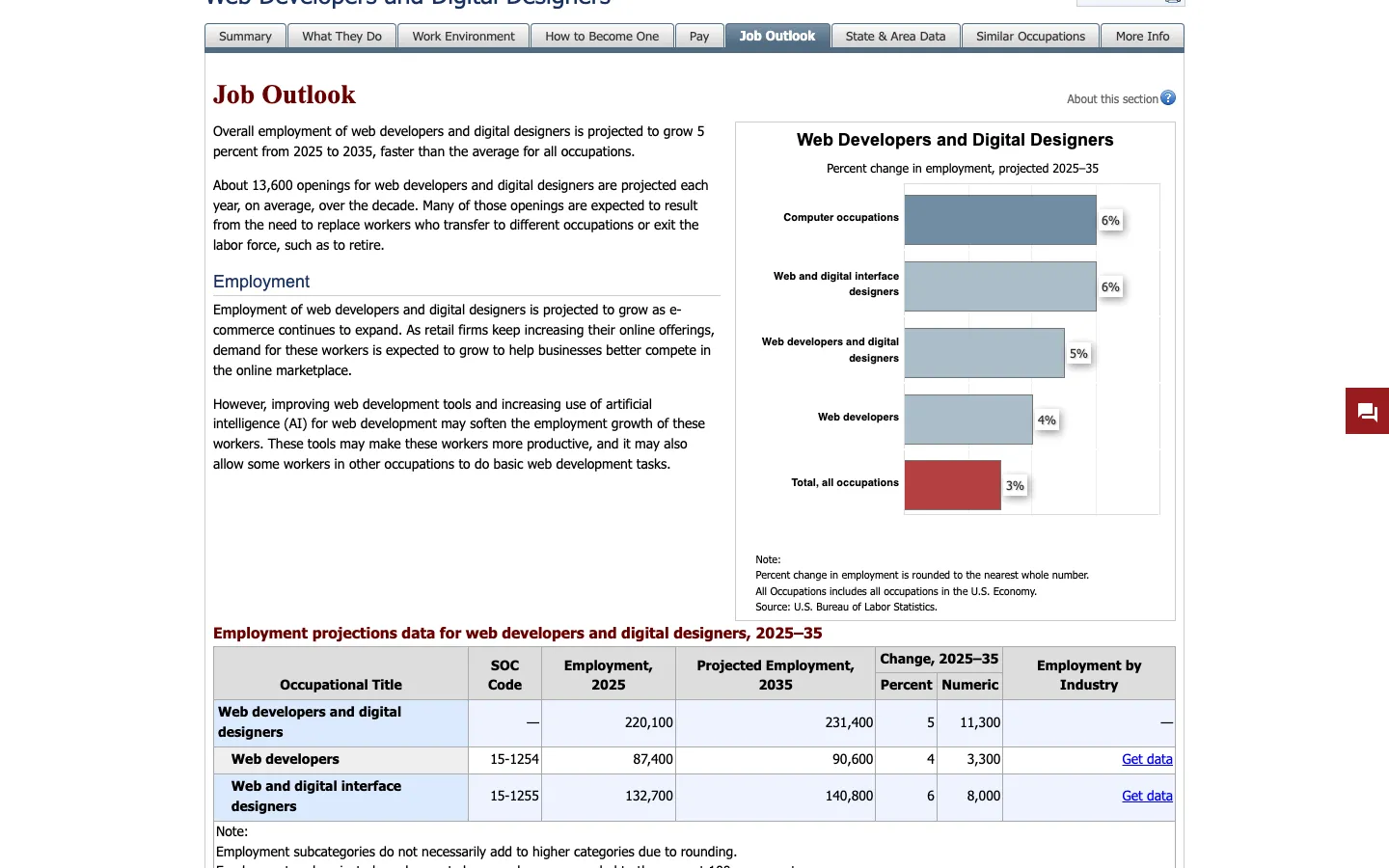
"Improving web development tools and increasing use of artificial intelligence (AI) for web development may soften the employment growth of these workers. These tools may make these workers more productive, and it may also allow some workers in other occupations to do basic web development tasks."
Read it closely. The government's own forecasters expect AI to make the existing designers more productive and to let non-designers do the basic tasks. That is a smaller future headcount than they expected in 2023, not a disappearing one. Even after the cut, interface designers are projected to grow at the same rate as computer occupations as a whole, 6 percent, and twice the economy-wide rate.
What it cannot tell you: BLS counts employees and the self-employed in a fixed job definition. It does not see a UX lead whose title became "product designer" or "design engineer," and the projections are a model, not a survey of hiring plans.
2. The employers: UX up, graphic design down
The World Economic Forum's Future of Jobs Report 2025 asked employers representing more than 14.1 million workers which roles they expect to grow or shrink between 2025 and 2030. In its list of the fastest-growing jobs by net growth, UI and UX Designers come eighth, after big data specialists, fintech engineers, AI and machine learning specialists, software developers, security management specialists, data warehousing specialists and autonomous vehicle specialists.
In the list of fastest-declining jobs, Graphic Designers come eleventh, after postal clerks, bank tellers, data entry clerks and cashiers. The report calls this out as "a major change from the report's 2023 edition, when Graphic Designers were considered a moderately growing job," and names AI and information processing as a driver of the decline.
That split is the most useful finding anywhere in the data. The same technology, in the same survey, is expected to grow one design job and shrink another. The difference is what the job produces. A graphic designer's deliverable is often the artefact itself, and artefacts are what generative tools make. A UX designer's deliverable is a decision about how a product should behave, tested against real users, and the tools need someone to make it.
What it cannot tell you: these are employer expectations, collected in late 2024, not hires. Executives have been wrong about technology timelines before, in both directions.
3. The job ads: down a lot, but not because of ChatGPT
Indeed's Hiring Lab publishes a daily index of job postings by category, where 1 February 2020 equals 100. It has no design category; the nearest are software development, media and communications, and arts and entertainment. We downloaded the series on 13 October 2026; the latest point is 2 October 2026.
| Indeed category | 2022 peak | 30 Nov 2022, ChatGPT launch | 2 Oct 2026 | Change since launch |
|---|---|---|---|---|
| Software Development | 233.9 | 142.5 | 78.3 | −45% |
| Media & Communications | 172.3 | 125.1 | 70.9 | −43% |
| Arts & Entertainment | 155.1 | 123.9 | 87.8 | −29% |
| All US postings | 146.7 | 103.8 | −29% |
This is the chart people mean when they say AI is taking design jobs, and the dates do not support it. Software development postings peaked in February 2022 and had already fallen 39 percent by the week ChatGPT launched. The fall began with interest rates and the end of pandemic over-hiring, nine months before a chatbot was public. It has also turned: software development postings are up 22 percent on a year ago, from 64.3 to 78.3.
What it cannot tell you: a posting index counts ads, not hires, and it cannot separate a design role from an engineering role in the same category. It says the market for digital product work is smaller than in 2022. It does not say why, and the timing argues against AI as the main reason.
What AI is actually taking
Put the three sources together and the pattern is consistent. AI is taking the production layer of design work: first drafts of screens, variations, asset resizing, placeholder copy, handoff redraws, basic pages assembled from a template. BLS says it in the phrase "basic web development tasks." The WEF says it by putting graphic designers on the declining list. We wrote up the same thing from inside our own work in AI in web and app design: threat or tool, and compared what each tool produces in the best AI tools for UI/UX design.
What it is not taking is the part of UX that was never about drawing: deciding which screen should exist, running the research that says so, writing down what a good outcome is, and designing what happens when the product, or the model inside it, is wrong. Those are the parts that measuring the hidden value of UX is about, and they get more important as AI features ship, not less. A chatbot bolted to the corner of a product needs a designer to decide when it should refuse, how it shows uncertainty, and how a user undoes what it did. That is the work in designing for AI.
What to do with this
If you are a UX designer: the safe position is the one the data protects. Move toward decisions, research and AI product behaviour, and away from being paid for the pixel output alone. Use the tools for drafts so the time goes to judgment.
If you are hiring: the BLS paragraph is a fair description of what changes. One senior designer with good tools now covers work that took two, and some basic tasks can move to people who are not designers. It does not remove the need for someone who owns the decisions. Our decision tree for hiring a designer or subscribing to one prices both routes.
If you are adding AI to a product: design is where those features usually fail, at the handoff between what the interface promises and what the model can deliver. Our AI Feature Sprint designs and builds one AI feature into your stack, with its failure states and an eval harness, from $24,000 in two to three weeks, fixed before it starts. For a team that wants to work this way itself, the AI Workshop is a half day for $5,000 or two days for $9,000, run on your own product.
Sources, read on 13 October 2026: BLS Occupational Outlook Handbook, Web Developers and Digital Designers (current edition, plus Internet Archive copies from 6 June 2024, 10 July 2025 and 21 October 2025); World Economic Forum, Future of Jobs Report 2025, Figure 2.2 and accompanying text; Indeed Hiring Lab job postings tracker, US postings by category and aggregate, data through 2 October 2026.
Have a product idea?
Designed, built, and shipped in about 5 days.