WordPress Alternatives
WordPress Alternatives in 2026: Builders, Code, and When to Leave
Webflow, Framer, Squarespace, Wix, Ghost, managed WordPress hosting, and a Next.js site on your own account, compared against WordPress on price, maintenance, and editing, with every price read live on 9 September 2026 and a migration that lost zero rankings as the receipt.
| Vendor | Pricing | Turnaround | Best for |
|---|---|---|---|
| WordPress.com (what most people mean) | $4, $8, $25, or $45/mo introductory on yearly billing; the renewal price shown to us changed between two loads on the same morning | Days, with a theme | A blog-first site that wants the WordPress editor without running a server |
| WordPress.org on WP Engine or Kinsta | WP Engine Essential from $28/mo on annual billing (1 site, 25,000 visits, 10 GB, 75 GB bandwidth); Kinsta from $30/mo annual, first month free | Same site, a day to move; both offer migration help | Teams that want to keep their plugins and theme and stop doing the hosting and patching themselves |
| Webflow | Basic $15/mo, Premium $25/mo billed yearly; Team $2,500/mo; Optimize from $299/mo | A week with a designer | Marketing sites where a designer owns the build and wants a real CMS without plugins |
| Framer | Free; $10/mo or $30/mo (staging and branching); $20 per extra editor, $10 per content editor; $40 per extra 100 GB | A weekend to rebuild a small site | Design-led startup sites with motion and a small team |
| Squarespace | $19, $29, $49, or $99/mo on annual billing | A weekend, DIY | Small businesses and independents who want a clean template, commerce, and nothing to maintain |
| Wix | Free plan; $17, $29, $39, or $159/mo on yearly billing | A weekend, DIY | Owners who want bookings, ordering, and apps inside one builder |
| Ghost(Pro) | Starter $18/mo, Publisher $29/mo, Business $199/mo billed yearly at 1,000 members (10,000 on Business); custom SSL or subdirectory install +$50/mo | A day to import a WordPress export | Publications and newsletters that want memberships and email built in, not bolted on |
| Next.js or Astro on Vercel, Cloudflare, or Netlify | Vercel Hobby $0 or Pro $20 per seat; Cloudflare Workers free or from $5/mo; Netlify free or from $9/mo | Days with a developer or an agent; hours per new page after | Teams who want the fastest site, no plugin stack, and pages shipped by people and agents from one repo |
| SUURThat’s us | Website Migration from $6,000 flat for up to 20 pages; Website Care Plan $1,500/mo after | About 2 weeks for a site of up to 20 pages, then 4 weeks of Search Console watch | WordPress sites with rankings worth keeping that want the move to code done by one senior with the URL map agreed before anything moves |
- Pricing
- $4, $8, $25, or $45/mo introductory on yearly billing; the renewal price shown to us changed between two loads on the same morning
- Turnaround
- Days, with a theme
- Best for
- A blog-first site that wants the WordPress editor without running a server
- Pricing
- WP Engine Essential from $28/mo on annual billing (1 site, 25,000 visits, 10 GB, 75 GB bandwidth); Kinsta from $30/mo annual, first month free
- Turnaround
- Same site, a day to move; both offer migration help
- Best for
- Teams that want to keep their plugins and theme and stop doing the hosting and patching themselves
- Pricing
- Basic $15/mo, Premium $25/mo billed yearly; Team $2,500/mo; Optimize from $299/mo
- Turnaround
- A week with a designer
- Best for
- Marketing sites where a designer owns the build and wants a real CMS without plugins
- Pricing
- Free; $10/mo or $30/mo (staging and branching); $20 per extra editor, $10 per content editor; $40 per extra 100 GB
- Turnaround
- A weekend to rebuild a small site
- Best for
- Design-led startup sites with motion and a small team
- Pricing
- $19, $29, $49, or $99/mo on annual billing
- Turnaround
- A weekend, DIY
- Best for
- Small businesses and independents who want a clean template, commerce, and nothing to maintain
- Pricing
- Free plan; $17, $29, $39, or $159/mo on yearly billing
- Turnaround
- A weekend, DIY
- Best for
- Owners who want bookings, ordering, and apps inside one builder
- Pricing
- Starter $18/mo, Publisher $29/mo, Business $199/mo billed yearly at 1,000 members (10,000 on Business); custom SSL or subdirectory install +$50/mo
- Turnaround
- A day to import a WordPress export
- Best for
- Publications and newsletters that want memberships and email built in, not bolted on
- Pricing
- Vercel Hobby $0 or Pro $20 per seat; Cloudflare Workers free or from $5/mo; Netlify free or from $9/mo
- Turnaround
- Days with a developer or an agent; hours per new page after
- Best for
- Teams who want the fastest site, no plugin stack, and pages shipped by people and agents from one repo
- Pricing
- Website Migration from $6,000 flat for up to 20 pages; Website Care Plan $1,500/mo after
- Turnaround
- About 2 weeks for a site of up to 20 pages, then 4 weeks of Search Console watch
- Best for
- WordPress sites with rankings worth keeping that want the move to code done by one senior with the URL map agreed before anything moves
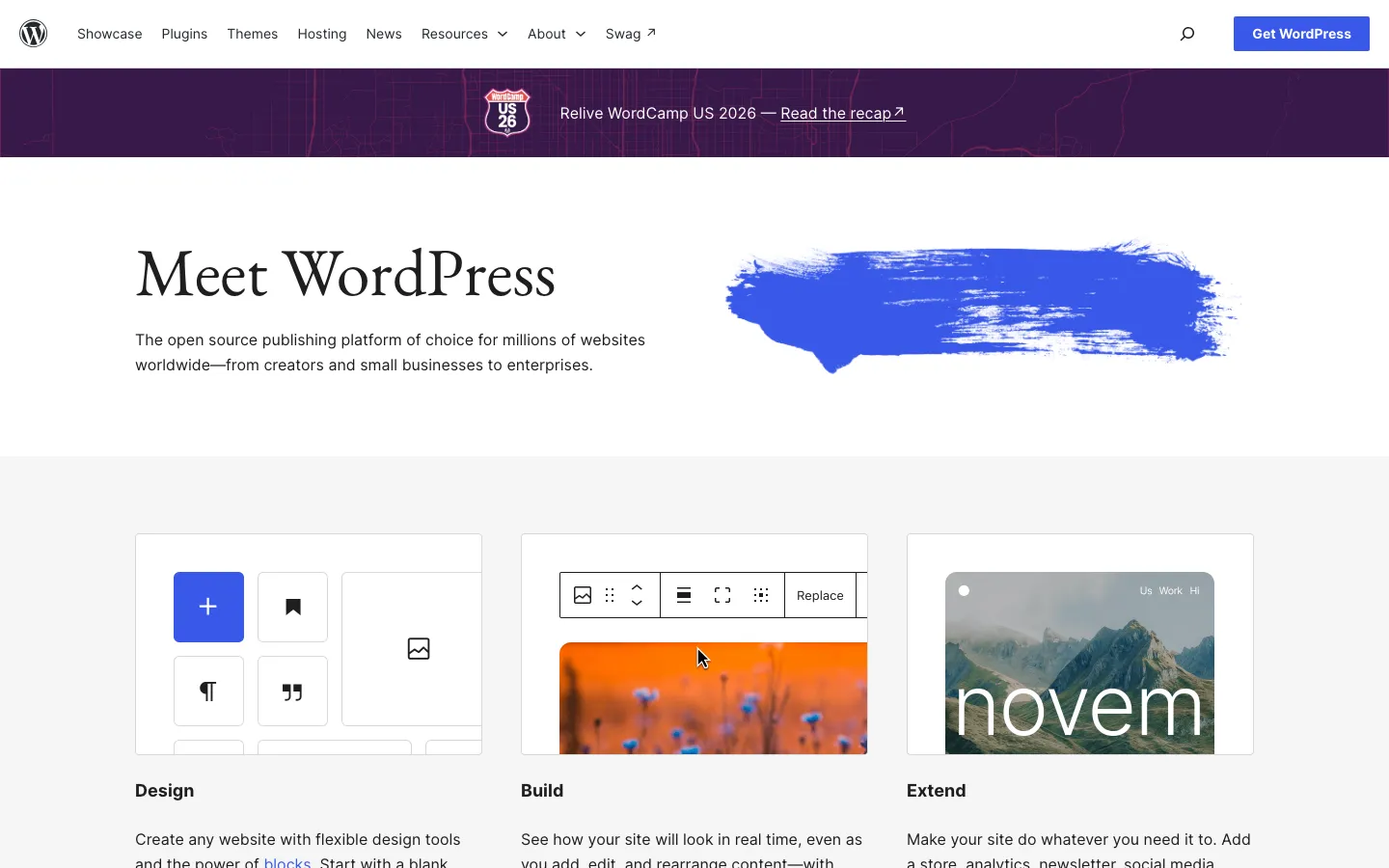
WordPress runs somewhere around two fifths of the web, and the sites leaving it are not leaving because it stopped working. They leave because a marketing site for a company that is not a publisher ends up carrying a publisher's stack: a managed host, a theme, a page builder, thirty plugins, and a monthly patch cycle, to serve forty pages that could be static files. The alternatives fall into three groups, and which one fits depends on which of those chores you are trying to escape.
This page compares them with every price read from the vendor's own pricing page on 9 September 2026. It ends with the option we build and the one this site runs on, and with a WordPress migration we ran that lost zero rankings, so you can weigh the recommendation against the receipt.
The four reasons teams leave WordPress
Maintenance. Core updates, theme updates, plugin updates, PHP version bumps, backups, and the security patch you find out about from a client. A site with thirty plugins is thirty vendors, each on its own release schedule, each able to break the others. Managed hosting takes the server off your plate; it does not take the plugins off it.
Performance. Page builders and plugin stacks ship JavaScript and CSS for features the page in front of the visitor does not use. Core Web Vitals pay for it. Most WordPress performance work is the removal of things, which is a strange way to spend a budget.
Cost creep. The software is free. The managed host, the premium theme, the page builder licence, the forms plugin, the SEO plugin, the caching plugin, and the backup plugin are not, and they renew on different dates. Nobody chose the bundle; it accreted.
Editing. The Gutenberg block editor and the third-party page builders pull in opposite directions, so every WordPress site becomes a bespoke admin that only the person who built it understands. When that person leaves, the site gets frozen.
Read the alternatives against those four. Builders fix maintenance and, mostly, editing. Managed hosting fixes maintenance alone. Code fixes all four but replaces the plugin directory with a developer or an agent, which is the honest trade.
WordPress.com: the hosted version, with a renewal catch
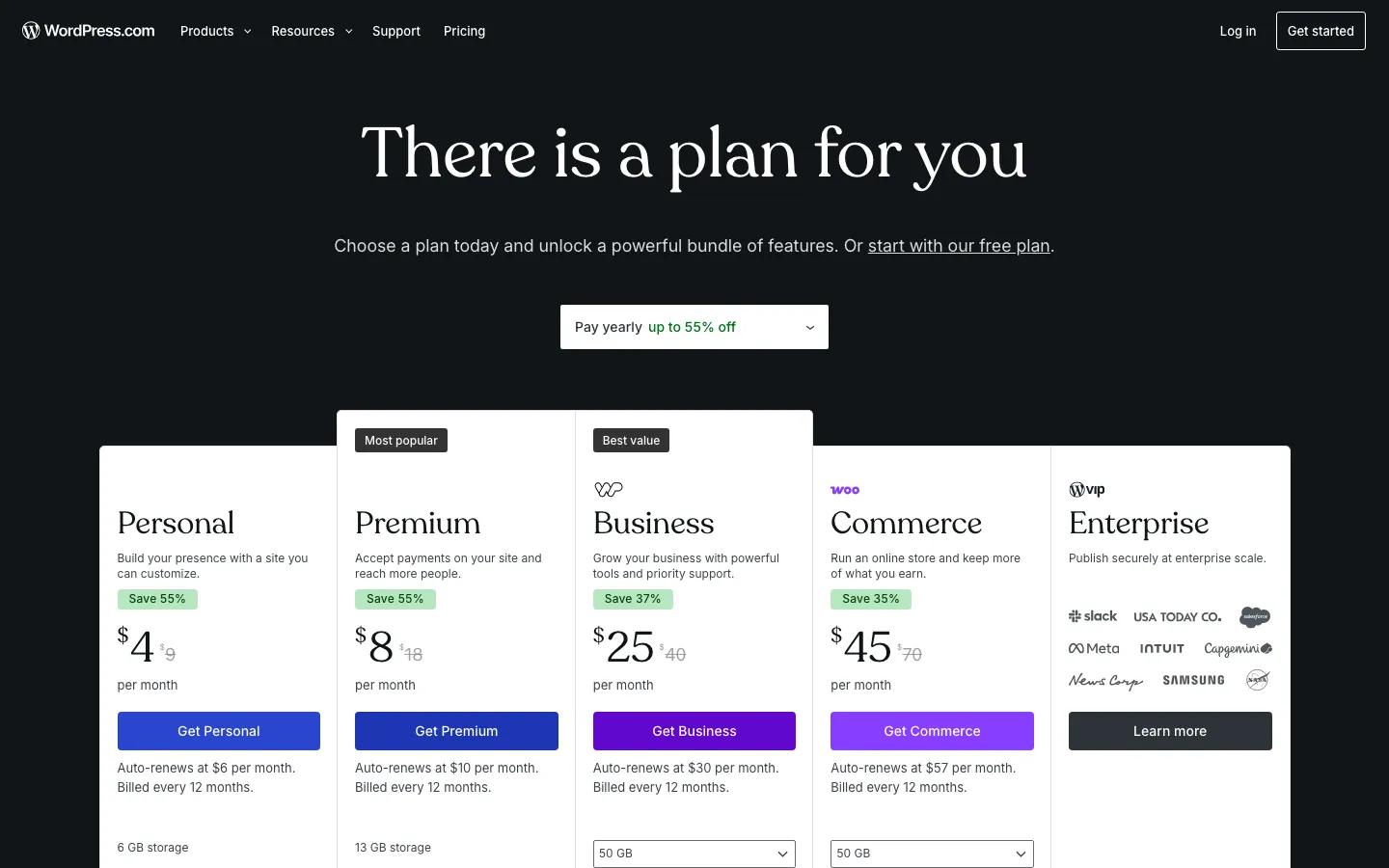
WordPress.com is Automattic's hosted WordPress, and for a lot of people it is what "WordPress" means. On 9 September 2026 it showed Personal at $4 a month, Premium at $8, Business at $25, and Commerce at $45, all introductory prices billed yearly. The catch is the renewal: on one load that morning the plans renewed at $10, $18, and $45; on another load, minutes later, the same plans showed $6, $10, $30, and $57. Whichever schedule you get, the first year is not the price. Plugins and custom themes arrive on Business, which is where the site becomes real WordPress again, with the maintenance that implies.
Best for: a blog-first site that wants the WordPress editor and never wants to see a server.
Managed WordPress hosting: keep everything, lose the chores
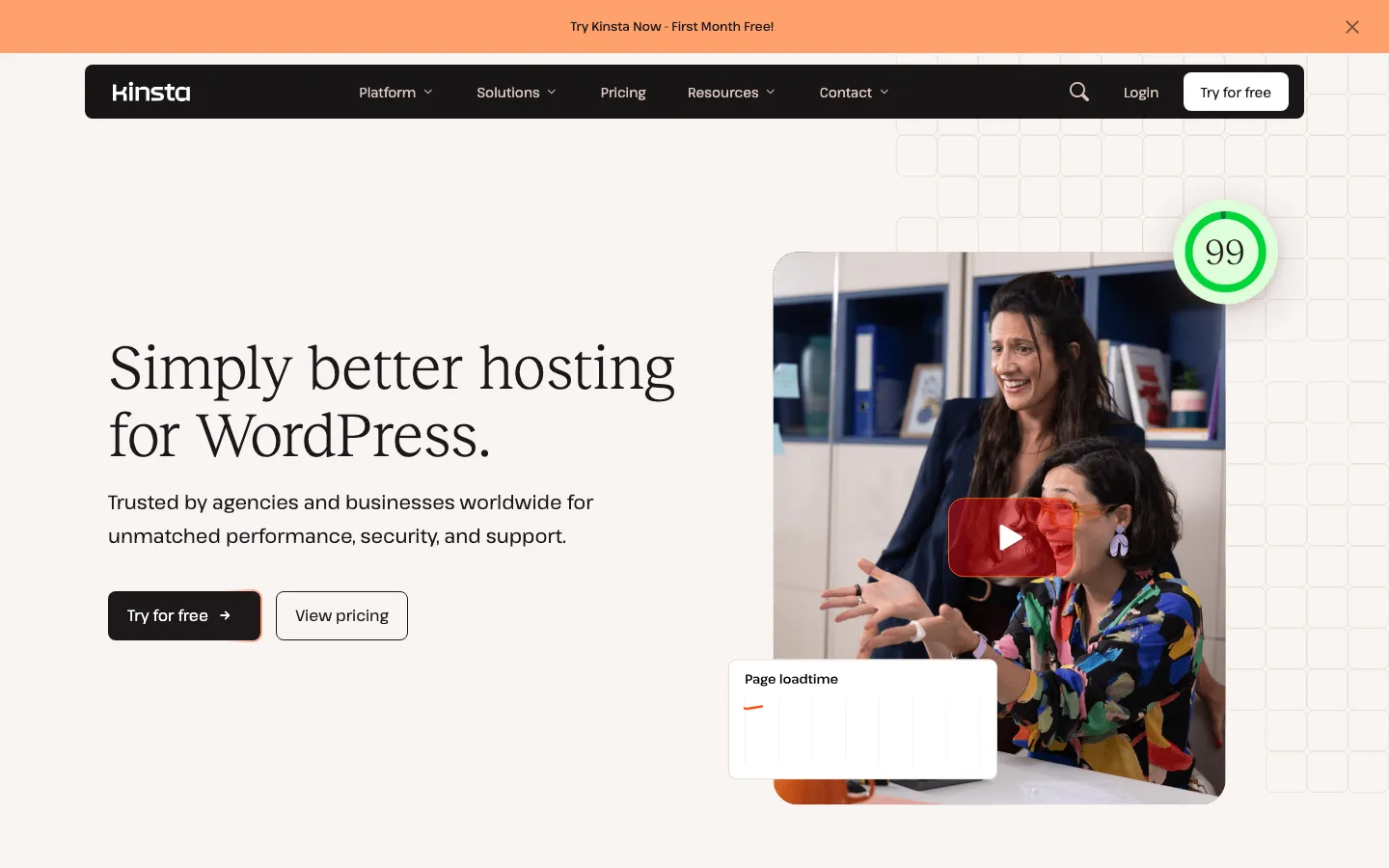
If the only real complaint is hosting, patching, and backups, the cheapest fix is not an alternative to WordPress at all. WP Engine's Essential plan was $28 a month on annual billing on 9 September 2026 for one site, 25,000 visits, 10 GB of storage, and 75 GB of bandwidth, with bigger tiers inside the same plan and Core and Enterprise on request. Kinsta was from $30 a month on annual billing, first month free, with each additional site at $30 and each extra 20 GB at $20, and it advertises free migrations. Both patch core, back up daily, and answer the phone.
What they do not fix is the plugin stack, the page builder, or the editor. Your thirty vendors come with you.
Best for: a team that likes its WordPress site and wants someone else to run the server.
Webflow: the designer's builder with a real CMS
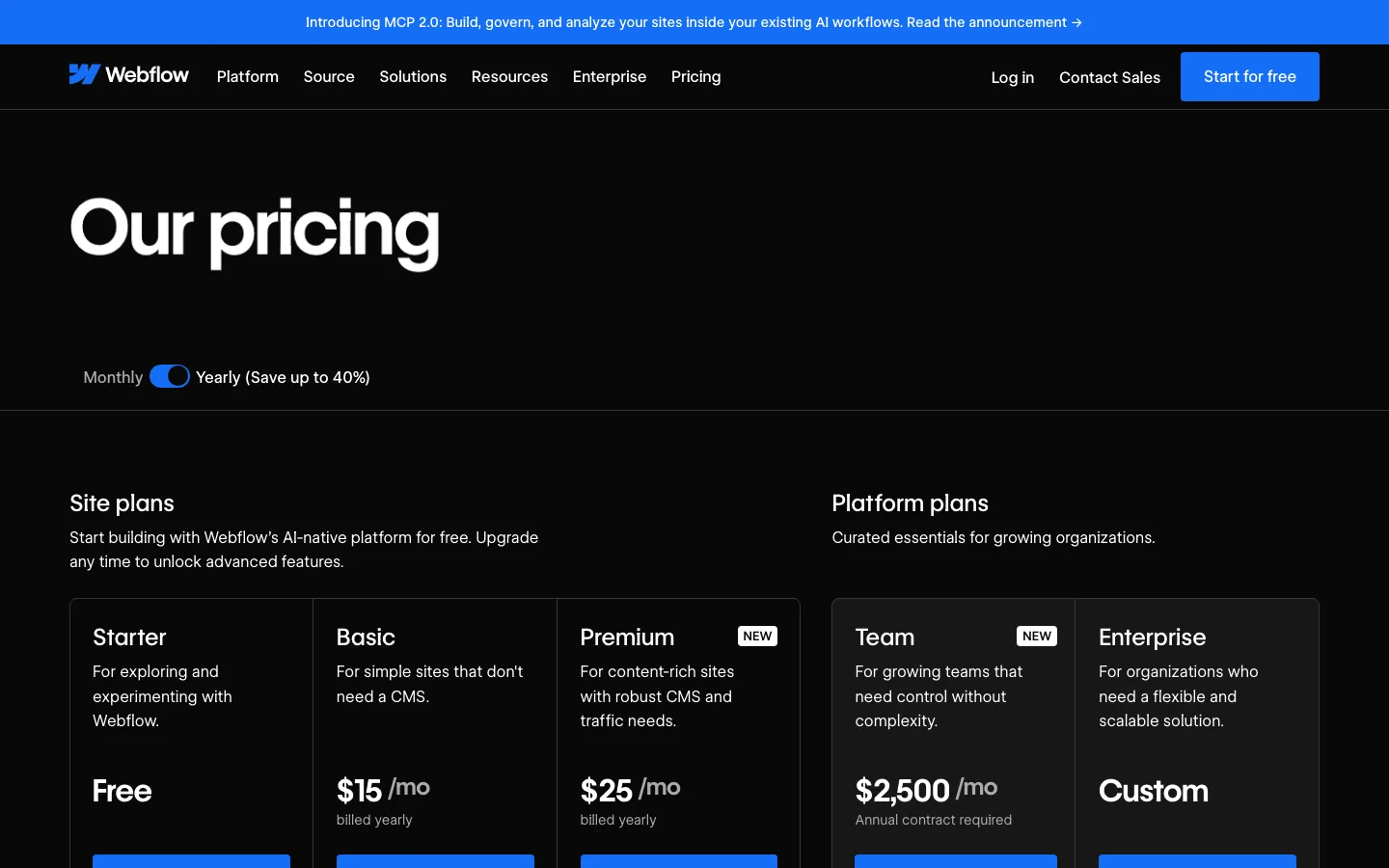
Webflow is where a lot of WordPress marketing sites go when a designer is in charge of the move. It is a visual builder with a structured CMS, hosting, and no plugins to update; the collections replace custom post types and the designer replaces the page builder. On 9 September 2026 the Basic site plan was $15 a month and Premium $25, both billed yearly, with bandwidth tiers above the included amount, Team at $2,500 a month, and Optimize for A/B testing from $299.
It solves maintenance and editing. It brings its own limits: no branching, so you publish the whole site or nothing, paid seats for every collaborator, and metered bandwidth. Our Webflow alternatives page is the list of teams who left it for exactly those reasons, and the Webflow pricing guide explains which plan a given site needs.
Best for: a marketing site where a designer owns the build and the team is small.
Framer: faster, cheaper, and branching on Pro
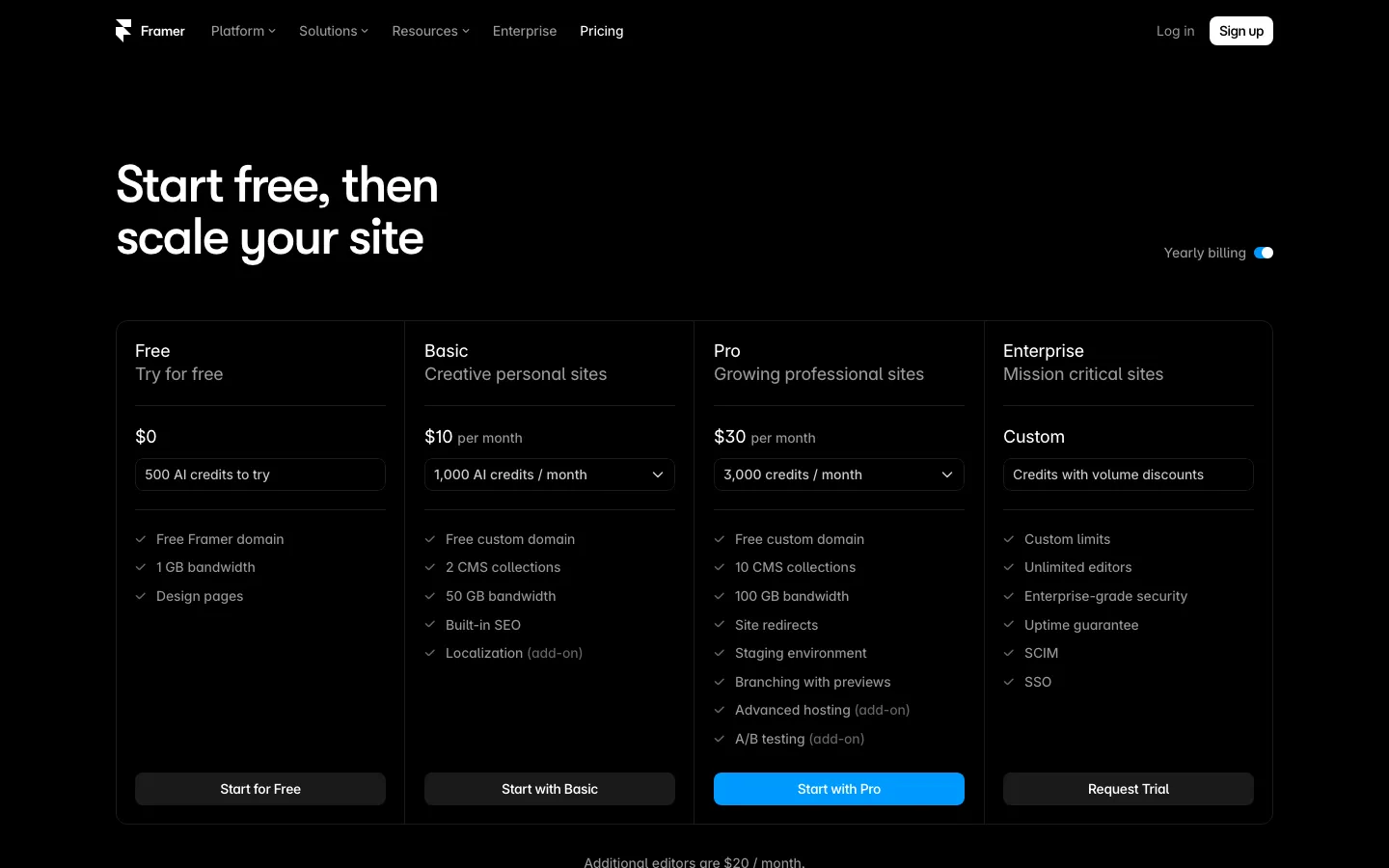
Framer is the design-led builder: motion is native, a small site can be rebuilt in a weekend, and on 9 September 2026 the plans were free, $10 a month, or $30 a month, with the $30 Pro plan including a staging environment and branching with previews. Editors cost $20 a seat and content editors $10; extra bandwidth is $40 per 100 GB; each extra locale is $20.
For a startup site coming off WordPress with a designer on the team, it is the quickest exit on this list. For a content-heavy site, its CMS is thinner than WordPress's or Webflow's, and the per-seat pricing bites once several people touch the site.
Best for: design-led startup sites with a small team.
If Framer is the platform being outgrown, the Framer alternatives page covers the seat pricing, the CMS limits, and the code exit from that side.
Squarespace and Wix: the no-maintenance exits
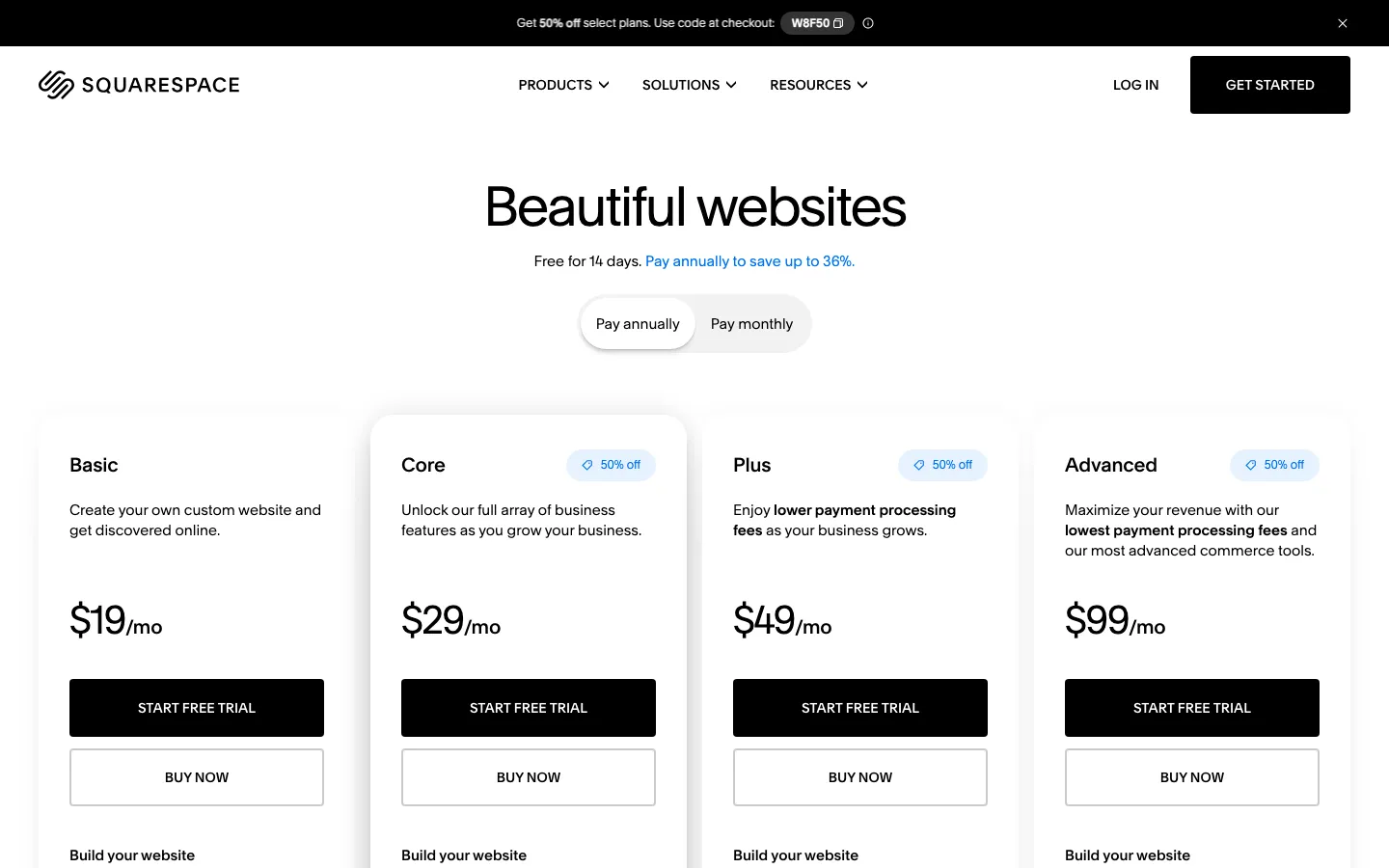
Squarespace, at $19, $29, $49, or $99 a month on annual billing on 9 September 2026, is the simplest way to stop maintaining a website. Templates are good, commerce is built in, and there is nothing to patch. The trade is customization: what the template does not do, the site does not do.
Wix, free and then $17, $29, $39, or $159 a month on yearly billing the same day, has the widest feature menu of any builder, bookings, ordering, apps, and its own app market, and the lowest ceiling for a site that wants to be fast or unusual. Both are fine homes for a restaurant, a studio, or an independent, and our restaurant website builders comparison covers that use case in detail.
Best for: small businesses and independents who want a site that never asks for anything.
If Squarespace is the platform being outgrown, the Squarespace alternatives page covers the store, the template ceiling, and the code exit from that side. The Wix alternatives page does the same for Wix, lock-in included.
Ghost: for publications, the honest WordPress successor

If the site is a publication, Ghost is the alternative WordPress's own blogging heritage points to. Posts, newsletters, memberships, and paid subscriptions are one system, not four plugins, and the editor is the best of any tool on this page for writing. On 9 September 2026 Ghost(Pro) was $18 a month on Starter, $29 on Publisher, and $199 on Business, all billed yearly and priced by member count, with 1,000 members on the lower plans and 10,000 on Business; a custom SSL certificate or a subdirectory install is $50 a month extra. It imports a WordPress export in an afternoon.
It is not a marketing site builder. Landing pages, calculators, and anything that is not a post are work.
Best for: newsletters and publications that want memberships and email built in.
Next.js or Astro on Vercel, Cloudflare, or Netlify: the code exit
This is the option that fixes all four reasons, and it is worth being precise about what it costs and what it asks of you.
What it costs. Vercel's Hobby plan was $0 and Pro $20 a month per seat on 9 September 2026. Cloudflare's Workers plan is free or from $5 a month. Netlify is free or from $9. A static marketing site on any of them costs between nothing and a coffee, and there is no plugin, theme, or builder licence to renew, because there are no plugins: forms, metadata, sitemaps, structured data, caching, and image optimization are part of the framework.
What it changes. The site is a repository. Every change is a branch with a preview URL; collaborators are unlimited; the pages are static files served from the edge, which is why a comparison page on this stack scored 98 on Lighthouse mobile at a 1.7-second Largest Contentful Paint in our own published audit. And the site becomes something an agent can work on: describe the page in Cursor, Claude, or Codex, point it at the existing components, preview, ship. Maintenance turns into checks an agent runs on a schedule, Lighthouse, accessibility, broken links, orphan pages, instead of a patch Tuesday.
The receipt. This site is Next.js on Cloudflare. In the first week of September 2026, fifteen offer pages were rebuilt on a new template in one day, a post has shipped daily since 31 August, and every intake form is smoke-tested from a script with the delivery confirmed in the inbox. The blog you are reading is a folder of files, not a plugin.
What it asks. Someone has to set it up, and someone, or something, has to make the changes. The honest comparison is not "WordPress versus code" but "a plugin directory versus a developer or an agent with a repo."
SUUR: the WordPress migration service, flat-fee, rankings kept
This is us, so weigh it accordingly. We move WordPress sites onto the code stack above as a flat-fee Website Migration: from $6,000 for a site of up to twenty pages including posts, about two weeks, in Next.js on your own Vercel or Cloudflare account, with the source in your repository. It is run as an SEO project: every URL exported with its traffic and mapped in writing before anything moves, 301s for anything that changes, titles, descriptions, canonical tags, and structured data carried over, and Search Console watched daily for four weeks after cutover with anything that moved fixed inside the fee.
The receipt is 2Wheel Epix, a mountain-bike tour operator we moved off WordPress with a full redesign at the same time, on competitive multi-day tour queries, with zero rankings lost. The full recipe, step by step, is in how to migrate a website without losing rankings. Afterwards, the Website Care Plan at $1,500 a month keeps the site hosted at cost on your account, edited within two business days, updated, and monitored, which is the layer where the agent workflow above lives for a team that does not want to run it.
Best for: a WordPress site with rankings worth keeping, owned by a company that wants the exit done by one senior in two weeks rather than by a committee in a quarter.
When WordPress is still the right call
When the site is the content and the content is the business. A publication with dozens of contributors, an editorial workflow that lives in the WordPress editor, or a dependency on a plugin that has no equivalent elsewhere are all good reasons to stay, on a managed host, with a plugin list someone is willing to defend. The trouble is the other case: a company that is not a publisher, running a publisher's stack to serve forty pages. For that site, every option on this page is cheaper to own than the one it is on, and the code one is the only one that gets faster over time instead of heavier.
Frequently asked questions
There is no single best one, because people leave WordPress for different reasons. For a small business site that should never need maintenance again: Squarespace or Wix. For a design-led marketing site with a designer on the team: Webflow or Framer. For a publication with a newsletter and members: Ghost. For a company site that has to be fast, owned, and worked on by several people and by agents every week: a Next.js or Astro site in a repository on Vercel or Cloudflare. And if the only real complaint is that hosting and patching are a chore, managed WordPress hosting at WP Engine or Kinsta fixes that without changing anything else.
Verified on 9 September 2026. WordPress.com: $4, $8, $25, or $45 a month introductory on yearly billing, with a higher renewal price that the pricing page showed two different versions of on the same morning. Self-hosted WordPress on managed hosting: WP Engine Essential from $28 a month on annual billing and Kinsta from $30, plus whatever your premium plugins and theme renew at. Squarespace: $19 to $99 a month annual. Wix: free, then $17 to $159 a month yearly. Framer: free, $10, or $30 a month, plus $20 per extra editor. Webflow: $15 or $25 a month billed yearly. Ghost(Pro): $18, $29, or $199 a month billed yearly. A code stack: Vercel Hobby free or Pro $20 a seat, Cloudflare Workers free or from $5 a month, Netlify free or from $9. A static marketing site in code costs between nothing and a coffee to host, and has no plugins to renew.
Four reasons come up in almost every conversation we have with a company on WordPress. Maintenance: core, theme, and plugin updates, PHP versions, backups, and security patches are a standing chore, and a site with thirty plugins is thirty vendors. Performance: page builders and plugin stacks ship a lot of JavaScript and CSS, and Core Web Vitals suffer. Cost creep: the software is free, but managed hosting, a premium theme, a page builder licence, a forms plugin, an SEO plugin, and a caching plugin add up to a subscription bundle nobody chose on purpose. Editing: the Gutenberg block editor and the third-party page builders pull in different directions, so every WordPress site becomes a bespoke admin that only the person who built it understands.
No, and the difference decides which alternatives even apply. WordPress.org is the free, open-source software you host yourself or on a managed host like WP Engine or Kinsta; you can install any plugin and theme and you own the whole thing. WordPress.com is Automattic's hosted service running that software with restrictions that lift as you pay more; plugins and custom themes arrive on the Business plan at $25 a month introductory. If your complaint is hosting chores, moving from WordPress.org to managed hosting or to WordPress.com solves it. If your complaint is the plugin stack, performance, or the editor, neither does.
Yes, if the migration is run as an SEO project and not a design project. Export every URL with its traffic, map each to its new path, ship 301s for anything that moves, carry over titles, descriptions, canonical tags, and structured data, keep the sitemap and robots honest, and watch Search Console daily for the first weeks. We moved 2Wheel Epix off WordPress with a full redesign at the same time, on competitive multi-day tour queries, and lost zero rankings. The WordPress side is the easy part: the export tool and the REST API give you every post, page, and image.
Most of them stop being plugins. Forms deliver to your inbox or your CRM from a few lines of code. SEO metadata, sitemaps, and structured data are part of the framework, not a plugin. Caching is what a static site is. Analytics and tag managers paste in the same way. Image optimization happens at build. The plugins that do real work, a booking engine, a membership system, a store, become integrations with the service that actually runs them, which is usually what the plugin was doing anyway. What you lose is the plugin directory as a way to add features on a Friday afternoon; what you gain is a site with no thirty vendors in it.
Managed hosts migrate WordPress to WordPress for free: Kinsta advertises free migrations and WP Engine has a migration plugin. Moving to another builder is usually DIY or a freelancer at a few hundred to a few thousand dollars, depending on page count. Moving to code, run properly, is a project: our Website Migration is from $6,000 flat for a site of up to twenty pages including blog posts, about two weeks, with every URL mapped in writing before anything moves, redirects, metadata, and structured data carried over, the site delivered on your own Vercel or Cloudflare account in your own repository, and four weeks of Search Console watch afterwards. Larger sites are quoted from the URL inventory before day one.
When the site is the content and the content is the business: a publication with dozens of contributors, a site whose editorial workflow lives in the WordPress editor, or one that depends on a plugin that has no equivalent elsewhere. WordPress on a good managed host with a disciplined plugin list is a fine home for that. The trouble starts when a marketing site for a company that is not a publisher inherits the whole stack, thirty plugins, a page builder, and a monthly patch cycle, to serve forty pages that could be static files.
Want to talk to SUUR directly?
We work with founders shipping product, not just decks.