SaaS Design Predictions, Checked in 2026
In January 2025 we made five predictions about SaaS design for the next five years. Twenty-one months in, three came true in some form, one was already true when we wrote it, and one has not happened. AI personalisation arrived, but as agents and metered AI credits rather than interfaces that read your mood: on 6 October 2026 Figma, Notion and Linear all sold AI by the credit, and Intercom charged $0.99 per Fin outcome. Accessibility became law in the EU, where the European Accessibility Act applies to consumer services provided after 28 June 2025. Data-driven design came true mostly in pricing, as usage and outcomes became the thing customers pay for. Cross-device consistency was already table stakes. Self-rearranging interfaces did not arrive; layouts stayed stable and a chat or agent surface was added beside them. The prediction we missed entirely: pricing turned into a design problem.
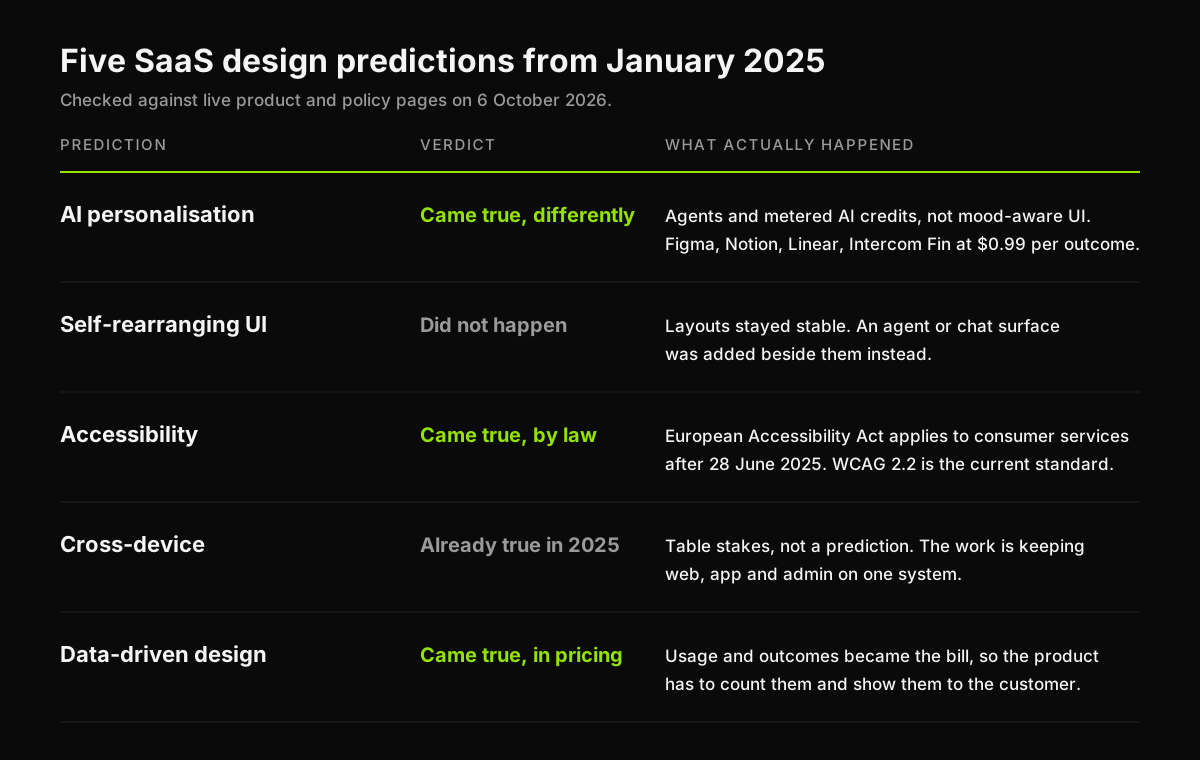
The original version of this post was a list of trends with a column called "Future Potential (2030)." Predictions are cheap unless someone checks them, so here is the check. Every claim about a product below comes from that product's own page, read on 6 October 2026.
1. AI personalisation: came true, but not the way we said
What we predicted: platforms would tailor themselves to each user, with interfaces that "anticipate needs" and, by 2030, adjust to "your mood, location, or environment."
What happened: AI arrived in SaaS as a separate worker you assign tasks to, and it arrived with a meter on it.
- Figma gives every seat a monthly AI credit allowance shared across all its AI features: 500 on Starter and on Collab, Dev and View seats, 3,000 on a Professional full seat, 3,500 on Organization, 4,250 on Enterprise. Its pricing page says "AI add-ons are now available for all plans."
- Notion includes Notion Agent on its $20 seat plan, offers a trial on its $0 and $10 plans, and sells Custom Agents at "$10 per 1,000 monthly Notion credits."
- Linear lists a Linear Agent and an agent platform on its plans, which run $10 and $16 per user a month, with some features marked "Requires AI credits."
- Intercom charges "$0.99 per outcome" for its Fin AI agent, "One outcome per conversation, max."
None of these pages sells an interface that reshapes itself around your habits. They sell agents that do work, priced by the work. The design consequence is different from what we expected: the hard problem is not adaptive layout, it is designing how a person delegates to an agent, checks its output and undoes it. We wrote about that in designing for AI.
Verdict: came true, differently.
2. Interfaces that change themselves: did not happen
What we predicted: layouts that rearrange in real time around user behaviour, moving toward "AR-driven, fully adaptive UIs."
What happened: we saw no sign of it in the products we read. The tools people use all day kept stable layouts, and AI was added as a panel, a command bar or an agent, not as a layout that moves.
In hindsight this was predictable. People build muscle memory for where things are. A button that moves because a model thinks you need it elsewhere is a button you cannot find. The best SaaS interfaces still win by density and predictability, not by shape-shifting.
Our own product work points the same way. Overseer, a concept we designed for Apstra, is a single pane for operating data centre fabrics around the world, rolling up roughly 27,000 devices across six continents and drilling down to a single device. Its value is that everything stays where the operator expects it at every zoom level. The Overseer case study includes a live interactive recreation.
Verdict: did not happen, and we no longer think it should.
3. Accessibility: came true, by regulation
What we predicted: accessibility would move from compliance to a core part of SaaS experience, with "unified accessibility standards" by 2030.
What happened: the standard and the law both arrived early.
- The W3C's WCAG 2.2 is a W3C Recommendation; the version on w3.org is dated 12 December 2024. It sets a 4.5:1 minimum contrast for text and 3:1 for user interface components.
- The European Accessibility Act (Directive (EU) 2019/882), read on EUR-Lex, "applies to the following services provided to consumers after 28 June 2025," and the list includes "e-commerce services," defined as services provided "through websites and mobile device-based services."
The nuance for B2B SaaS: the Act's service obligations are framed around consumers, so a product sold only to businesses should check its own position rather than assume it is covered or exempt. A product with any consumer-facing checkout, booking or account flow in the EU should assume it is in scope.
Verdict: came true, and sooner than "by 2030."
4. Cross-device consistency: already true when we wrote it
What we predicted: seamless transitions between devices would become standard.
What happened: they were standard in January 2025. This was a description, not a prediction, and we should not have listed it.
The real work here is less glamorous: keeping one design system across the web app, the mobile app, the marketing site and the admin tools, so they feel like one product. ILTY, an AI mental-health companion we designed and built, shipped as a native iOS app, a marketing site of more than 226 pages and an admin dashboard in eight weeks, on one brand system across three platforms. Consistency came from shared tokens and components, not from any adaptive technology.
Verdict: already true, not a prediction.
5. Data-driven design: came true, mostly in pricing
What we predicted: platforms would use analytics to refine layouts and optimise navigation.
What happened: that was always true of good SaaS teams. The bigger change is that usage data became the invoice. When a customer pays per outcome, per credit or per unit of usage, the product has to count those units accurately, show them to the customer before the bill arrives, and explain what counted. Intercom's page spells out its rule: if a conversation is reopened, "the outcome is refunded."
That turns metering into a design surface. Customers now need a usage view, a credit balance, a forecast and an explanation of every line, inside the product. A usage or billing view the customer can trust has become a screen worth designing properly, which is the kind of single screen our SaaS Dashboard engagement is for, designed and built as working front-end, $15,000 flat in about two weeks.
Verdict: came true, in a place we did not look.
What we missed: pricing became a design problem
The biggest shift in SaaS design since January 2025 was not on our list. As AI made per-seat pricing awkward (an agent does the work of several people but needs no seat), companies moved toward credits, usage and outcomes. That pushed complexity onto two screens: the pricing page, which has to let a buyer estimate a bill, and the in-product usage view, which has to keep the bill from being a surprise.
Both are design problems. A pricing page that lists "3,000 AI credits a month" means nothing until a buyer knows what a credit buys. We covered how established companies combine these models in what B2B SaaS is, and the marketing side of it, including pricing pages, is part of our SaaS website design work.
What to do with this in 2026
If you run a SaaS product, the checked predictions suggest a short list:
- Design delegation, not adaptation. If you add AI, design how users hand work to it, review it and reverse it. Leave the layout alone.
- Explain the meter. If any part of your price is usage, credits or outcomes, show the balance and the definition in the product.
- Treat accessibility as a requirement. Check contrast and keyboard access against WCAG 2.2, and check your EU consumer exposure.
- Keep one system across surfaces. App, site and admin should share tokens and components.
- Distrust five-year predictions, including ours. Check them against live product pages every year.
The short answer
Of our five January 2025 predictions, AI personalisation came true as agents and metered credits, accessibility came true through the European Accessibility Act and WCAG 2.2, and data-driven design came true mainly as usage-based pricing. Cross-device consistency was already standard, and self-rearranging interfaces never arrived. What we missed is that pricing, and the screens that explain it, became one of the central design problems in SaaS.
Sources, read on 6 October 2026: the pricing pages of Figma, Notion, Linear and Intercom; WCAG 2.2 on w3.org; Directive (EU) 2019/882 on EUR-Lex. SUUR project facts from our Overseer and ILTY case studies.
Have a product idea?
Designed, built, and shipped in about 5 days.